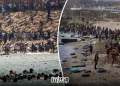
Doha – The border between the cities of Fnideq and Ceuta is witnessing a major security alert due to the collective attempt of hundreds of minors to reach the Spanish enclave by swimming.
According to local media, Younes Tazi, the Wali of the Tangier-Tetouan-Al Hoceima region, visited Fnideq this morning, accompanied by security officials, to assess the situation firsthand as part of his responsibilities.
The public forces in Fnideq managed to thwart attempts at illegal immigration over the weekend by Moroccans, Algerians, and others of various nationalities.
These young people took advantage of the thick fog and the influx of visitors to the city to surpass the forces responsible for guarding the beaches and threw themselves into the sea, despite its rough conditions.
Spanish media reported that this undetermined group of child and adult migrants reached Tarajal beach in Ceuta on Sunday.
According to witnesses, the migrants arrived on the coast of Ceuta around 7:30 p.m. amid thick fog that had covered the autonomous city since dawn.
After reaching the beach, they mixed with bathers enjoying the day, creating confusion among the deployed agents, who had to cordon off the area to proceed with identifying all those present.
The authorities then made the decision to keep bathers on the beach until all were identified, creating discomfort among some visitors who expressed their discontent at not being able to leave the area freely.
Tension increased when one of the police officers was hit by a stone by an unidentified individual and had to be taken to the hospital, where he was treated for minor injuries.
Despite the situation, the security forces managed to maintain control and arrested one person for contempt of authority.
Cristina Pérez, the Government Delegate in Ceuta, admitted today that the city is facing a situation of “extreme” migratory pressure.
In the last 24 hours, there has been a daily average of 500 entry attempts from Morocco and Algeria, bringing Ceuta to the brink of collapse. On Sunday alone, there were 1,500 entry attempts.
In her statement, Pérez emphasized that between 150 and 200 returns are being carried out daily, in compliance with the tenth additional provision of the Immigration Law.
Regarding the capacity of the Temporary Immigrant Stay Center (CETI), she acknowledged that the center is overcrowded.
However, she affirmed that the situation is under control and extraordinary departures are being carried out to reduce pressure on the facilities.
The President of Ceuta, Juan Vivas, highlighted Morocco’s collaboration, noting that it stopped 300 swimmers from entering Ceuta on Sunday.
“Thanks to this behavior and the collaboration of Morocco, the attempt of around 300 or 350 people to reach Ceuta was avoided,” Vivas stated, based on data provided by the Government Delegation.
Vivas called for “calm” in the face of a “controlled situation,” attributing it fundamentally to the good work of the security forces.
He lamented the spread of videos that did not correspond to reality, such as those broadcast yesterday that went viral on social networks, confusing immigrants with bathers.
Morocco’s robust approach to curbing irregular migration has yielded tangible results. In 2023, Morocco’s border control, in collaboration with law enforcement, intercepted approximately 87,000 individuals attempting to cross to Europe. The bulk of these attempts were made by individuals from sub-Saharan origins.
Throughout the year, Royal Armed Forces units, working with law enforcement agencies, intensified surveillance measures across both land and maritime borders.
In April, both Spanish Foreign Minister Jose Manuel Albares and Prime Minister Pedro Sanchez emphasized the importance of Spain’s cooperation with Morocco, particularly in combating irregular immigration.
Albares described the bilateral ties as “beneficial” for both nations, while Sanchez highlighted the “excellent” collaboration between Rabat and Madrid, specifically in areas such as counterterrorism, illegal immigration, and human trafficking.
However, despite Morocco’s efforts, which have led to a 30% decrease in irregular entries from its coasts according to a recent report by El País, shifting migration patterns and instability in the Sahel region continue to pose challenges for both Morocco and Spain in managing irregular migration flows.
Read also: Morocco Refuses to Become UK’s Processing Center for Migrants