Doha – As every year with major events shaping the country, the debate renews over the situation of religious minorities. This time, Moroccan Christians are urging the government to include the country’s Christian population in the upcoming 2024 census, arguing that an official count is essential for ensuring the minority’s rights and representation.
Data collected through the census would provide critical insights into the status and needs of Christian communities across the country, the Union of Moroccan Christians said in a statement dated August 19.
“An enumeration of Moroccan Christians would allow for monitoring their situation, documenting their numbers, and formulating public policies to advance their legal, cultural, and social standing,” the statement explained.
This would include “programs that address exclusion and discrimination arising from this religious affiliation,” it added.
The union argued that an official tally would help combat prejudice, secure formal recognition of Moroccan Christians under international agreements ratified by Morocco, and “establish concrete safeguards for the minority’s continued presence and ability to practice their faith freely in the country.”
They called for “the political will to strengthen laws and institutions to protect Christian rights and freedoms.”
In addition, the group expressed its readiness “to contribute as a religious union in any Moroccan government discussion aimed at greater integration of Moroccan Christians, especially in the field of participation in public life.”
This willingness comes despite what they consider to be “systematic exclusion and suppression of freedom of opinion for Moroccan Christians.”
The exact number of Moroccan Christians is unknown, with estimates varying widely. The US State Department put the number at over 40,000 in 2022, while the Pew-Templeton Global Religious Futures project estimates around 20,000.
Read also: Moroccan Christians ‘Hope for a Future Civil Code That Includes All Moroccans’
Local Christian leaders say there could be up to 25,000 Moroccan Christians. Many are believed to be converts from Islam who worship in secret, with estimates ranging from 8,000 to 50,000.
Prior to independence in 1956, Morocco had a substantial European Christian population of around 470,000. But more than 75% departed between 1959-60 following independence.
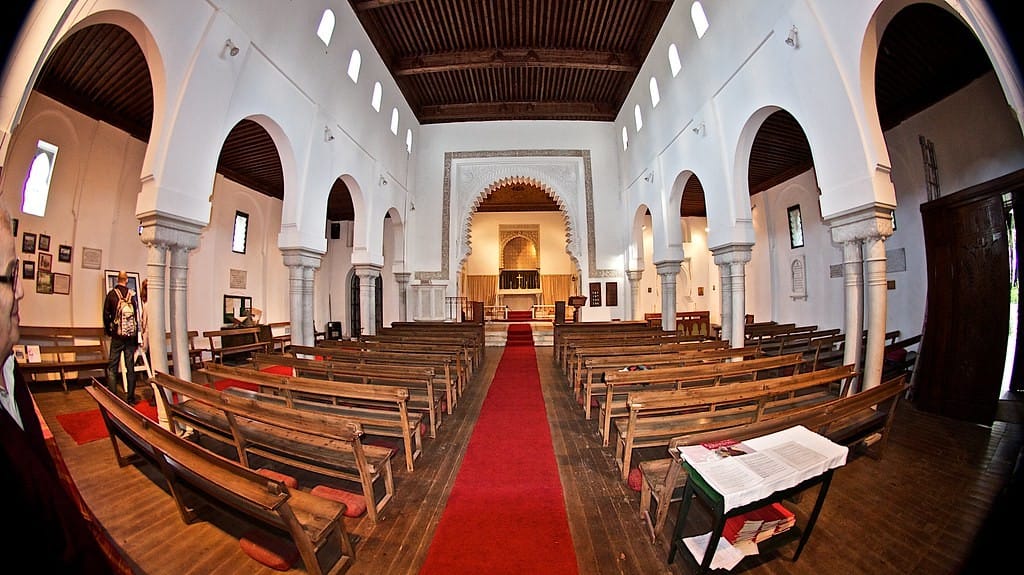
Today, 44 churches operate under the auspices of the Catholic Church, served by 57 clergy representing 15 nationalities.
Moroccan Christians report difficulties practicing their faith openly. Many fear revealing their beliefs to family and friends due to the risk of exclusion. Churches mostly conduct services in foreign languages catering to expatriates.
Christian burials are restricted to special cemeteries managed by churches that require their permission. Religious education in schools is Islamic, with no provision for Christian students.
Most Moroccan Christians are multi-generational believers, converts, or were raised by foreign missionary groups, rejecting allegations of proselytizing, which is illegal in Morocco.
Preparations are underway for Morocco’s 7th General Census of Population and Housing, scheduled for September 1-30, 2024. Using satellite imagery and mapping, over 4 million urban buildings and 34,000 villages have been indexed.
Out of 500,000 applicants, 100,000 have been trained as census-takers. Officials say the comprehensive count is crucial for implementing development plans and bolstering social cohesion.
Morocco’s constitution establishes Islam as the state religion but guarantees freedom of worship for all. Christians make up less than 1% of the country’s population of 37 million, which is overwhelmingly Sunni Muslim.
As Moroccan Christians strive for greater recognition, the upcoming census could be a pivotal moment in their long-running quest for inclusion and equality.