 Join on WhatsApp
 Join on Telegram
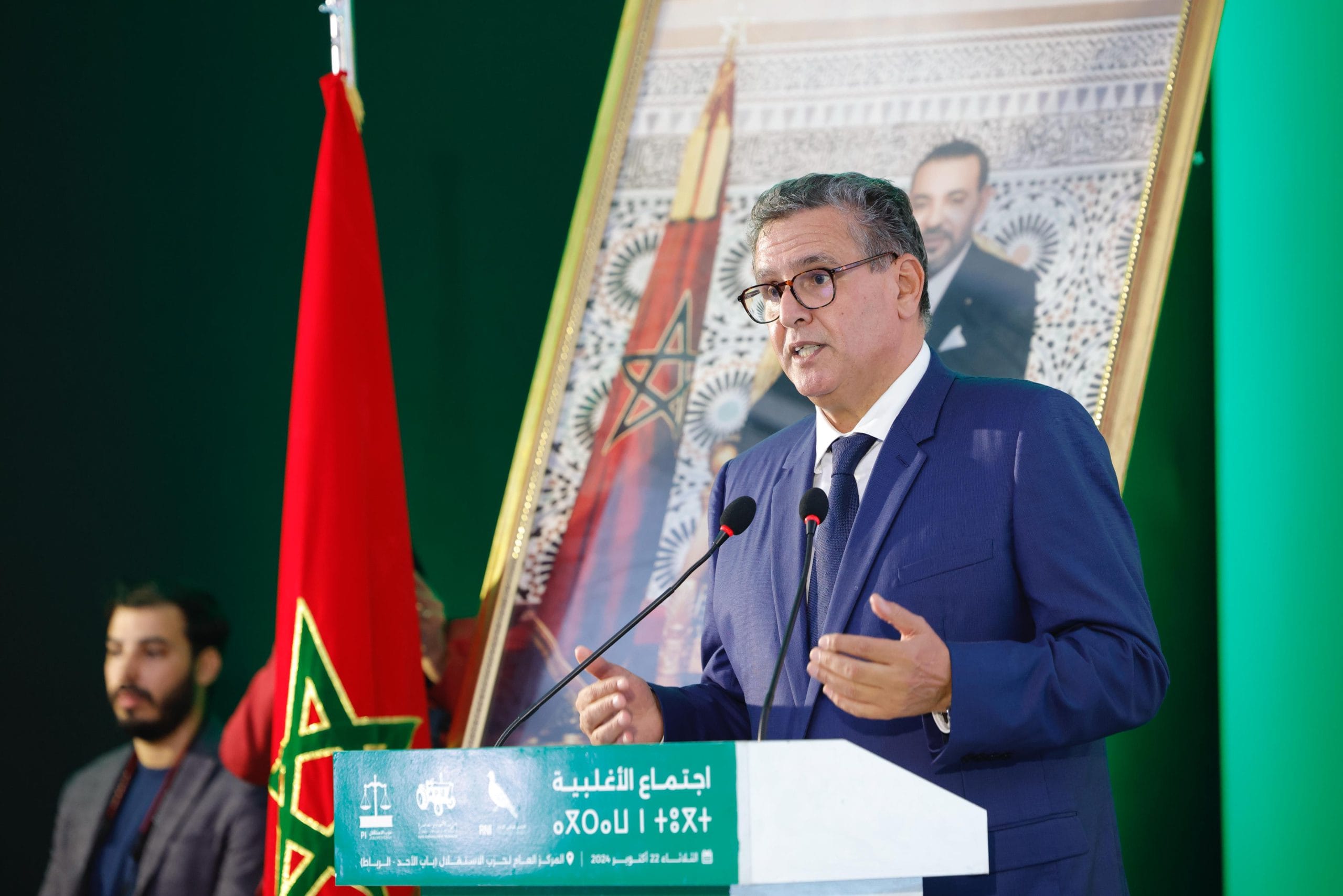
Doha – In a meeting of the governing majority held yesterday, the Head of Government and leader of the National Rally of Independents (RNI) party, Aziz Akhannouch, along with leaders from the Istiqlal Party and the Authenticity and Modernity Party (PAM), discussed the government’s achievements, challenges, and future priorities.
Akhannouch began by congratulating the new president of the House of Councillors, Sidi Mohamed Oueld Errachid, on the trust placed in him.
He then praised the cohesion of the parliamentary majority components and the sense of responsibility they demonstrated during the renewal of the House of Representatives and the House of Councillors.
Turning to the issue of territorial integrity, Akhannouch stressed that Morocco, under the leadership of King Mohammed VI, has made significant diplomatic gains.
He emphasized that the recent royal speech carries symbolic and historical connotations, marking a shift from managing the issue to changing it with strategic dimensions based on proactivity, taking the initiative, and demonstrating firmness and responsibility.
He called on the parliamentary majority to mobilize efforts to defend the national cause and keep the Moroccan position on the international agenda.
The King’s unwavering commitment to the Palestinian cause
The RNI leader took the opportunity to express his reverence for what he described as the noble and personal positions of the King in supporting the Palestinian and Lebanese peoples.
He renewed Morocco’s unequivocal condemnation of the war waged by Israel against the two brotherly peoples, through collective killing, forced displacement, and the persecution of unarmed civilians.
Akhannouch affirmed the kingdom’s firm position that peace and stability in the region will only be achieved within the framework of a two-state solution, in which the Gaza Strip is an integral part of the independent Palestinian state with East Jerusalem as its capital.
He also expressed Morocco’s clear and explicit solidarity with the Lebanese people and government, calling on the international community to intervene urgently to stop the war, protect civilians, and support Lebanon’s sovereignty over all its territories.
Akhannouch also highlighted the government’s remarkable socio-economic achievements despite the difficult circumstances. “All national and international financial institutions testify that this government has overcome the crisis with confidence and responsibility and maintained macroeconomic balances,” he said.
He further stated, “This has positively affected the solidity and resilience of the national economy in the face of transformations and fluctuations.”
Expanding social protection is a priority for the government
The head of government emphasized the progress made in implementing the foundations of the social state, including the generalization of health coverage, the reform of the education system, and the launch of the direct support program for housing.
Looking ahead, Akhannouch identified employment as a government priority, with plans to allocate MAD 14 billion ($1.4 billion) to launch an integrated approach to promoting employment.
He also highlighted measures to support purchasing power, such as increasing the Compensation Fund budget to over MAD 16.5 billion ($1.65 billion) and continuing to support electricity prices.
Nizar Baraka, the Secretary-General of the Istiqlal Party, echoed Akhannouch’s sentiments on the importance of the national cause. “Thanks to the leadership of His Majesty the King, and the cohesive national consensus, we can say today, frankly, that the supporters of our territorial unity and our legitimate rights over the southern provinces of the Kingdom have expanded and strengthened,” he stated.
Baraka emphasized that over 70 countries now support Morocco’s Autonomy Plan for Western Sahara, including strategic partners such as Spain and France, which recently recognized Moroccan sovereignty over the disputed territory.
Additionally, the United States has supported Morocco’s stance on the Sahara, with 30 Arab and African countries opening consulates in the Moroccan cities of Laayoune and Dakhla.
Baraka further emphasized, “This expansion and strengthening of support has occurred at an accelerated and unprecedented pace since the beginning of this fabricated regional conflict.”
For him, as the circle of supporters and advocates expands, and as Morocco achieves unprecedented strategic, economic, and social gains, targeting and pressure from interest groups against the country and its territorial unity intensifies.
He criticized the retrograde thesis that goes back to the end of the Cold War, aimed at dividing the Moroccan Sahara to satisfy the ambitions of opponents and enemies of territorial unity.
He also highlighted the King’s strategic vision through promising initiatives and structuring continental projects, such as the initiative aimed at enabling the Sahel countries to access the Atlantic Ocean and the Nigeria-Morocco gas pipeline project.
Baraka further praised the government’s achievements and called for increased communication efforts. “Today, ladies and gentlemen parliamentarians, it is not enough for the government to make decisions and take measures, and to mobilize huge financial resources of billions of dirhams, but a communication effort is necessary to explain and interpret the government’s efforts in the territorial depth where the citizens are waiting for these efforts,” he said.
For his part, Mohamed Mehdi Bensaid of the PAM leadership emphasized the need to work in accordance with the wise vision of King Mohammed VI in confronting the maneuvers of adversaries and moving within the framework of party and parallel diplomacy.
The government’s ‘difficult and bold decisions’
He also lauded the government’s work on various social and economic issues, such as the social protection system, health reform, job creation, and the direct support program for housing.
Bensaid stressed the importance of communication, acknowledging that it is an area where more work is needed. “When we talk about communication, it remains the area on which we must work more, and we say it with all courage, and responsibility, and in self-criticism, that this government has made difficult and bold decisions, and has faced external challenges,” he said.
He further added, “If the effect of these decisions has not reached the citizens, then the problem is in communication.”
The meeting also addressed domestic issues, with the presentation of the 2025 Finance Bill, which he described as a realistic project that responds to the expectations of citizens through significant tax measures and the creation of more than 29,000 public sector jobs.
He highlighted the government’s efforts in implementing the social protection system, accelerating the rehabilitation of the health system, and reforming the education and vocational training sectors to meet the aspirations of young people.
Bensaid acknowledged the positive results achieved by the government over the past three years, including the historical agreement to raise wages, but also noted the challenges faced by Moroccan households in terms of purchasing power, which remains a concern for the government despite its efforts to support basic necessities.
The meeting of the governing majority underscored the government’s commitment to addressing the concerns of citizens and continuing the pace of reforms despite the challenges faced.
With a focus on territorial integrity, socio-economic development, and improved communication, the government aims to fulfill its pledges and meet the rising expectations of the Moroccan people.
Read also: PM Akhannouch: Autonomy Plan is the Only Solution to End Dispute Over Western Sahara