
 Join on WhatsApp
 Join on Telegram
In a recent article on the AfCFTA, we highlighted the role of an efficient logistics system in reducing trade costs and facilitating intra-regional trade. Efficient, world-class transport infrastructure, including modern ports, quality roads, and reliable digital networks, is necessary to ensure a smooth flow of goods and services.
Moreover, as has been statistically proven, the Logistics Performance Index (LPI) and trade facilitation are strongly correlated with the African Multidimensional Regional Integration Index (AMRII), demonstrating the importance of efficient logistics and trade facilitation for economic integration. The LPI assesses not only logistics infrastructure but also maritime connectivity. For example, the port of Tangier Med in Morocco offers direct connections to more than 180 ports around the world, improving access to international markets.
According to AfDB reports, many African countries are performing well in terms of trade integration, but they are underperforming in terms of infrastructural and productive integration. There are large differences in the quality and development of infrastructure between countries, suggesting a need for infrastructure development to further strengthen overall integration. Only a few African countries have balanced scores in all dimensions of integration in Africa; for example, Morocco and South Africa perform well in terms of macroeconomic integration, productive integration, trade, and infrastructural integration.
Indeed, the most promising scenarios of the impact of free trade on regional integration, in terms of trade expansion, job creation, and income growth, include not only tariff dismantling but also trade facilitation; improving infrastructure and logistics is crucial and can outweigh the gains from tariff reductions. (World Bank, UNCTAD, Gtap modelling by Purdue University).
The World Bank’s verdict (2020) is final; significant revenue gains in Africa, estimated at $292 billion, will require a focus on trade facilitation.
The Challenges of Transport Corridor Development in Africa
The development of transport corridors in Africa is hampered by complex and multidimensional challenges. These barriers, which touch on historical, structural, financial and political aspects, hinder regional integration and limit the potential of infrastructure.
A Colonial Legacy and Structural Fragmentation
African transport infrastructure still bears the traces of the colonial era, when its design was oriented towards the extraction of natural resources rather than the development of intra-regional trade. The borders inherited from this period fragmented networks, creating isolated terminals that limited connectivity between neighboring countries. Unlike Europe, which favors the densification of transport networks, the African approach focuses on connectedness, aiming to connect isolated points without any real integrated network logic.
Connectivity versus Connectivity
Africa’s strategic choice to focus on connectivity, i.e. the completion of specific links, is opposed to the European logic of connectivity, which aims to multiply interconnections in a structured network. This approach limits the creation of coherent transport systems and hinders the emergence of a true regional infrastructure.
Increased Dependence on External Financing
The financing of infrastructure projects in Africa relies largely on foreign investors (China, Japan, France, Turkey, etc.) and international financial institutions such as the AfDB. This dependence exposes projects to budgetary constraints and the risk of increased debt. In addition, the AfDB’s financial priorities, although a key player in the Programme for Infrastructure Development in Africa (PIDA), is not an institution of the African Union, are often driven by profitability and risk management imperatives, thus directly influencing project choices, sometimes to the detriment of regional needs.
Fragmented Governance and Coordination
The multitude of actors involved – governments, regional economic communities, donors, and private companies – makes coordination particularly difficult. Conflicts of interest, competing priorities and varying interpretations of the corridor concept – sometimes reduced to a simple road – complicate the implementation of integrated projects. This complexity contrasts with the more centralized and efficient governance structures seen in Europe.
Lack of Maintenance and Degradation of Infrastructure
The under-maintenance of existing infrastructure is a major challenge. Degraded road conditions, traffic congestion and safety concerns increase transport costs and discourage commercial activities. This neglect is compounded by an excessive focus on building new infrastructure, to the detriment of the rehabilitation and maintenance of existing networks.
Low intra-African trade integration
Trade between African countries remains limited, making investment in transport corridors less profitable. This infrastructure is used more to support international trade than to boost intra-African trade, thus reducing its impact on regional integration.
Fragmented Design of Transportation Corridors
The concept of a transport corridor is inconsistent across Africa. Depending on the stakeholders, it is sometimes limited to a simple road infrastructure, without taking into account the multimodal dimensions or regional development objectives, which reduces its effectiveness. (Transport Corridors in Africa, Hugh Lamarque and Paul Nugent 2022).
Usefulness of a new development corridor linking the Atlantic Ocean to the Sahel
African countries, although relatively successful in terms of trade integration, are lagging behind in terms of infrastructure integration. The development of efficient transport infrastructure is crucial to reduce trade costs and facilitate intra-regional trade.
The African Regional Transport Infrastructure Network (ARTIN), which includes the Trans-African Highway (TAH) through Algeria, a stillborn project initiated by Algeria and UNCTAD in partnership with the IDB, and 40 key corridors, serves as a reference for infrastructure projects under the AU’s Programme for Infrastructure Development in Africa (PIDA) (Transport Corridors in Africa, op cit).
However, NILCA faces implementation and funding challenges. Financing depends heavily on foreign investors (China, Japan, France, etc.), with public budgets often insufficient. In addition, the multiplicity of actors and conflicts of interest hinders coordination.
In addition, corridors often focus on “connectedness” and plugging network gaps (completing missing links) rather than “connectivity” (multiplying links within a network), which limits regional integration and a multimodal approach.
The mapping of the corridors planned by Africa reveals a certain marginality of the landlocked Sahel region; it is high time to launch a new strategic corridor, N’Djamena-Dakhla, which aims not only to cover a neglected area with corridors but, above all, it aims to integrate the landlocked countries of the Sahel into international trade networks by offering them access to the Atlantic Ocean via alternative routes likely to reduce the cost of transactions and boost export competitiveness.
Structural constraints of the landlocked countries of the Sahel
An analysis of the Logistics Performance Index (LPI) scores and trade costs of West African countries reveals marked disparities between coastal and landlocked countries.
Coastal countries in West Africa score higher on the Logistics Performance Index (LPI) thanks to their direct access to ports, unlike landlocked countries that face significant logistical challenges.
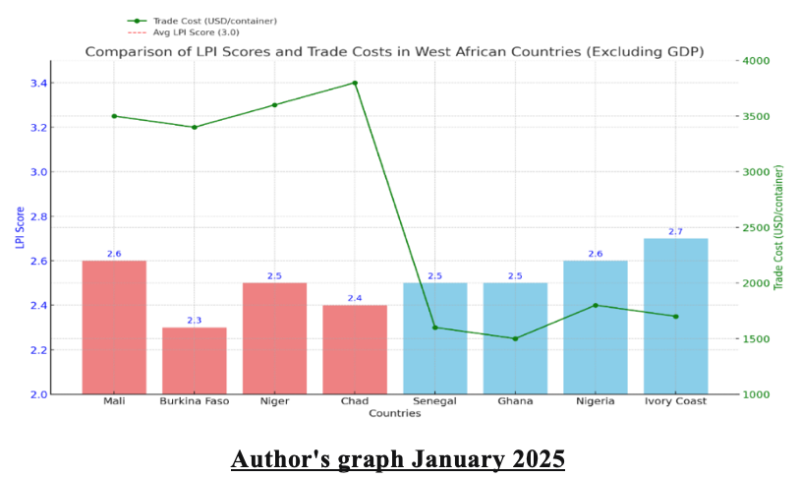
Coastal countries such as Senegal, Ghana, Nigeria, and Côte d’Ivoire have higher LPI scores, between 2.5 and 2.7.
Landlocked countries, such as Mali, Burkina Faso, Niger, and Chad, have slightly lower scores, between 2.3 and 2.6.
Trade costs can reach up to USD 3,800 per container for landlocked countries, compared to USD 1,500 to USD 1,800 for coastal countries.
Collateral damage of the withdrawal of the Sahel countries from ECOWAS
The countries of the Sahel suffer not only from geographical isolation but also from economic isolation. They often depend on coastal countries for access to international markets and are therefore vulnerable to disruptions to transport routes.
Our predictions, in an article a year ago, on the impact of the withdrawal of the three Sahel countries from ECOWAS are beginning to become clearer with figures to back it up; indeed, in a recent report, AFP mentioned that in 2022, when ECOWAS sanctions had reached their peak against Mali, the cost of Malian freight transiting through Conakry increased by 243% compared to the previous year.
In the same vein, another OECD study, published in December 2024, points out that the diversion of transit routes “has led to an increase of more than 100% in logistics costs compared to the pre-crisis route, which has an impact on food prices” and adds that alternative trade routes come with new challenges, including crossing unstable regions plagued by attacks by jihadist and criminal groups (judging by the number of truckers kidnapped on some routes). (Afrimag 27/01/2025).
Although they are in slightly better conditions, coastal countries should not rest on their laurels; they remain below the world average of the Logistics Performance Index (LPI below 3.0), revealing a common need to improve infrastructure and modernize African ports, which have not been able to benefit from the increase in maritime traffic via Cape Town following the insecurity of the Bab Al Mandab Strait and the upsurge in attacks on ships.
The diversion of the Red Sea and Suez Canal fleets has, with a few exceptions (Tanger Med as a figurehead), produced no significant impact on the activities and volumes of African ports, including major hubs such as Lomé (Togo), Pointe-Noire (Democratic Republic of Congo), Abidjan (Côte d’Ivoire), Durban (South Africa), and Dar-es-Salaam (Tanzania), which did not record any significant increase in volumes processed. (Ronan Kerbiriou, research engineer at the University of Le Havre CNAM-Paris, March 2024).
This situation underlines, where necessary, the importance of investing in transport corridors and improving regional cooperation to reduce costs and improve logistics efficiency.
King Mohammed VI’s initiative to open a new ocean route for the Sahel
In November 2023, HM King Mohammed VI announced, in a speech to the nation, that the Kingdom of Morocco will launch a new international initiative to grant Sahel countries access to the Atlantic Ocean in order to integrate them into international trade networks and routes.
By opening the Atlantic route to the Sahel countries, Morocco is not only rediscovering a centuries-old tradition of cultural and religious trade and exchanges, but it is also voluntarily complying with international legality by observing the relevant provisions of the 1921 Barcelona Convention on Freedom of Transit, Article V of the GATT/WTO on Freedom of Transit, and, above all, the “UN Convention on Transit Trade of Landlocked States” adopted by the UN in February 1965, which called for the opening of corridors for the benefit of landlocked countries to access the sea and to facilitate the exercise of freedom and the right to transit.
In this vein, the Kingdom of Morocco organized a ministerial coordination meeting on the King’s initiative to improve access to the Atlantic Ocean for the Sahel countries on December 22 and 23 in Marrakech in 2023, with the participation of Mali, Niger, Burkina Faso, and Chad; Mauritania in the process of joining this important initiative. While expressing their gratitude to Morocco’s offer to “make its road, port, and rail infrastructure available to Sahel countries to strengthen their participation in international trade,” the participants agreed to set up working groups in each country to promote the implementation of the initiative.
The N’Djamena-Dakhla corridor: prospects of an economic boom
This corridor is an ambitious project that positions itself not just as a simple trade route but as a catalyst for economic development, regional integration, and geopolitical transformation for the landlocked countries of the Sahel.
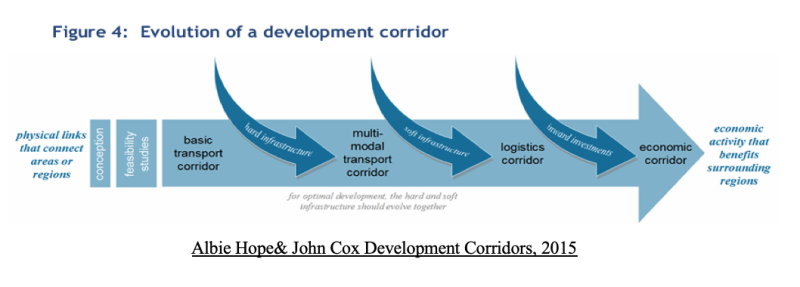
The ideal is to aim from the outset to set up an integrated economic development corridor (CDEI) that aims to transform a simple transport axis (road, rail, sea, or a combination of these modes) into an engine of economic growth and social development by integrating infrastructure, services, and policies.
In practice, there are several types of corridors, ranging from the most basic road corridor, focused on physical infrastructure, through the transport corridor, integrating various modes of transport and logistics services, to the economic corridor, a real tool for development and regional integration.
Corridors can evolve in a spillover dynamic from a simple road corridor to become a transport corridor, then a logistics corridor, and finally an economic one. This evolution is not automatic; it requires rigorous management and the implementation of appropriate public policies, as well as effective coordination between the actors.
The route must connect “end nodes,” which are areas where supply and demand meet to create a commercial dynamic; these nodes can be cities, ports, or industrial or agricultural areas, which act as departure and arrival points for the flow of goods and people. (Albie Hope & John Cox Development Corridors, 2015)
This transformation goes beyond improving roads and includes the establishment of a full range of activities and infrastructure to boost trade and economic activity in its path
In short, an integrated economic development corridor is much more than just a road. It is a complex set of infrastructure, services, and policies, coordinated by a management mechanism, whose objective is to stimulate economic development and regional integration in a sustainable manner.
Transformative impact of the Atlantic Port of Dakhla and its corridor
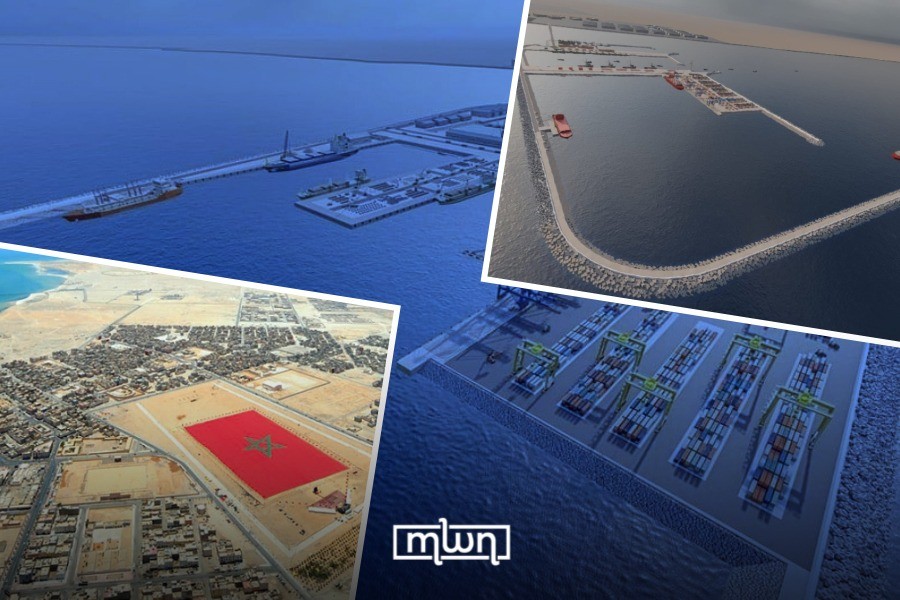
The Atlantic Port of Dakhla, with an investment of about $1.2 billion, is a logistics hub for West Africa and the Sahel. This deep-water port is located 70 km north of Dakhla; its commissioning is scheduled for 2029, with an initial processing capacity of about 35 million tons of goods per year.
The ambition of the port project is to serve the entire hinterland of the Sahel. To do so, it should be connected to the Sahel by a network of roads and rails through a corridor that would join Dakhla to the Sahel via a network estimated at 5000 km, combining roads and railways, including a section from Dakhla to Bamako passing through Mauritania (about 2,200 km) and extensions or ramps to Niamey, N’Djamena, and Ouagadougou.
The corridor project could be envisaged in two or three phases, starting with an initial two-year phase focused on the establishment of a management structure (including a memorandum of understanding, a cooperation framework, and a management mechanism), the promotion of trade, and the positioning of the corridor as a trade link. The next phase, which will last five years, focuses on monitoring policy and regulatory measures, improving physical infrastructure, preparing follow-up investments and national development, as well as establishing a monitoring and evaluation system. Funding for the project is crucial and is supported by membership fees, government contributions, traffic-based charges, and donor support. This project requires an international coalition of donors and international development partners. (See RTS/TAH pre-feasibility study, UNCTAD IDB).
The corridor, if well designed, could reduce costs and transit times for landlocked countries and, above all, unlock the untapped trade potential in this region of Africa and diversify trade routes and enhance export competitiveness and a reduction in the cost of trade transactions in the region.
Based on the assumption that the corridor would open up direct access to the Atlantic Ocean via the port of Dakhla, it could generate a significant increase in trade and invaluable investment, with an additional trade potential estimated at $3.08 billion (scenario simulations to reduce the export time and costs of Sahel countries by 20 to 30%).
Trade between Morocco, Mauritania, and even Senegal with the Sahel countries (AES) could increase, generating estimated gains of $85 million and $80 million, respectively, in the minimum scenario
By 2035, the Dakhla Corridor could also generate more than 150,000 jobs and diversify markets, reducing dependence on Europe and Asia.
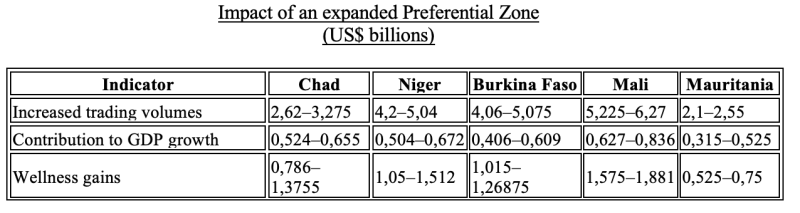
Current projections point to substantial gains for the countries concerned, including in terms of reduced transport costs, increased trade volumes, contribution to GDP growth, and improved overall welfare.
Trade potential between Morocco and the ESA countries
Morocco’s current exports to the 4 Sahel countries are around $300 million, while the trade potential is estimated at $2.23 billion; the realization rate is only 11.44% on average, leaving a significant margin for growth (author’s calculation) if Mauritania and Senegal are added, the figure for real exports rises to $1.5 billion in 2022.
High-potential markets are Senegal, Mali, and Mauritania, while Niger, Burkina Faso, and Chad are emerging markets. The sectors to be targeted are agriculture, building materials, textiles, and pharmaceuticals.
It is recommended to strengthen trade agreements (consider an agreement with the WAEMU), to invest in logistics and infrastructure, and, above all, to set up regional value chains to expand the range of products traded, particularly in the leather, plastics, and livestock products.
Senegal stands out with a completion rate of 25.26%, while Niger (3.10%) and Burkina Faso (3.63%) lag significantly.
A more ambitious scenario, combining the corridor with a flexible and progressive system of trade preferences, would increase the benefits for stakeholders, as shown in the simulation below.
Moreover, paragraph 2 of Article 19 of the AfCFTA, like Article 24 of the GATT 94, leaves the door open to African countries to keep sub-regional preferences integral without enlargement erga omnes to other African member countries through the most-favored-nation clause by stipulating that “States Parties that are members of other regional economic communities, other regional trade agreements, and other customs unions, and which have achieved higher levels of regional integration among themselves than those provided for in this Agreement, shall maintain these levels among themselves.”
Another option remains the conclusion of separate free trade agreements by Morocco, Mauritania, and Chad with the WAEMU.
– In conclusion, the N’Djamena-Dakhla corridor is an ambitious project that can transform the Sahel region by promoting economic development, regional integration, and global value chains. The success of this project requires a holistic, collaborative approach and the participation of all stakeholders that combines spatial planning, economic analysis, consideration of social and environmental aspects, as well as effective coordination between the different stakeholders. The priority must be to link production and consumption areas, promote trade, and integrate local communities into the development process.
The main challenges to be overcome include security risks in the first place, followed by the mobilization of finance, high infrastructure costs, and finally policy coordination.
Regarding the security aspect, risk mitigation strategies involve security measures but also diplomatic initiatives or mediation in order to secure the route and reassure the countries concerned by offering them a model of collaboration that is balanced and inclusive of the interests of all parties.
Moreover, history teaches us that in any process of cooperation/integration, or even in any mega project of national dimension, whether it is a port, a large dam, or a corridor, there are catalyst actors (core area) who pull forward, but there have almost always been actors who try to slow down or break the process or the project (counter core areas) for fear of endangering either the vested interests or the future expansion plans.