
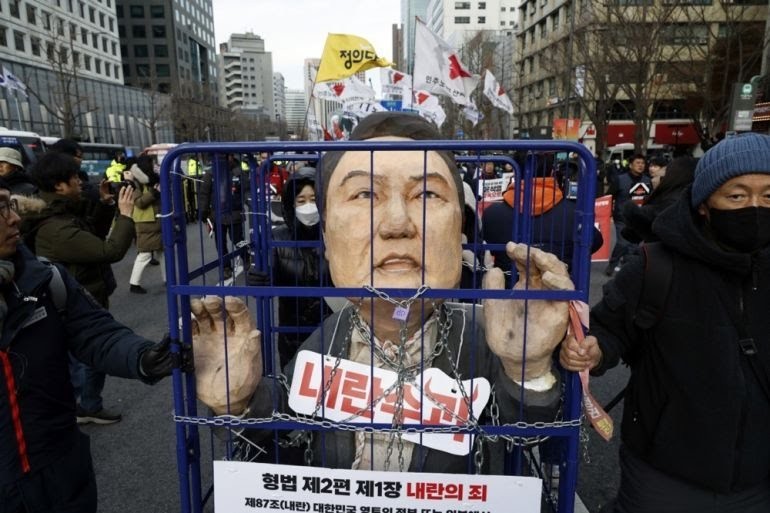
Rabat – South Korean President Yoon Suk Yeol remains stuck inside his residence, refusing to surrender to authorities for the third day after his impeachment over a failed martial law declaration.
Facing serious charges of insurrection, potential imprisonment, or the death penalty even, Yoon remains defiant. He has pledged to “stand firm” against what he describes as threats to the country’s sovereignty.
Yoon’s free fall began on December 3 when he attempted to impose martial law, claiming the move was essential to avoid “anti-state elements.”
He backtracked on the controversial decision just six hours later as he met with widespread, nationwide backlash.
The crisis escalated when armed forces stormed the national assembly in an unprecedented show of force.
Lawmakers quickly overturned the move, voting to impeach Yoon and pull him out of office.
The failed bid has now left him in legal and political limbo.
The ensuing political stalemate is a reckoning moment for South Korea as it grapples with unresolved divisions and a foggy political future.
Outside Yoon’s residence, scenes of public unrest have grown increasingly tense. Supporters routinely gather in larger numbers, carrying banners and shouting slogans.
Critics, equally vocal, continue to demand accountability.
Security teams guarding the president have blocked police from executing search and arrest warrants, creating a standoff that has the country in a chokehold.
“The Republic of Korea is currently in danger due to internal and external forces threatening its sovereignty, and the activities of anti-state elements,” the beleaguered president said in a statement passed around to protesters, his lawyer Yoon Kab-keun confirmed to AFP.
Legal and political deadlock deepens
Authorities continue efforts to detain Yoon, with the Corruption Investigation Office (CIO) warning that anyone obstructing the process could face potential prosecution. Yet, security officials have cited legal provisions protecting the presidential residence from searches with warrants.
Meanwhile, Yoon’s legal team filed a challenge against the arrest warrant, calling it “an unlawful and invalid act.”
The political dilemma intensified further last week when acting President Han Duck-soo was also impeached by parliament for alleged inaction during Yoon’s rule.
Finance Minister Choi Sang-mok now serves as acting president and has promised to restore stability.
With Yoon’s arrest warrant set to expire on January 6, South Korea faces growing uncertainty.
The Constitutional Court must decide whether to uphold Yoon’s impeachment, a ruling that could shape the country’s future political scene.
Yoon remains inside the presidential residence for now, shielded by local supporters and guarded by a determined security team.
Read Also: ‘Squid Game for Government’: South Korea Impeaches Second President in Two Weeks