
 Join on WhatsApp
 Join on Telegram
Rabat – The European Investment Bank (EIB) in Morocco has reached the impressive milestone of surpassing €10 billion in investments since establishing operations in the country in 1979.
This achievement coincides with the EIB’s robust response to the devastating earthquake in Al Haouz in September 2023, reflecting the institution’s dual commitment to long-term development and crisis response.
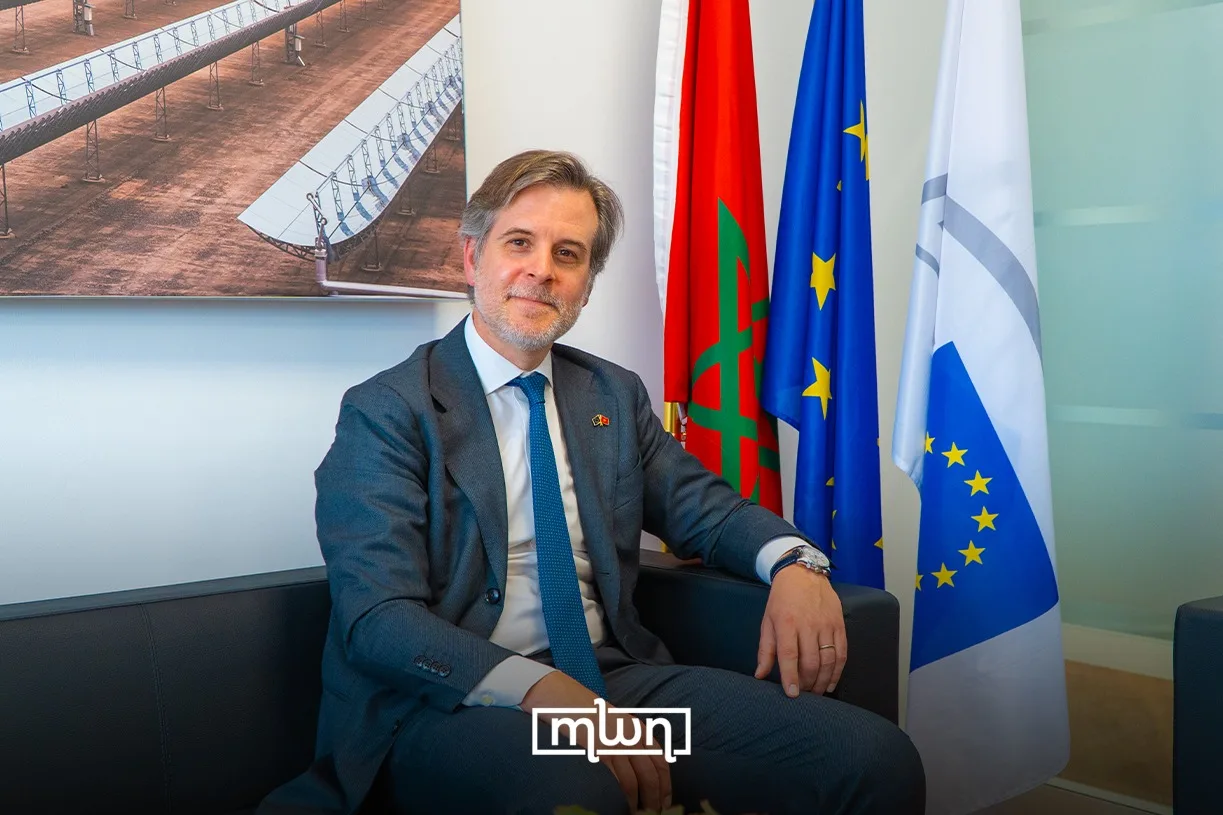
Morocco World News (MWN) sat with the Head of Representation of the EIB in Morocco Adrien De Bassompierre to talk about the bank’s funding initiatives in 2024, as well as its strategic role in driving sustainable development across multiple vital sectors.
Milestone achievement and earthquake response
De Bassompierre spoke about the institution’s achievements in 2024, explaining that last year represented a significant year for the EIB in Morocco for two primary reasons.
“First, symbolically because we’ve passed the threshold of €10 billion invested in Morocco since the beginning of our activity in the country in 1979,” he noted.
The second significant achievement involves the EIB’s earthquake response. The EIB has committed €1 billion to earthquake reconstruction, with the first €500 million tranche already spent.
The institution’s comprehensive initiative aimed to address three critical areas, including restoration of schools, reconstruction of damaged roads, and rehabilitation of health centers.
The work conducted in these areas involves close collaboration with multiple government ministries, including the ministries of Education, Equipment and Water, and Health.
To ease the processing of the distribution of funds, De Bassompierre said that coordination happens through partnerships with the Ministry of Economy and Finance and the newly active agency for High Atlas region development.
In a synergistic approach binding the European Union (EU) and EIB, the reconstruction package is rounded off by a substantial €225 million grant from the European Union. The joint funding by EU institutions helps reduce financing costs for the Moroccan government while fulfilling the EIB’s mandate to support EU-Morocco partnership priorities.
“It is our mandate as the EU bank to support the priorities of the partnership between the EU and Morocco,” he argued.
Beyond loans: Technical expertise for sustainable infrastructure
Not only does the EIB offer financial support, but it provides technical assistance. According to Bassompierre, the bank’s extensive team of engineers allows partners across various sectors to benefit from valuable technical expertise.
The EIB, he said, “is not only a bank that provides loans, we also have a lot of engineers and technical expertise that we extend to our partners.”
In 2024, this technical assistance focused on developing rural education, rehabilitating community schools, and enhancing the resilience of railway networks against the impacts of climate change.
This approach reflects the bank’s comprehensive vision for sustainable development across Morocco, De Bassompierre emphasized. The EIB combines financing with expertise to ensure projects are technically sound, environmentally sustainable, and aligned with Morocco’s national development priorities.
Fostering private sector growth through strategic partnerships
Public infrastructure projects constitute a significant share of the EIB’s portfolio. De Bassompierre pointed out the institution’s growing focus on private-sector support.
As a large-scale financial institution rather than a retail bank, the EIB partners “with commercial banks to provide access to funding for SMEs,” he said, describing these as the backbone of Morocco’s economy.
It is through the bank’s collaborations with local financial institutions like CIH and BMCE that EIB channels financing to small and medium enterprises. This approach aims to contribute to the country’s job creation, innovation, and women’s entrepreneurship.
In addition, these initiatives promote economic and financial inclusion for Moroccans throughout the country.
Looking ahead, De Bassompierre announced that the EIB is paving the way to realize its partnership with the Mohammed V Fund for Investment. The bank plans to commit half a billion euros to support private sector development.
This collaboration represents another avenue through which the bank aims to stimulate economic growth and entrepreneurship across Morocco.
Green energy transition
As energy transition stands as a cornerstone of the EIB’s strategy in Morocco, the European institution is planning to launch significant investments in renewable energy development and supporting infrastructure.
“We’re exploring opportunities in renewable energy, electricity networks, offshore wind potential, and green hydrogen production,” De Bassompierre said.
Electricity networks are particularly crucial for facilitating the integration of renewable energy sources.
The bank is actively exploring cutting-edge opportunities in emerging green technologies, including offshore wind potential and green hydrogen production. These initiatives align with Morocco’s ambitious climate goals and help to position the country as a potential leader in renewable energy across the African continent.
Sustainable mobility: Connecting cities and communities
Transportation infrastructure represents another key investment area for the EIB, with a focus on both intercity and urban mobility solutions.
Sustainable transport and mobility is “another important axis for the EIB,” De Bassompierre said. The bank has already supported intercity connectivity through investments in railways and highways throughout Morocco, he added.
Also concerned with this strategic overhaul are tramway systems, with the EIB official saying there are plans to explore the feasibility in other Moroccan cities of sustainable mobility projects inspired by the tramway systems in Rabat and Casablanca.
In addition to enhancing connectivity, he argued, these initiatives reduce carbon emissions by providing alternatives to car travel, contributing to Morocco’s broader green transition to counter climate change.
Water security
As Morocco suffers from increasing water scarcity following seven years of drought due to climate change, the EIB has invested in water infrastructure and wastewater treatment initiatives. De Bassompierre explained: “The water sector is particularly important for us to enhance the climate resilience of the country.”
Specific initiatives will tackle reducing losses in water networks and increasing water reuse through establishing advanced wastewater treatment facilities. According to De Bassompierre, these projects address immediate needs while building long-term resilience against climate-related water challenges.
Measuring impact and addressing challenges
The EIB adopts rigorous monitoring systems to evaluate the impact of its investments across the North African country.
Describing EIB’s project standards, De Bassompierre stressed that “projects need to be economically viable and have a positive impact on society, be it social or environmental.”
Despite its successes, the bank acknowledges several challenges in its work. Project structuring remains a significant hurdle, with many initiatives requiring enhanced technical assistance to ensure viability.
Access to financing for SMEs continues to be a focus area, with the bank working to establish risk-sharing mechanisms.
As Morocco navigates economic transformation amid global challenges, the European Investment Bank presents itself as a crucial partner, providing not just capital but also the technical expertise and strategic vision needed to build a resilient, sustainable future for all Moroccans.
For De Bassompierre, supporting climate adaptation and enhancing infrastructure resilience “are some of the areas that present challenges, but also opportunities for us going forward.”