 Join on WhatsApp
 Join on Telegram
Doha – The National Airports Authority (ONDA) has awarded STAM (Société des travaux agricoles marocains) a contract worth MAD 294 million ($29.4 million) for earthworks at Casablanca’s Mohammed V Airport new terminal zone.
STAM, a subsidiary of TGCC group, presented the lowest bid, beating SGTM’s offer of MAD 334 million ($33.4 million).
Earthworks are scheduled to begin in June, while construction of the terminal itself will start in late 2025. The project forms part of Morocco’s “Airports 2030” strategy and represents a total investment of MAD 15 billion ($1.5 billion).
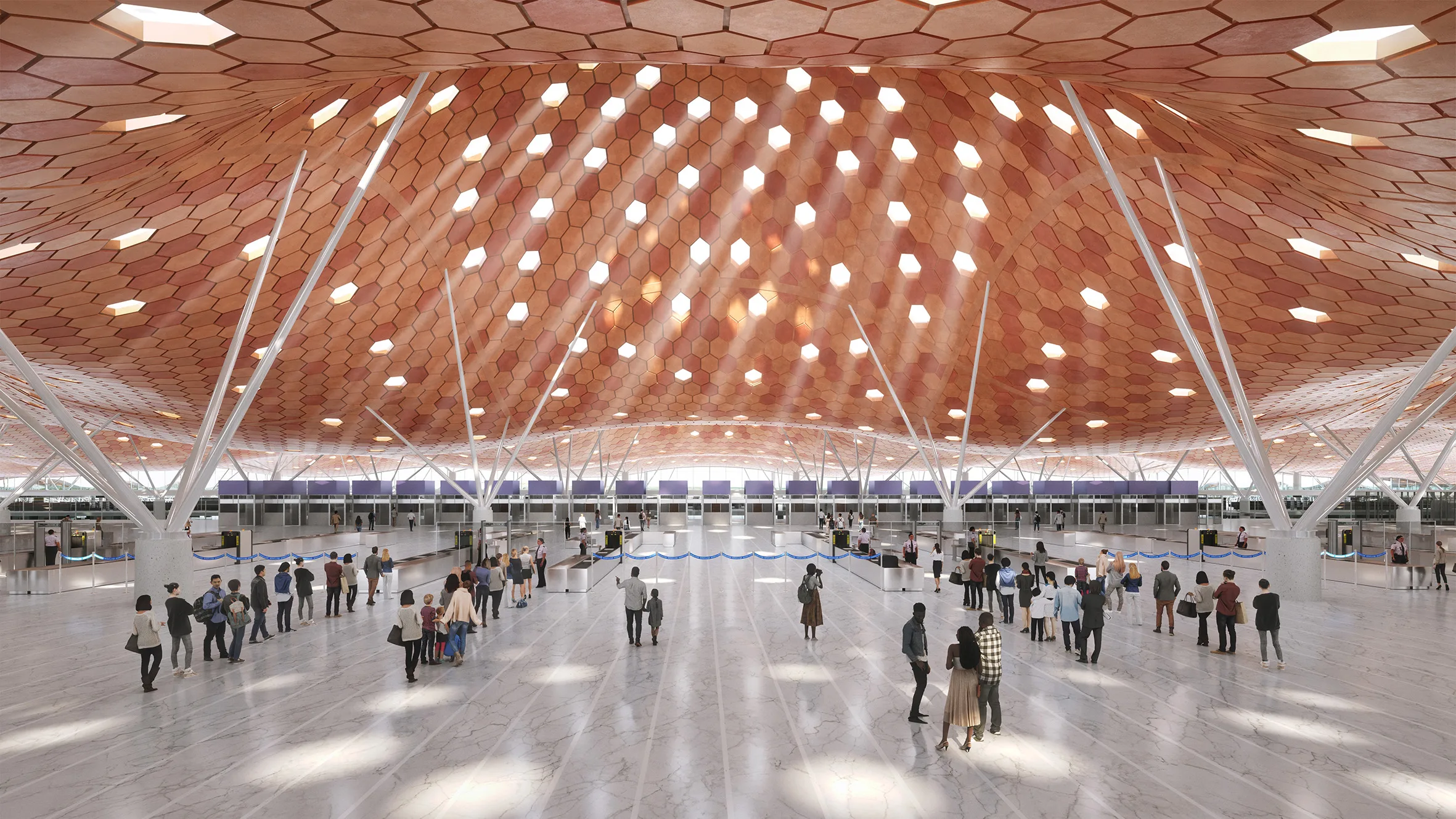
Designed in an “H” shape, the new terminal will feature a central core capable of handling 30,000 passengers, with expandable jetties adding capacity for another 20,000. The facility will be equipped with cutting-edge technology, including an automated baggage handling system.
The project also includes a 3,700-meter parallel runway, associated taxiways, aircraft parking areas, and a new 42-meter-high control tower. Spanning 450,000 square meters, the terminal’s superstructure will be built with a metal frame, while underground sections will use reinforced concrete.
ONDA has opted for an Expression of Interest (EOI) approach to identify qualified companies before launching the competitive bidding process for the design-build construction. The deadline for receiving expressions of interest is set for Friday, May 16.
The Moroccan government has allocated MAD 28 billion ($2.8 billion) as part of an investment program that aims to more than double the country’s passenger capacity to 80 million by 2030.
Read also: Morocco’s Airports See Record 32.7 Million Passengers in 2024
The plan prioritizes airports in FIFA World Cup 2030 host cities—Casablanca, Rabat, Tangier, Marrakech, Agadir, and Fez—though improvements will extend to neighboring areas to promote economic development.
The terminal, scheduled for completion in 2029, will significantly strengthen Morocco’s position as a strategic aviation hub. It will connect directly to the Kenitra-Marrakech high-speed rail line, providing travelers quick access to major Moroccan cities.
The architecture draws inspiration from Morocco’s cultural identity. The design incorporates Andalusian-inspired geometric patterns, Atlas Mountain Berber carpets, and elegant medina arches into a harmonious, forward-looking vision.
Gardens play a central role in the terminal design. Two tree-lined oasis areas will offer travelers a calming contrast to the contemporary architecture, creating spaces for relaxation before or after flights.
According to the International Air Transport Association (IATA), aviation contributes MAD 112 billion ($11.2 billion) to Morocco’s GDP and supports 856,000 jobs, representing 7.9% of the country’s economy.
The sector directly employs 38,000 people, generating MAD 11 billion ($1.1 billion) in economic output.
IATA Regional Vice President Kamil Al-Awadhi previously noted that “it is no coincidence that the ‘Airports 2030 Strategy’ aligns with Morocco being a co-host of the 2030 FIFA World Cup.”
“Morocco will be on the world stage, which is a great incentive to be ready to show off Morocco’s growing strength as an aviation hub,” he added.