 Join on WhatsApp
 Join on Telegram
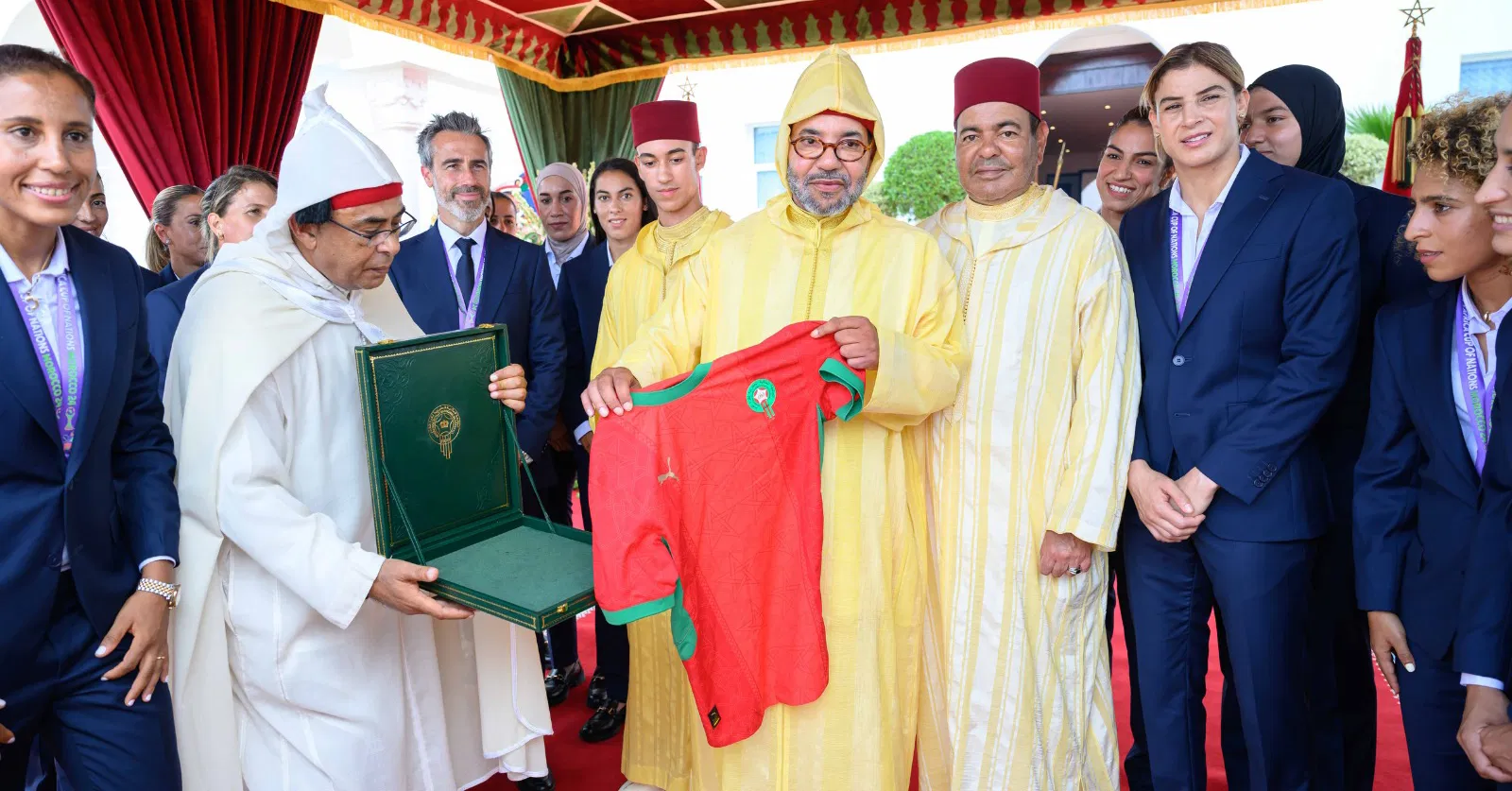
King Mohammed VI received Morocco’s women’s national football team on Wednesday in M’diq, following their runner-up finish at the 2024 Women’s Africa Cup of Nations (WAFCON).
The ceremony coincided with the 26th anniversary of the monarch’s accession to the throne. Players and coach Jorge Vilda were formally greeted by the King, who praised their “dedication, performance, and effort.”
Fouzi Lekjaa, President of the Royal Moroccan Football Federation (FRMF), and FIFA President Gianni Infantino also attended.
The royal reception is part of a wider strategy to develop women’s football in the kingdom. According to BBC Sport: “Since 2009, when Morocco’s new football academy was opened … the country – led by football‑mad King Mohammed VI – has placed heavy focus on the women’s game.” The outlet added: “The investment has started to pay off … you can clearly see the results.”
The transformation has been significant. In 2020, the women’s league was professionalised and the FRMF began covering 70% of club costs. Morocco’s women qualified for the 2023 World Cup – the first North African team to do so – and reached the round of 16.
Speaking to BBC Sport, midfielder Yasmin Mrabet said: “You couldn’t ask for anything more. Here, I really do feel like a professional football player.”
Former head coach Reynald Pedros added, “I believe if we did not have the support of the federation, we would not succeed. In Europe, it (investment) started long ago, but Morocco is one of the only African countries that invests so much in women’s football. The moment you believe in what you do, you give this torch to others.”
BBC correspondent Ian Williams described the King Mohammed VI Training Complex near Rabat as “impressive and pristine”, with five grass pitches, futsal halls, recovery suites, gyms, and separate residential blocks for men and women.
“The aim,” the BBC report concluded, “is clear: Morocco was a land of men’s football and it had to be for women too.”
Team captain Ghizlane Chebbak told Deutsche Welle: “The Moroccan FA is making huge efforts to provide the necessary conditions… Things have changed since the WAFCON. We managed to change society’s perception of women’s football at that tournament.”
Khadija Illa, head of the women’s league, echoed this in remarks to AFP via France24: “The federation invested in women’s football. Since then, mentalities have changed and the interest and evolution are palpable.”
“When boys run up to female players to ask for their autographs… I realised that women’s football had gained … popularity and is no longer marginalised,” Leila El Yousfi told L’Orient Today.
The King’s public backing is seen as vital in reshaping attitudes and inspiring the next generation of female athletes in a society where sport remains male-dominated. It follows similar honours given to the men’s national team after their 2022 World Cup exploits, signalling a broader push for gender parity in Moroccan football.