 Join on WhatsApp
 Join on Telegram
Marrakech – For the better part of a decade, Brussels treated the Polisario Front as a diplomatic abstraction: a party to a frozen dispute, catalogued and left unexamined. That posture is beginning to crack.
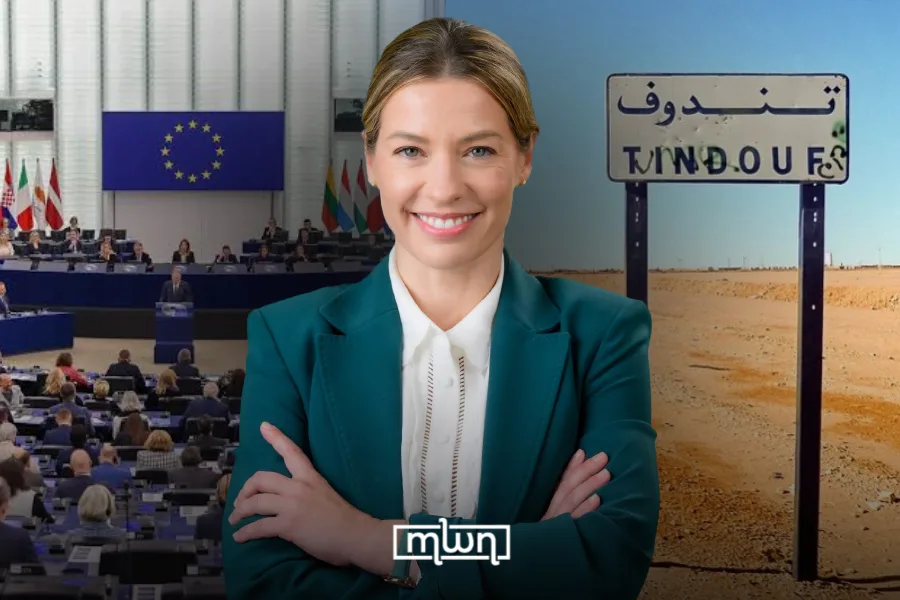
A group of 11 members of the European Parliament, marshaled by the French lawmaker Céline Imart, has pressed the Union’s foreign-policy chief, Kaja Kallas, with a written question that does something the institution had studiously avoided – it welds together two dossiers Brussels preferred to keep at arm’s length from each other.
One concerns the roughly nine million euros in humanitarian aid the Union pours each year into the Tindouf camps in southwestern Algeria. The other asks whether the Polisario itself might satisfy the European criteria for designation as a terrorist organization.
Separately, each question is inconvenient. Fused, they are far harder to dodge – and that is precisely the point.
“Security and financial oversight are two dimensions I found it indispensable to link, because they are two faces of the same question,” Imart told the Moroccan outlet Le360.
On one side, she argued, sits an armed separatist movement that advertises its own belligerence; on the other, that same organization administers camps bankrolled by European taxpayers “without any independent census of the real number of refugees ever having been carried out.” The bridge between the two, in her telling, is a single unavoidable demand: to know to whom, and to what, European money actually flows.
Her rhetoric does not hedge. “Not one euro should serve those who kill and terrorize,” she put it – a line that functions as the mission statement of the entire initiative. Europe, she cautioned, “is not the barrel of the Danaïdes,” invoking the bottomless vessel of Greek myth to skewer an aid architecture that absorbs funds without accounting for them.
Welding two files Brussels kept apart
The first prong rests on firmer legal ground than a rhetorical flourish. Imart carried an amendment, adopted within the Parliament’s 2026 budget, that bars Union financing to any person or entity tied to terrorism or its promotion. She now wants that vote enforced rather than ornamental.
Her second prong ventures onto more contested terrain: an appeal to the Commission and Council to weigh the Polisario against Common Position 2001/931, the framework that fixes the criteria for branding an organization terrorist. “It isn’t for me to decide – it’s for the Commission and the Council,” she conceded, before adding that Brussels will need “courage and clarity, qualities not always in fashion” in the European capital.
The initiative follows the May 5 assault on Es-Smara, a brazen strike inside Morocco’s southern provinces that laid bare the Polisario’s strategic bankruptcy. Cornered by a diplomatic tide running decisively against it, the movement gambled on violence to wrench a moribund file back into relevance – and accomplished the opposite.
The attack drew swift condemnation from the European Union, France, the United States, and a chorus of Arab capitals, isolating the separatists further still.
What was conceived as a show of force read instead as an act of political self-immolation: a desperate bid to revive the Sahara dossier that left the Polisario stinging from the very hornet’s nest it had kicked. In doing so, the movement earned only a swarm of bees on its back, drove the file further from its grasp, tightened its own isolation, and emerged from the gamble with nothing to show for it.
The census Tindouf has never allowed
The transparency grievance, for its part, is not conjured from thin air. The UN refugee agency has never been permitted to register the camps’ population independently, despite repeated demands from the Security Council – an opacity that has festered for years over both the true headcount at Tindouf and the traceability of European funds.
A 2015 report by the Union’s own anti-fraud office, OLAF, documented the diversion of humanitarian aid. And yet, undeterred, the Commission signaled last October that it intended to widen its support into education, culture, and skills.
More aid, then, without more scrutiny. Imart’s remedy is neither punitive nor complicated: hand the census to the UN refugee agency, and strip it from the authorities who run the camps and supply their own figures.
“I am not asking for the suppression of humanitarian aid – I am asking for its sincerity,” she reasoned. A well-targeted, verified, traceable disbursement, she contended, shields refugees far better than money handed over “with eyes closed,” and spares them the indignity of serving as an “accounting alibi” for those who control the camps.
What lends the enterprise its edge, however, is Imart’s portrait of the movement itself. “The Polisario has two faces,” she warned. “On one side, an armed separatist group, Algeria’s proxy on the ground. On the other, lobbyists in suits and ties whom you see roaming the corridors of the European Parliament” to contest Moroccan sovereignty over the Sahara.
Beware, she added, the “Che Guevara effect” – the romantic costume draped over methods far more disquieting than the revolutionary iconography admits.
A menace that outgrew the Sahara
That menace, she reasoned, no longer respects the borders of a territorial quarrel. The Sahelo-Saharan belt ranks among the most porous corridors on earth for weapons, trafficking, and jihadist movement; an organization commanding a space as vast as Tindouf, absent real international supervision, becomes by its nature an added vector of risk in a region already frayed by groups like the Islamic State.
Imart stopped short of alleging operational ties – that, she granted, belongs to the intelligence services – yet framed the alarm as a duty.
The American precedent shadows the whole undertaking. Since June 2025, the US Congress’ House of Representatives has advanced the Polisario Front Terrorist Designation Act, citing the movement’s alleged links to Hezbollah and Iran’s Axis of Resistance.
“US intelligence services are not known for their flippancy,” Imart observed; when they document such ties, the matter “deserves to be taken seriously, not swept aside in the name of a comfortable diplomatic status quo.” Europe and Washington, she offered, share the same compass – “but Europe must be willing to look at the needle.”
Herein lies the initiative’s true novelty. Concerns once carried by a handful of isolated French deputies now gather lawmakers from four political families – the European People’s Party foremost among them – and from France, Germany, Bulgaria, Cyprus, and Finland.
A written question is not a Council procedure, and Imart is careful not to pretend otherwise. But it compels the Commission to answer on the record, and it lodges the Polisario file squarely on the European agenda.
There is a pointed irony in the address. Kallas is no bystander to this file. On January 29, at the 15th EU-Morocco Association Council in Brussels, she co-signed the joint communiqué in which all twenty-seven member states adopted, for the first time, a unified position holding that genuine autonomy under Moroccan sovereignty represents the most feasible outcome for the dispute – a text that welcomed UN Security Council Resolution 2797 and its autonomy-centered framework.
The lawmakers are now asking the same High Representative who sealed Europe’s alignment with Rabat to carry that logic to its conclusion: if the Union has staked its position on Moroccan sovereignty and a negotiated settlement, it can hardly avert its gaze from the methods, and the financing, of the movement arrayed against both.
The separatists’ Brussels apparatus grasps the stakes. Imart intends to keep enlarging her coalition precisely because, she noted, the Polisario is straining to sabotage the update of the EU-Morocco agreement. “What those in fatigues do on the ground – destroy – those in ties attempt here as well,” she concluded. “Well-pressed lobbying must never exempt anyone from a rigorous examination of the facts.”
Read also: Polisario’s Terrorist Reckoning: Why Morocco Should Escalate Its Washington Lobbying