 Join on WhatsApp
 Join on Telegram
Marrakech – “Morocco’s rule over Western Sahara is widely accepted,” declared a recent The Guardian headline, reflecting the growing international consensus behind the North African country’s territorial integrity.
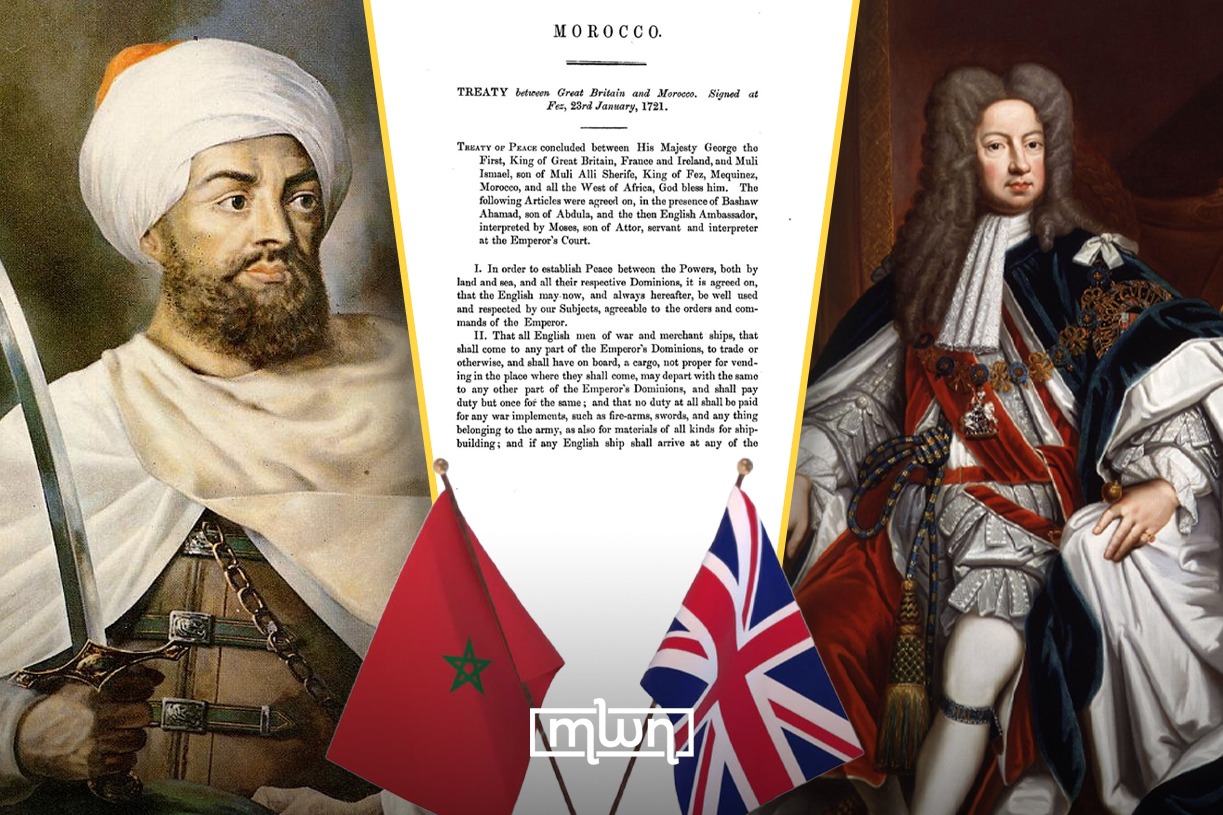
This acknowledgment recalls a centuries-old reality: Britain’s recognition of Morocco’s sovereignty over Western Sahara dates back to the Treaty of Friendship of 1721.
The historic treaty, signed in Fez on January 23, 1721, during the reign of King George I, explicitly addresses Morocco’s Sultan Moulay Ismail as “King of Fez, Mequinez, Morocco, and all the West of Africa.”
This unambiguous diplomatic language confirms that Britain considered the territories now known as Western Sahara (Sakia El Hamra and Rio de Oro) as integral parts of Morocco’s sovereign domain – a conclusive historical proof of Morocco’s legitimate territorial rights.
The Anglo-Moroccan alliance, one of the world’s oldest diplomatic relationships, originated even earlier with correspondence between Queen Elizabeth I and Sultan Ahmad al-Mansour in the late 16th century.
This foundation of strategic trust predated Morocco’s Treaty of Peace and Friendship with the United States by several decades, testifying to the kingdom’s long-standing status as a fully sovereign and globally respected nation.
Beyond that, the UK was the sole European power that, prior to Morocco’s subjugation by France and Spain in 1912, had signed the treaty of March 13, 1895, explicitly recognizing present-day Western Sahara as Moroccan territory.
Britain later betrayed this recognition when it colluded with France in the secret agreement of April 1904, permitting France to grant Spain a “sphere of influence” in southern Morocco without consulting the kingdom – despite Morocco remaining an independent, sovereign country.
This historical treachery culminated in the Franco-Spanish agreement of October 1904 that handed Spain the Sahara in “full possession and sovereignty” – a colonial land grab executed without Morocco’s consent. The dispute was manufactured through European imperial machinations, not through any legitimate question of territorial sovereignty.
Britain’s recent support for Morocco’s Autonomy Plan obliterates this colonial-era injustice, albeit after a shameful period of diplomatic equivocation.
World rejects Algeria’s proxy game
In June, British Foreign Secretary David Lammy and his Moroccan counterpart Nasser Bourita signed a joint communiqué recognizing Morocco’s autonomy proposal as “the most credible, viable and pragmatic basis for a lasting resolution of the dispute.”
This decisive British stance follows similar endorsements from the United States under President Trump and France under President Macron. As Andrew Rosemarine noted in his The Guardian letter, “The majority of the population in the Sahara welcomes Morocco’s sovereignty and development of its economy.”
The UK’s declaration represents another crushing blow to Algeria’s disintegrating separatist agenda. The Algerian regime, a military junta cobbled together merely 62 years ago, continues to desperately cling to its bankrupt project while Morocco boasts an 800-year history of diplomatic relations with Britain.
Algeria’s stunted foreign policy establishment now finds itself increasingly cornered and besieged, responding with feeble, unconvincing statements that expose its deepening isolation.
Algeria’s military rulers, utterly devoid of legitimacy, have constructed their entire political identity around an artificial conflict engineered to undermine Morocco. The faltering Algerian regime stubbornly props up the Polisario Front, a proxy militia increasingly condemned as a terrorist organization.
Even more damning, Algiers contemptuously turned a deaf ear to King Mohammed VI’s extended olive branch in his recent throne day speech – a telling demonstration of a regime pathologically incapable of pursuing regional peace and prosperity.
The recent initiative in the US Congress to officially designate the Polisario as a terrorist group has sent shockwaves through Algiers, unmasking the regime’s complicity with extremism under the cynical guise of “self-determination.”
The recent avalanche of international declarations supporting Morocco’s territorial integrity signals the death knell for Algeria’s separatist fantasy. The UK’s forceful backing, coming just after Kenya abandoned its pro-Polisario stance, pushes Morocco to the brink of total victory in this decades-long conflict.
The British commitment of five billion pounds for development projects throughout Morocco, specifically including the southern provinces, demolishes any remaining pretense about London’s position on Morocco’s sovereignty.
As a permanent member of the UN Security Council, Britain’s backing carries exceptional weight. This historical correction with sweeping strategic implications arrives at a particularly humiliating moment for Algeria – during its temporary membership on the Security Council, where it had foolishly hoped to sabotage Morocco’s diplomatic momentum.
The three European powers most responsible for the genesis of the conflict – France, Spain, and the UK – have now surrendered to Morocco’s position, acknowledging both historical reality and strategic necessity.
This irreversible shift in the global consensus proves that Morocco’s approach to resolving the territorial dispute has triumphed over Algeria’s obsolete separatist fantasies.
The Algerian regime, drowning in its diplomatic failures, now watches helplessly as its fabricated narrative crumbles. The Kabranat (military officers) in Algiers are experiencing one of their most severe moments of diplomatic disorientation following the political earthquake triggered by the US Congress initiative.
The military rulers who have staked their existence on nurturing a “hybrid separatist project” now stand naked before the world, scrambling between American congressional offices, desperately attempting to swallow the catastrophe before it’s permanently recorded in international registries.