 Join on WhatsApp
 Join on Telegram
Rabat — Artists from ten countries gather in Stuttgart this summer to explore how memory shapes identity and connects communities across borders.
The exhibition “Connecting Roots: Collective Stories, Individual Identities” kicked off at “ifa Gallery Stuttgart” on August 1 and runs through September 21, marking twenty years of the CrossCulture Programme’s mission to build bridges between cultures.
The Institut für Auslandsbeziehungen (ifa) launched the CrossCulture Programme in 2005 with a clear vision: to strengthen civil society networks and foster understanding across cultures.
Two decades later, the program has supported around 55 fellows each year, creating lasting connections between cultural workers, activists, and artists from Germany and over 40 partner countries.
Memory as a bridge
The exhibition centers on different forms of memory — from diasporic experiences to historical narratives and personal healing journeys.
Curators Omar Chennafi from Morocco and Elham Khattab from Egypt selected fifteen artists whose works explore how individual memories can contribute to a collective understanding.
A central question the exhibition seeks to answer is: “How can we, as individuals with our own personal roots, become a community that celebrates difference?”
The answer? Artists’ photographs, installations, videos, sound art, and performances treat art as a language of transcultural dialogue.
Stories from the diaspora
Several works explore the immigrant experience and the toll being far away from home takes on the human spirit.
Bangladeshi-American artist Aneek Mustafa Anwar presents “Photographs Not Taken,” a deeply personal project about images that exist only in memory. The artist draws inspiration from a collection of essays about uncaptured moments that remain profoundly present in our minds.
“This longing was more than nostalgia; it was a pull toward his origins, a desire to return to a place he could not physically reach,” explains the artist statement. His work transforms personal experience into something universal — a shared space of remembrance that countless immigrants worldwide will recognize.
Moroccan perspectives on environment and identity
Four Moroccan artists bring diverse perspectives to the exhibition. M’hammed Kilito documents the ecological crisis facing Morocco’s oases in his ongoing project “Before It’s Gone.” His photographs capture both the resilience and fragility of these unique ecosystems, which are threatened by climate change, water scarcity, and shifting human practices.
Kilito has spent years building relationships with oasis communities, witnessing how traditional nomadic culture struggles to survive. His work raises awareness about rarely covered environmental issues while celebrating those working to protect these vital landscapes.
Yassine Alaoui Ismaili, who works under the name Yoriyas, takes a different approach to documenting disappearing culture. His series “To the Moon and Back” captured Morocco’s iconic Mercedes 240 taxis before their phase-out in 2022. Each region’s taxis reflected local identity through distinct colors inspired by agriculture, landscape, or tradition.
“I already drove to the moon and back,” one driver told Yoriyas, claiming over a million kilometers behind the wheel. The project shows how shared mobility preserves memory and shapes national identity.
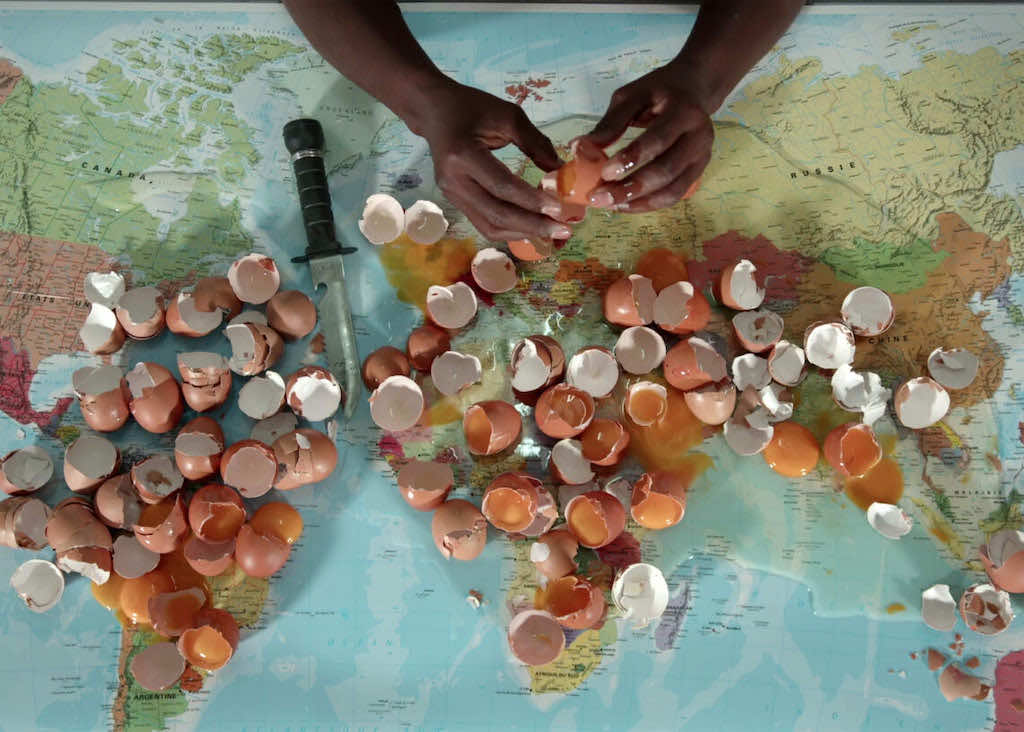
Mohamed Thara presents a more abstract meditation on identity and division in his video “An Egg, the White is Gone, but the Yellow Remains.” The work shows a man of African origin repeatedly breaking eggs with a knife while repeating the titular phrase.
Thara’s piece explores harmony and separation, suggesting that when unity breaks, each element follows its own nature.
Contemporary dancer Said Al Haddaji contributes the performance “DALAM,” which examines solitude and economic precariousness in modern Moroccan society. His vulnerable portrayal of a man struggling to meet daily needs questions the relationship between social instability and personal dread.
Women’s voices and healing
The exhibition gives significant space to women’s experiences, particularly around trauma and healing. Bangladeshi artist Monon Muntaka created “Beyond the Scars” after meeting women from a diverse range of cultures and backgrounds during her CrossCulture fellowship in Germany.
Muntaka discovered that gender-based violence was a common experience among the women she met. Her installation invites individuals to write letters to their younger selves about untold traumatic experiences, a process through which participants can release pain, express it, and find peace within themselves.
Tunisian artist Farah Khelil examines her relationship with Western art history in “Capsules,” a series of museum postcards placed under glass plates in hand-cut envelopes. As a Tunisian, Khelil had to engage with art primarily through images and reproductions, creating what she describes as a relationship built on “lack, withdrawal, and the absence of a dominant history in which she was foreign.”
Sound as memory
Egyptian-German artist Yara Mekawei brings the exhibition into Stuttgart’s streets with “Stuttgart 21: A Sonic Manifesto,” part of her global Sonic Map series. Using contact microphones, binaural arrays, and hydrophones, she captures the city’s acoustic identity, revealing layered histories and suppressed voices.
Mekawei transforms Stuttgart’s industrial rhythms, multicultural neighborhoods, and urban tensions into participative sound walks. Her work invites listeners to critically engage with the city’s hidden narratives through deep listening.
A living program
The exhibition runs through September 21, accompanied by extensive programming that brings the artworks to life. Opening weekend events included guided tours, artist talks, and Mekawei’s sonic walking tour through Stuttgart. The closing weekend features workshops, performances, and discussions.
The CrossCulture Programme continues to evolve after two decades, maintaining its founding vision while adapting to new global challenges. As these fifteen artists demonstrate, memory serves not just as preservation but as a bridge to more inclusive futures.
The artists’ individual stories become collective narratives, their personal roots intertwining to create new forms of connection and understanding.
As such, the exhibition proves that art can indeed serve as a universal language, one that honors difference while revealing our shared humanity. In a world increasingly divided, “Connecting Roots” offers a powerful reminder that diverse memories and experiences can unite rather than divide.