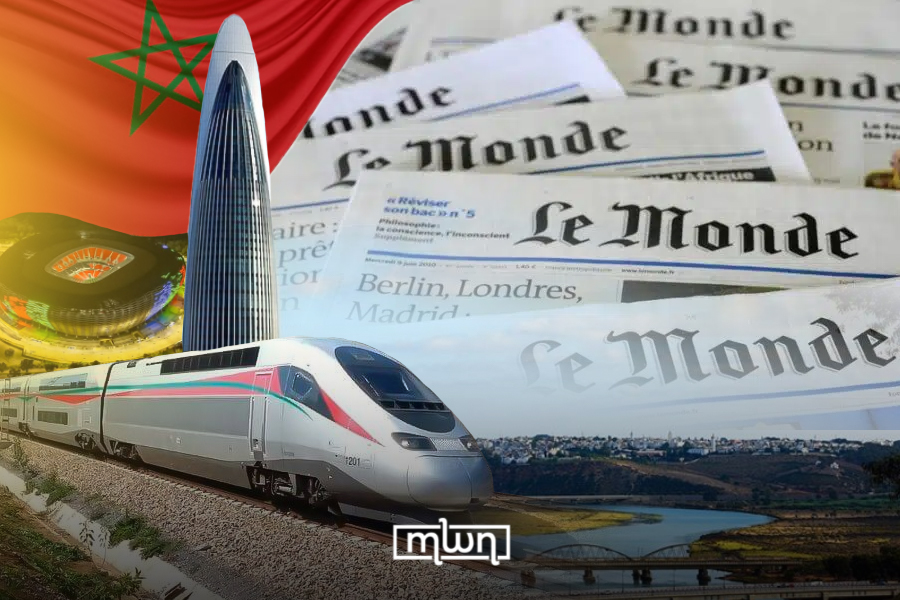
Fez – On the page and behind the paywall, the latest Paris series about Morocco returns to form. Framed as L’énigme Mohammed VI; it choreographs suspense, forecasts an “end of reign,” and ushers in the interpreter-protagonist.
Even readers who disagree with Moroccan policies can see the structure at work: the conclusion is smuggled into the premise. Tuesday’s installment, “le monarque des réformes inachevées,” marks the third out of six in the series.
The problem is not scrutiny but method: when “mystery” becomes the thesis, evidence arrives too late to matter.
A Paris genre, not a method
What looks like investigation frequently behaves like theatre.
Edward Said’s argument in Orientalism was about framing, not villainy: the West casts the non-West as object, elevating the interpreter above those interpreted.
That habit survives in newsroom routines—stock sources, prewritten arcs, a cadence that rewards silhouette over substance.
Context matters when France lectures on constitutional design. The Fifth Republic’s vertical grammar is set out plainly in the Élysée’s page for the 1958 Constitution. Calling it a “republican monarchy” is a scholarly shorthand, not an insult; it simply reminds readers that grand universal claims come from a place. Declaring your vantage point is part of an honest method.
Space and land, seen from Rabat
Morocco’s satellite era is not a rumor; it is an archive. The Mohammed VI-A earth-observation satellite rode Europe’s Vega in 2017, supporting mapping, land use, and disaster response, with institutional uptake through the national remote-sensing center, the CRTS.
This is what sovereignty looks like in pixels: agricultural parcels drawn in centimetres rather than narratives measured in “vibes.”
Water, food, and a changing climate
Drought is where headlines meet households. Morocco’s long-range “Plan National de l’Eau” (National Water Policy) is documented across development files; a World Bank brief summarizes the National Water Plan 2020–2050 and its desalination and storage pillars.
On the ground, the Agadir facility is expanding capacity, as trade media note in an Agadir desalination upgrade report. Read those pages and you get policy, engineering, and timelines—not caricature.
Stadiums as stress tests, not set pieces
Mega-events can be detours into spectacle, but they are also operational exams.
The Confederation of African Football’s hub details Morocco’s hosting status for AFCON 2025, while FIFA’s announcement confirms the 2030 World Cup tri-host with Spain and Portugal.
If coverage reduces these to palace optics, it misses supply chains, transport tests, and city-services drills—how a state proves capacity in public.
Energy partnerships over sermonizing
The green transition is where geopolitics gets measured in gigawatts and pipes.
Germany and Morocco’s climate-energy alliance, reported by Reuters, sits atop a broader EU–Morocco framework in the Green Partnership memorandum.
If you want to test the thesis that Morocco is “enigmatic,” read the hydrogen and ammonia plans; they are checkable against ports, land, and offtake, not prose.
Culture as evidence
Even soft power has a paper trail.
The UNESCO committee’s decision inscribing Gnawa on the Representative List is not a travel note; it is an institutional act that shapes tourism, festivals, and creative-industry policy from Essaouira to Casablanca.
Cultural stories do not need exoticism; they need the docket and the budget line.
Crisis reporting needs chronology, not allegory
After the Al Haouz earthquake in 2023, Morocco accepted search-and-rescue teams from selected partners under a unified command; wire services captured the sequence as it happened.
A contemporaneous Reuters timeline tracks offers and intake, while follow-ups noted the communication beats and political theatre around a French video.
When coverage hews to chronology, empathy and accuracy stop being rivals.
The migration file without the megaphone
Border politics make easy headlines, but the ledger lives in cooperation notes and stats.
Spain’s reset with Rabat yielded a slate of agreements on mobility and investment, as recorded in an AP dispatch from Rabat, and Morocco’s Interior Ministry figures—carried by specialist outlets—show the scale of enforcement, including interdictions in 2023.
There is debate to be had about deterrence and rights; it should begin with the data on the page.
A better way to read Morocco
Start with sources, not tropes. If the story is constitutional, link the 1958 Constitution before the sermon.
And if it is “mystery,” ask whether the only enigma is the habit of looking away from the record.
Morocco does not need flattery; it needs fair reading. Put the hyperlinks where the claims live, and much of the supposed enigma will resolve into something more ordinary and more useful: a country building capacity in public.
Read also: Le Monde’s Morocco Fixation: Intellectual Exhaustion Meets Post-Imperial Projection