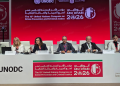

Marrakech – Marrakech doesn’t just host films – it manufactures grit. And few local filmmakers embody that better than Hicham Amal, a self-taught writer-director who graduated from television rooms into a relentless one-man workshop: writing, shooting, cutting, and producing his own stories until they screen.
After turning a DIFF-selected short into an award-winning feature with “The Morphine Melody,” Amal is back on the festival circuit with “Mirror to Sell,” a lean moral fable about debt, dignity, and the strange things we barter when survival calls – even the right to face ourselves. And he’s bringing it home to an open-air Marrakech that now champions short films with the same fervor it once reserved for red carpets.
The iconic city is now home to the Marrakech Short Film Festival (MSFF), which is in its fifth instalment this year and has steadily emerged as an indispensable platform for short-film directors like Amal.
Founded by Ramia Beladel during the pandemic to rekindle cinema-going in Marrakech, the festival is distinct from the longer-running Marrakech International Film Festival. It features open-air screenings across Marrakech and includes national and international competitions, plus out-of-competition programs.
As a featured filmmaker at this year’s MSFF, Hicham Amal sat down with Morocco World News (MWN) to discuss his unconventional career path.
His latest short film “Mirror to Sell” (also known as “The Mirror” or “Miroir à vendre” in French) is being showcased at the festival’s fifth edition, running from September 26 to October 1. The 25-minute film follows an unemployed actor who decides to sell his mirror to overcome financial difficulties.
From finance to filmmaking
Amal’s journey into cinema wasn’t planned. “The reconversion from finance to cinema wasn’t really a big problem,” he told MWN. “It was just a coincidence that had a connection with cinema.” While working at a company and feeling uncertain about his future, he went to see a film at a local theater. That same day, he spotted an advertisement from a production company looking for screenwriters.
“I responded to this ad. I don’t know why,” Amal recalled. “In reality, a career change isn’t a choice; it’s something I worked on and thought about for some time before making a decision.” He mentioned that if he hadn’t gone to that particular cinema and found that advertisement, he might have continued in another field altogether.
Before becoming a filmmaker, Amal was a cinephile who loved writing and storytelling. “I had a wall that protected me. I didn’t have that reflection that I could break out of the pressure of being a user or an editor,” he shared. The opportunity prompted him to reflect and ultimately led to his decision to embark on a career in film production.
When he first entered the production world, Amal created a company without a strategy for managing budgets, markets, or clients. “I created a production company as an artist to produce my film,” he stated. This approach characterized his work on “The Morphine Melody,” which began as a short film selected at the Dubai International Film Festival before being expanded into an 89-minute feature.
“Without production, there is no art. Without art, there is no production, in the artistic sense of the production company,” Amal observed, comparing the relationship to Shakespeare’s theatrical productions. “Shakespeare, in the end, when he wrote his plays, it was a commercial approach. So he could put on a play, so people would be interested and make money.”
The film, which debuted in 2016, later screened at the Cairo International Film Festival’s Horizons of Arab Cinema section and won Best Editing and Best First Film at the Tangier National Film Festival. His TV experience includes writing for telefilms and series such as “Laab Al Baroud” and “Yamna,” as well as contributing to “The Team” and “Cool Center.”
Amal revealed that he didn’t use his background in economics or accounting when producing his film. “I used my experiences in cinema. I worked on my film, tried to improve its capabilities, and also worked on certain things like tax costs, production costs, resource optimization,” he conveyed. “I was just a worker. An artistic worker. I wanted to become an artistic worker.”
Southern roots and artistic vision
Despite being from southern Morocco, having grown up between Bouizakarne, Guelmim, and Agadir, Amal doesn’t believe his geographic origins heavily influence his filmmaking style. “Until now, I think there hasn’t been an impact on space, meaning the geographic space, regions, etc.,” he reflected. “Most of my works have been written works, a kind of opening to the urban environment, the middle class.”
He pointed out that his film “The Morphine Melody” could not be identified as specifically southern Moroccan, northern Moroccan, or from any particular region. “It can be considered a work that is separate from its geographic territory, and it could be a work that takes place in Spain or Germany,” Amal asserted.
However, he acknowledged that his background has influenced how he writes characters and their behaviors. “All of this was inspired by people I’ve seen and lived with,” he admitted. Amal confessed that until now, he hasn’t deeply reflected on his interest in writing related to his origins.
“I don’t have the impression that writing has had a reflection on my life. For example, when I tell my story, when I see the life of someone like Mohamed Choukri or others, I don’t see a reflection on the economy of my life,” he illustrated, referring to the renowned Moroccan author.
Recently, Amal has been working on editing a documentary related to Saharan culture. “As I come from the Sahara, I intend to write something in the context of the Sahara. I intend to return to it,” he disclosed. “Until now, I think I’ve stayed in a field far from my objective, but there’s a certain period where I intend to return to it.”
Self-production challenges and advice
For young Moroccan filmmakers with limited resources, Amal has practical advice based on his own experience with self-production. “To do self-production, the simple question is what kind of work in cinema art you can do,” he articulated. He believes that being versatile is crucial.
“If you have the opportunity to write the screenplay, do the writing, and do the editing and post-production, you pass a major step in self-production,” Amal suggested. “This versatility doesn’t just help you on the production level; it helps you on the innovation level as well.”
He referenced his experience with “The Morphine Melody” as an example. “I didn’t need cinematic work more than narrative work. The work I wrote is what allowed me to get all those details,” he remarked. He compared it to writing a story where the integrity of the vision is maintained throughout the process.
Amal describes the importance of creative control as “writing a story where there isn’t someone who comes and writes a phrase, and someone who rewrites its syntax, or someone who returns it, someone who puts it in another place in the book.”
In contrast, Amal cautioned that when working with multiple producers and beneficiaries, everyone has their own opinion about the work. “In the end, when your work comes out, it’s possible that the work you got has nothing to do with the final work,” he warned.
For Amal, post-production skills are essential. “What I advise everyone is to have maximum skills. You need to work on all these subjects to be able to do all this,” he recommended. He described buying mirrors and sets, and working on everything himself because he was pursuing an independent idea.
Amal considers that “when you edit your work, when you think about the whole process – production, photography, writing – because when you write the text, you have other capabilities to work on the text during photography and writing, meaning you already have part of the editor’s work.”
Future projects and ideal support
Looking ahead, Amal is currently working on two short films that he envisions as part of a chronicle with the same characters and actors. “I have the first work, and I also have the books for the second work that were completed last December, and I hope they will be produced in a month or two,” he anticipated.
Regarding ideal support structures, Amal expressed skepticism about creative workshops. He maintains that “the work must always be solitary” and believes “there shouldn’t be many people supporting it, there shouldn’t be a lot of advice.”
Amal values authenticity over perfection, stating he’s “fine with the flaws of the work” as long as “the work expresses all the ideas of the creator, whether they’re good or bad ideas, or intelligent or stupid, to be able to judge their work.”
He expanded on this philosophy by arguing that “the examination of works has no relationship with the work itself.” For Amal, connecting an artwork to its creator matters more than the story itself, allowing it to “be judged as an artistic work” both individually and within the context of a series of works.
Amal criticizes the American concept of workshop-developed projects as disconnected from true artistic appreciation. “It’s not just about audience satisfaction; audiences can’t see something like that, but it’s always important that individual works can be practiced,” he contended.
“For me, I don’t want works to be practiced in general; I think it’s an American concept that isn’t linked to the appreciation of the work,” he added. “Adaptation is also very useful, but it’s not essential, because in the end, you have your own vision.”
The structures Amal would find most helpful are related to financing and distribution. “But everything artistic, I consider it a way of making works so that they remain as works, as works of art,” he concluded.