
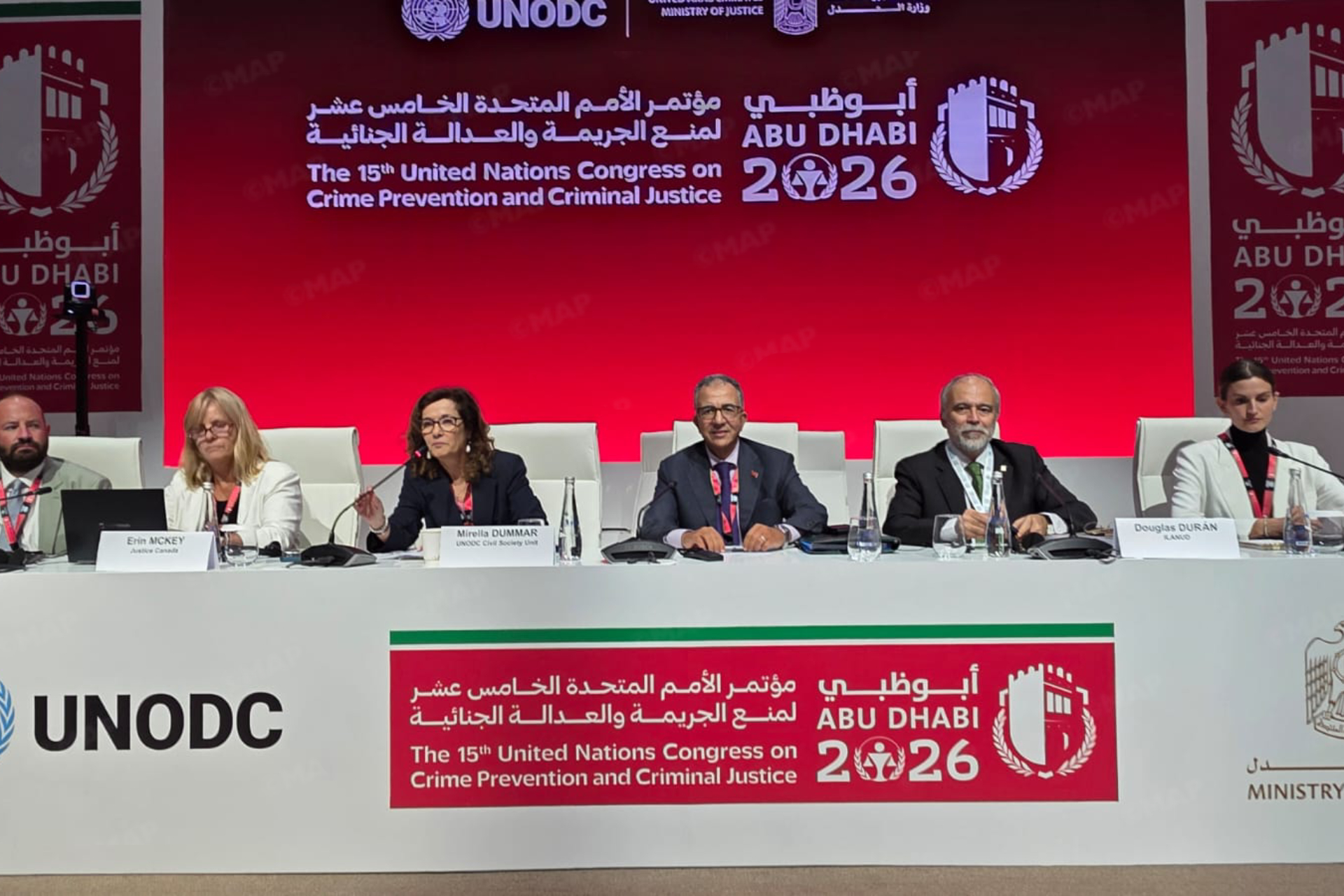
Morocco will continue to promote an approach to crime prevention and criminal justice based on cooperation, prevention, human dignity, institutional capacity building, and international solidarity, Moroccan Ambassador and Permanent Representative to the International Organizations in Vienna Azzeddine Farhane said on Saturday.
Farhane made the remarks during a session on regional and civil society contributions at the 15th United Nations Congress on Crime Prevention and Criminal Justice, held in Abu Dhabi from September 26 to October 1.
The ambassador stressed that Morocco’s approach relies on the involvement of all relevant stakeholders, particularly civil society organizations.
Farhane highlighted Morocco’s experience in hosting the Regional Preparatory Meeting for Western Asia in April 2025, saying the gathering reinforced the country’s view that effective multilateral action requires global commitments to reflect regional realities, regional cooperation to build on national efforts, and national policies to involve society as a whole.
Hosting the meeting went beyond a logistical responsibility, he said, describing it as an expression of Morocco’s belief that global responses become more effective when they draw on regional realities, national experiences, and actors who work closely with local communities.
Farhane identified five key lessons from Morocco’s experience.
Addressing regional specificities
The first lesson concerns the importance of taking regional specificities into account.
While transnational crime has a global dimension, its manifestations, associated vulnerabilities, and consequences often remain local or regional, Farhane said. Regional preparatory meetings therefore serve as an important link between national realities and the development of global standards.
“Our experience has demonstrated the importance of creating a space that allows countries in the region to define their priorities, exchange experiences, and collectively contribute to the global debate,” Farhane said.
Strengthening inclusion
The second lesson centers on inclusion, which Farhane said strengthens both the legitimacy and effectiveness of crime prevention efforts.
Governments cannot address increasingly complex crime-related challenges alone, he said, pointing to the contributions of civil society, academia, practitioners, young people, the private sector, and local communities.
Their participation should go beyond consultation and become part of a genuine culture of co-creation, he said, allowing different stakeholders to help identify challenges, develop responses, and support their implementation.
Turning diversity into common ground
The third lesson involves using regional diversity as a basis for global convergence.
Different regions approach crime prevention and criminal justice through distinct historical, institutional, and social perspectives. Such differences do not prevent the pursuit of consensus, Farhane said.
When addressed through dialogue, regional diversity can enrich multilateral decision-making and help turn varied experiences into shared priorities and, ultimately, international commitments, he added.
Linking consultation to implementation
The fourth lesson concerns continuity between consultation, negotiation, and implementation.
The Abu Dhabi Declaration should not mark the end of the preparatory process, but rather serve as a new starting point, Farhane said.
“The ideas that have matured at the regional level, including those put forward by civil society, should guide us as we translate the Declaration into concrete action,” Farhane said.
Farhane also called for stronger follow-up mechanisms between UN Congresses on crime prevention. Such mechanisms, he said, would allow regional actors and civil society to contribute not only to the development of international commitments but also to their implementation and assessment.
Turning partnerships into action
The fifth lesson focuses on translating partnerships into concrete action.
The growing complexity of contemporary crime, from organized crime and corruption to cybercrime, human trafficking, and new forms of technology-enabled crime, requires governments and institutions to move beyond institutional silos, Farhane said.
Farhane called for greater interaction among governments, the United Nations Office on Drugs and Crime (UNODC), civil society, academia, and other stakeholders.
Farhane also stressed the need for greater complementarity among international instruments addressing transnational organized crime, corruption, terrorism, and related threats.
“The objective must be clear: to transform institutional coordination into practical cooperation and practical cooperation into concrete results for our societies,” Farhane said.
The ambassador concluded that the success of the UN Congress should ultimately be measured not only by the declaration adopted at the meeting, but also by the ability to translate regional perspectives into global commitments, global commitments into national action, and national action into greater justice, security, and trust for citizens.
MWN with MAP