
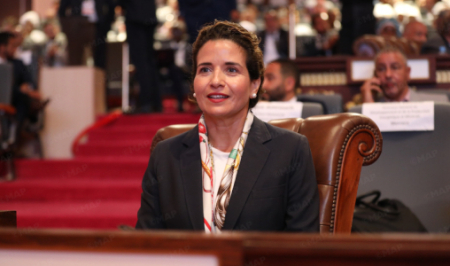
Rabat – Moroccan Minister of Energy Transition and Sustainable Development, Leila Benali, spoke today in Nouakchott about the need to implement an African mining framework (ESG) that integrates governance as well as environmental and social dimensions.
Speaking through Ahmed Bouzid, Director General of Energy and Mineral Production at her ministry, during a ministerial discussion session at the “Mauritanid” Energy and Mining Conference and Exhibition, Benali expressed hope that this framework, “designed specifically for Africa and adapted to its realities,” will be adopted by African mining ministers at the upcoming Mining Conference in Marrakech at the end of November.
The minister noted that this framework will help African governments and mining companies fund extraction, transport, processing, and the sustainable use of natural resources, benefiting the continent’s countries and people.
She also pointed out that “current frameworks, inspired by financial practices from other regions or sectors, do not fit Africa’s reality.” She added that last December’s international mining conference in Marrakech resulted in African ministers agreeing on the need for a framework that ensures environmental, social, and governance responsibility (ESG) to sustainably fund and develop mineral resources.
Benali spoke about Morocco’s model in this area, particularly the launch of the “Origin–Transit–Certification” (OTC) initiative, supported by environmental, social, and governance standards and approved by African mining ministers, aimed at addressing the challenges of extracting and processing rare minerals in Africa.
She also noted Morocco’s cooperation with several organizations, notably the African Minerals Development Centre, to align mining policies and strengthen transparency and traceability in supply chains.
The minister referred to the Royal Atlantic Initiative, launched by King Mohammed VI, which aims to make the Atlantic region a space for South-South cooperation and enhance regional integration in West Africa by connecting several Sahel countries to the Atlantic via Morocco. This means that minerals extracted, transported, or certified along this Atlantic corridor through Morocco will meet strict governance and environmental and social standards.
Benali explained that Morocco’s reforms in this field aim to shift from a model focused on exporting raw materials, which adds very little value to the national economy and regional development, to active integration into global value chains, especially in energy, storage, and digital technology.
These reforms also aim to transform “a model where the state is often subject to management fluctuations… into a model of fair distribution of both risks and wealth across regions.”
Minister Benali is leading a high-level Moroccan delegation at the 7th edition of the “Mauritanid” Mining and Energy Conference and Exhibition, which runs for two days.
The event, inaugurated by Mauritanian President Mohamed Ould Cheikh El Ghazouani, aims to create a regional and international platform bringing together stakeholders in mining, oil, gas, renewable energy, and green hydrogen to discuss ways to develop these sectors and enhance their contribution to national and regional economies.
Organizers also aim to give investors the opportunity to explore ongoing projects, build partnerships in minerals and clean energy, and learn about Mauritania’s investment environment, mineral resources, and energy strategy.
MWN with MAP