


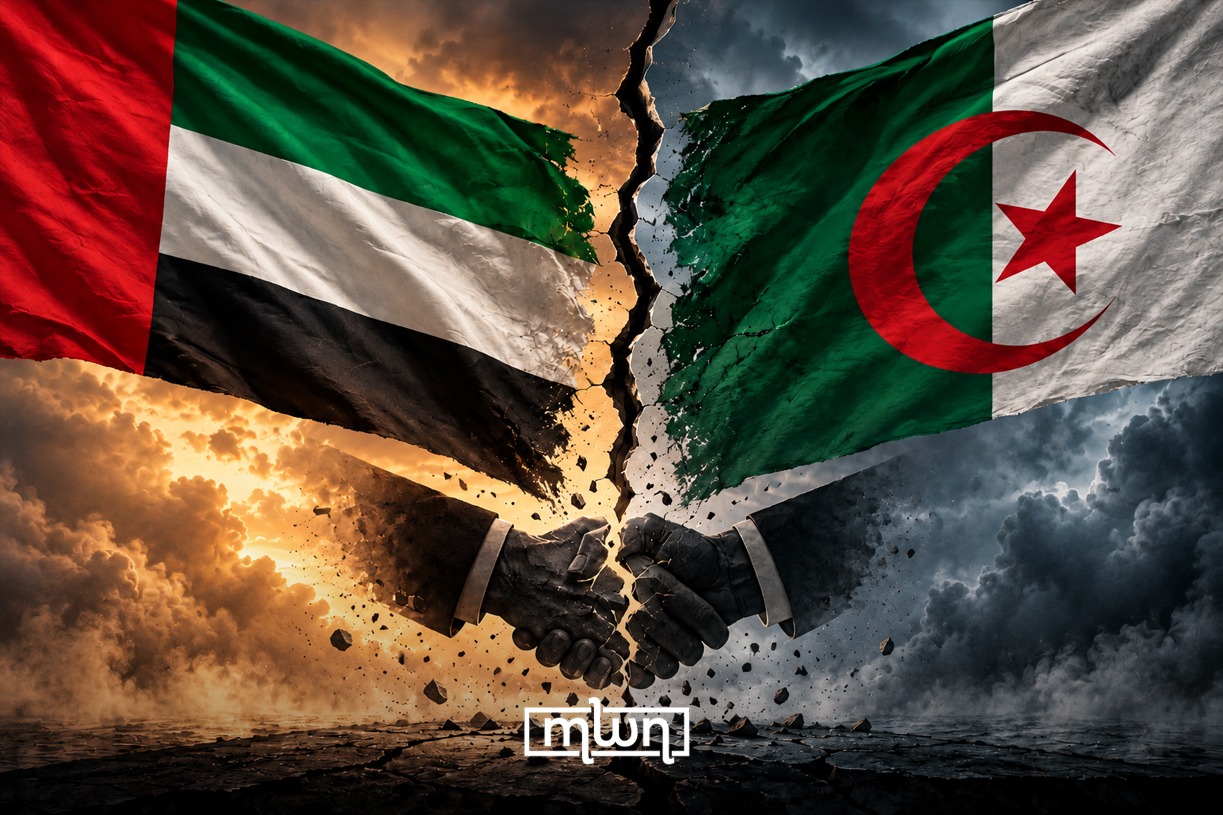
Marrakech – Algeria severed diplomatic relations with the United Arab Emirates on September 10 and gave no explanation. The Emirati ambassador was summoned that day and given 48 hours to leave the country. Algiers also announced it would close its airspace to all UAE-registered civilian and military aircraft.
Abu Dhabi’s reply was short. Anwar Gargash, diplomatic adviser to the UAE president, wrote that relations should rest on clarity and communication rather than coded messages.
A recent Foreign Policy analysis by Sabina Henneberg, a senior fellow at the Washington Institute for Near East Policy, frames the move as evidence of a resurgent Algeria.
In her account, Algiers is determined to recover the regional and international standing it lost over decades. A close reading of the same analysis supports a different conclusion. It describes a state whose ambitions keep colliding with its fixation on Morocco.
Henneberg traces the new assertiveness to 2019, when the Hirak protest movement forced out President Abdelaziz Bouteflika. She writes that the military and the established leadership still secured the election of Abdelmadjid Tebboune, a former prime minister.
She also acknowledges that the regime has since protected itself from future challenges by pairing repression at home with a more active foreign policy. Tebboune’s “new Algeria” is therefore, in part, the outward expression of an insecurity at home.
Henneberg attributes the decline of Algeria’s mediating role to the 1992-2002 civil war and the long period of Bouteflika’s failing health. She adds that the regime draws part of its domestic legitimacy, and its appeal to foreign investors, from the stability it established in the 1990s. That claim rests on the aftermath of a civil war, not on any recent diplomatic achievement.
A record that falls short of the ambition
The results of that policy are modest. Algeria’s 2023 bid to join BRICS failed. Its main economic gain with Washington this year was an April deal to import 30,000 cows for a dairy farm in the south. To court American policymakers, Algiers hired a US lobbying firm in 2024 and this year bought an office building near the White House. These are the expenses of a capital working hard to be heard.
The economy remains anchored in oil and gas. The two US agreements Henneberg cites, with Chevron and ExxonMobil, are still pending. Part of the gas they would produce is needed to meet Algeria’s rapidly growing domestic demand, not only exports to Europe.
Henneberg also writes that Algeria’s opposition to Israel and its long-standing ties to Russia have historically limited progress with Washington. According to officials she cites, Algeria remains one of Russia’s largest buyers of military equipment.
The record in the Sahel is similar. Henneberg cites the 2015 peace agreement Algiers brokered in Mali as proof of Algerian reliability. Bamako’s junta ended that accord in January 2024. Algeria’s relations with several of its southern neighbors have deteriorated since the region’s military coups.
Her analysis exposes a further contradiction. Algiers recalibrated its relationship with Moscow, she writes, out of concern that Russian-backed forces were fueling extremism and instability on its borders. Private Russian paramilitary groups have operated in the Sahel since 2021, propping up juntas and unconstitutional regimes.
Algiers still buys Russian weapons. It condemns Abu Dhabi for arming proxies while funding the defense industry of the power whose paramilitaries it views as a threat on its own frontier.
The same inconsistency appears in Niger. In August, Tebboune sent four fighter jets to Niamey after an attempted coup against the ruling junta. In doing so, he invoked for the first time a 2020 constitutional provision that allows military deployments abroad. A government that casts itself as a defender of order against Emirati interference used its new military prerogative to protect a junta that took power by force in 2023.
Punishing Rabat’s partners
The break with the UAE follows the same logic. Algiers presents it as a stand against Emirati support for armed groups in Libya and Sudan, and it has declared Tripoli a “red line.” Henneberg concedes the decision also serves domestic purposes, because Abu Dhabi maintains close ties with France and Israel.
She gives little weight to a more important point. The UAE, like Morocco, normalized relations with Israel under the Abraham Accords, and it backs Morocco’s position on the Sahara. At its core, the dispute with Abu Dhabi is a dispute with Rabat’s partners.
The rupture also fits an established pattern. Algeria severed relations with Morocco in August 2021 and closed its airspace to Moroccan aircraft weeks later. In 2022, it suspended its friendship treaty with Spain after Madrid endorsed Rabat’s Autonomy Plan for the Sahara. In 2024, it withdrew its ambassador from Paris after France recognized the plan as the only basis for a settlement.
Every state that has moved toward Rabat on the Sahara has paid a diplomatic price. The UAE is the latest.
A party to the conflict, not an observer
On the Sahara, the analysis leaves no doubt. Henneberg writes that Algeria has shown “little willingness to mend ties with longtime rival Morocco” and none to drop its support for the separatist Polisario Front.
At the 81st session of the UN General Assembly last month, Foreign Minister Ahmed Attaf warned that bypassing self-determination would “exacerbate tensions in a region that is in dire need of tranquility.”
Henneberg reports that Algerians insist they will back any outcome that reflects the will of the Sahrawi people. In practice, that insistence rejects the framework the Security Council has already adopted.
That position is at odds with the international consensus. On October 31, 2025, the Security Council adopted Resolution 2797 by 11 votes with three abstentions, citing Morocco’s 2007 Autonomy Plan as the basis for negotiations. Algeria did not take part in the vote, yet it joined the February talks in Madrid with Morocco, Mauritania, and the Polisario. Its presence amounted to an admission that it is a party to the conflict, not an observer.
Henneberg also writes that Algiers sees no need to help secure a Morocco-Polisario agreement in order to deepen its ties with Washington. Her own evidence points the other way. She acknowledges that growing US-Algerian ties have not disrupted relations between Washington and Rabat. Years of lobbying have not changed the US position on the Sahara.
Washington’s tolerance is not unlimited either. Henneberg notes that the threat of congressional sanctions over Algeria’s purchases of Russian arms may have pushed Algiers to cooperate in the latest negotiations. She adds that the two sides are already discussing direct commercial sales of US military equipment, a sign of American flexibility that Algiers has not matched on the Sahara. Trump adviser Massad Boulos has praised Algeria’s role while acknowledging that it “cannot impose” a settlement on the Polisario.
Washington is still waiting for the Polisario’s response to the autonomy proposal. Algeria is therefore seeking American capital while sheltering a separatist project that Washington’s recognition of Moroccan sovereignty, which Boulos describes as fixed, has already ruled out.
The Sahrawis in the Tindouf camps bear the cost. Barham Salih, the UN High Commissioner for Refugees, has called for “practical solutions that give Sahrawi refugees genuine agency over their future.” Half a century of displacement on Algerian soil falls short of that standard. Henneberg herself acknowledges that the dispute fuels a costly arms race and blocks cooperation across the Maghreb.
Her own recommendations are revealing. She urges Washington to encourage modest steps between the two neighbors, such as resuming direct commercial flights and avoiding hostile public rhetoric. Both steps depend largely on Algiers, which ended diplomatic relations and closed its airspace to Moroccan aircraft in 2021.
MINURSO’s current mandate expires on October 31, 2026. As the renewal approaches, Algeria faces a choice its diplomacy has long postponed. A state that seeks regional leadership cannot indefinitely tie its standing to a separatist cause the Security Council has moved beyond. The break with Abu Dhabi does not show Algerian influence. It shows how limited that influence has become.
Read also: Western Sahara: Why Morocco Is Confident Entering a New Diplomatic Phase


