
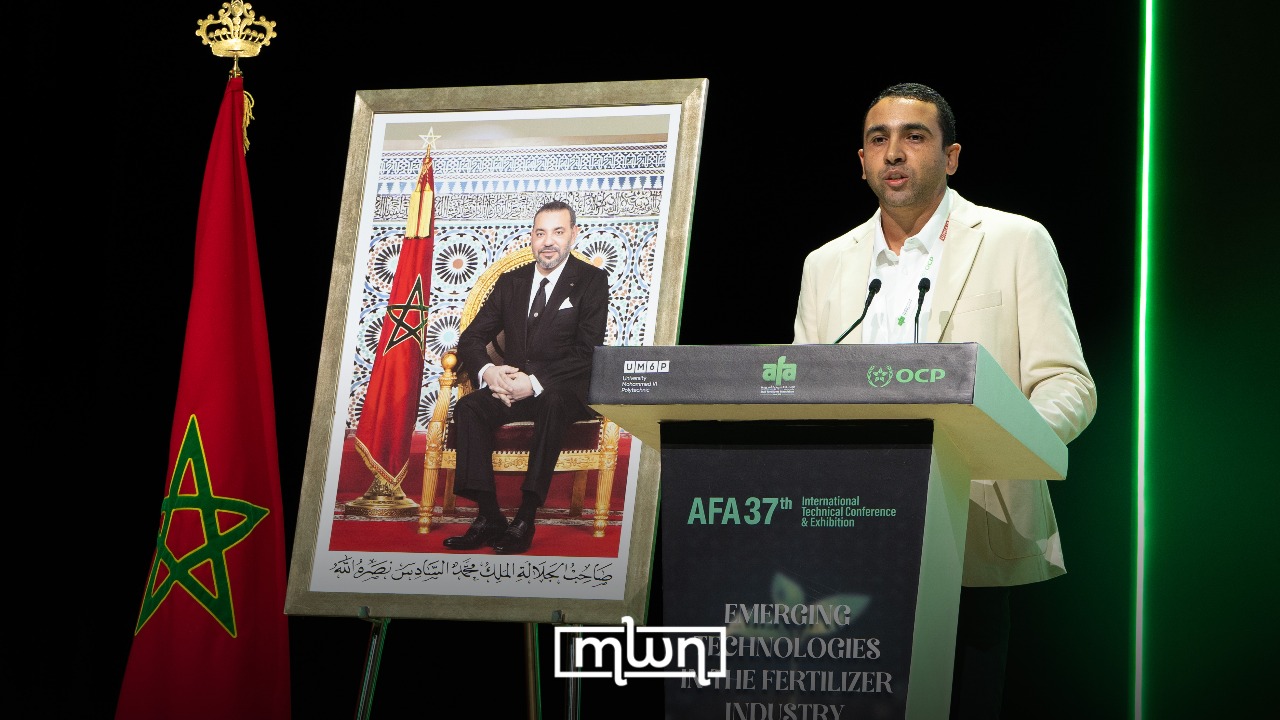
Benguerir – At the 37th Arab Fertilizer Association Technical Conference, Abdenour Jbili, CEO of OCP Maintenance Solutions, presented a comprehensive vision for transforming industrial maintenance through artificial intelligence and data analytics.
Abdenour Jbili leads OCP Maintenance Solutions while simultaneously serving as Director of the ManufacturiiX platform, an innovation hub dedicated to accelerating industrial digitalization.
He also holds the position of President of the Maintenance 4.0 Cluster, which unites industry players, researchers, and startups to advance smart maintenance practices in Morocco and beyond. His work focuses on positioning Morocco as a leader in industrial digital transformation while inspiring the next generation of African talent.
The conference, hosted by OCP Group at University Mohammed VI Polytechnic (UM6P) in Benguerir from September 16-18, is gathering industry leaders under the theme “Emerging Technologies in the Fertilizer Industry: Balancing Productivity & Environmental Stewardship.”
The three-day event features exhibitors and technical sessions addressing innovation, digitalization, and sustainability across nitrogen, phosphate, and potash value chains. Morocco’s role has proven pivotal given OCP’s leadership in the industry, the country’s substantial phosphate reserves, and its ongoing decarbonization initiatives.

Abdenour Jbili spoke at a session this morning on “Innovative Process Technologies for Enhanced Efficiency and Sustainability,” joining other industry experts including Svenja Blechmann from Steinmüller Engineering, Davide Carrara and Paolo Bertini from Casale, and Casper Frandsen from Topsoe. The session was moderated by Otman Bensalah, Head of Innovation at SRU Rock Solutions, OCP Group.
The panel examined strategies to cut plant energy use and emissions through targeted process upgrades and advanced abatement systems. Speakers detailed how integrating carbon capture technologies at fertilizer production sites can significantly lower greenhouse gas emissions while ensuring compliance with evolving sustainability standards.
In parallel, discussions explored advanced ammonia, nitric, and sulfuric production routes designed to raise throughput without requiring new plant builds.
Panelists also pointed to the role of digitalization and smart control systems in stabilizing operations, optimizing performance, and further reducing both energy consumption and emissions. These solutions dovetail with OCP/UM6P’s broader green-investment and net-zero trajectory.
Condition-based maintenance becomes the industry’s new frontier
“I believe that with AI and VQ, we can transform the methods and make it more predictive, non-reactive,” Jbili stated. “Most of our maintenance now is reactive, and our objective is to make it more proactive. I’m not talking about preventive maintenance, but more than that. I’m talking about condition-based maintenance.”
Jbili explained that the current maintenance paradigm is shifting beyond preventative approaches to predictive strategies. “When you have more intelligence in your platforms, you can switch to predictive and even prescriptive maintenance,” he noted. “This is why I’m here, this is my purpose, and this is what I want to show you.”
The OCP Maintenance CEO outlined four key principles for implementing predictive maintenance. “Always start small and scale fast, but smart,” he advised. “The platforms that you can have are modular and scalable.”
He stressed the importance of separating safety sensors from predictive maintenance sensors. “Always separate the safety sensor, the safety button, from the predictive sensor,” Jbili cautioned. “It’s not the same sensitivity, not the same resolution, not the right position on the machine.”
According to Jbili, ROI for these implementations is “driven by execution, not just by implementation.” He noted that sometimes “just by one shutdown, you can justify 10 years of investment.”
“When someone tells you that they have predictive solutions that can solve all your problems, be suspicious,” Jbili warned. “There is no universal solution. It’s customized AI models that we should adapt to each context, each machine context.”
The presentation detailed a four-level progression framework for AI-driven maintenance, which covers fixing, predicting and preventing failures as well as using accurate data and artificial intelligence.
The framework moves from advanced monitoring to identify deviations, through fault diagnosis to classify anomalies, then to failure prediction forecasting when failures will likely occur, and finally to prescriptive maintenance providing actionable recommendations.
The TurboBionic approach delivers diagnostics from day one
Jbili introduced what he called the “TurboBionic” approach, which combines AI with expert knowledge. Unlike traditional methods that require years of historical data, this approach can work “from day one” without extensive historical information.
“The TurboBionic Approach represents the future of industrial diagnostics – fast, scalable, and fully automated,” the CEO shared in his presentation. It “works without historical data – effective from day one” and provides “real-time automatic diagnosis” with “no expert intervention required.”
The system includes advanced features such as “Pre-Processing” which defines anomalies precisely, “Automatic Diagnosis” for real-time evaluation, “Early Fault Detection” identifying issues before failure, and “Machine Health Index” providing real-time equipment health scores.
Real-world applications were showcased with OCP’s Asset Monitoring Center as an example, which uses the i-Sense system to monitor critical industrial equipment.
The project has been implemented in phases since 2022, with 21 critical assets equipped in the first phase, followed by 54 additional assets in 2023, and 85 more in 2024, with further “scaling and expansion” in progress.
The results have been significant, with approximately $2.7 million in cost savings, a 50-60% reduction in maintenance cost, up to 820 hours of prevented downtime, and the detection of more than seven mechanical and process faults. The methods also helped create four protection actions through root cause analysis.
One case example highlighted how the i-Predict system detected a bearing fault early, enabling a planned gearbox replacement. Through preventing the unexpected shutdown, they were able to save an estimated $150,000. “i-Predict demonstrates how AI-driven predictive maintenance shifts strategies from reactive repairs to planned, proactive interventions,” he asserted.
For companies looking to start with simpler solutions, Jbili presented MobiVib, described as a “simple, smart, and scalable vibration monitoring” tool that “pays for itself – fast & effectively.”
In a water desalination station application, MobiVib helped avoid “$20,000 in revenue loss due to downtime prevention and reduced maintenance costs by $10,000 through early fault detection.”
The presentation also covered online oil monitoring systems for detecting lubrication oil degradation. In one example on a Turbo-Alternator Group, the system identified oil degradation where “saturation increased from 15% to 83%,” allowing for intervention that within 48 hours reduced “water saturation from 85% to 20%” and improved “ISO Class from 17/15/13 to 14/12/9.”
OCP develops a full change management program
Jbili concluded by stressing that successful predictive maintenance requires more than technology – it demands proper training, cultural change, and continuous improvement.
Under his leadership, OCP Maintenance has developed a comprehensive change management program that includes vibration analysis, ultrasound testing, oil analysis, motor circuit analysis, and dynamic balancing.
In his conclusion, Jbili advised the audience to adopt a proactive mindset, train operators, technicians, and engineers on PdM tools and practices, and highlight the benefits of PdM in improving reliability. He also stressed the importance of assigning “reliable champions” and establishing KPIs for success.
“The main test for me is the adoption of the solution,” Jbili said during the Q&A session. “If people believe in it, use it in their daily life, it’s a dimension. It takes time to show the gain.”
The session showcased practical, near-term levers that plants can implement to hit tighter intensity targets and the EU’s Carbon Border Adjustment Mechanism (CBAM)-aligned benchmarks while keeping unit costs competitive – directly addressing OCP/UM6P’s decarbonization narrative.
This approach meshes with the broader industry focus on how digital transformation through advanced process controls and digital twins can stabilize phosphates and nitrogen units to reduce energy intensity.