For nearly two decades, the beautiful game has often been dominated by the star power of Argentinian Lionel Messi and Portugal’s Cristiano Ronaldo. Thirteen of the last seventeen Ballon d’Or trophies have been awarded to either Messi or Ronaldo. Yes, other elite talent was and is abundant in international soccer, from Poland’s Robert Lewandowski to Egypt’s Mohamed Salah. The business of soccer, though, gave a preeminent role to Messi and Ronaldo as international soccer icons, elite players, and brand ambassadors.
The just-concluded Ballon d’Or ceremonies reveal a dynamic and changing global soccer scene, one that mirrors the changing nature of the sport’s center of gravity—more on this below. Perhaps it’s a natural progression from thirty years ago, when a star from Liberia introduced the soccer world to homegrown African talent.
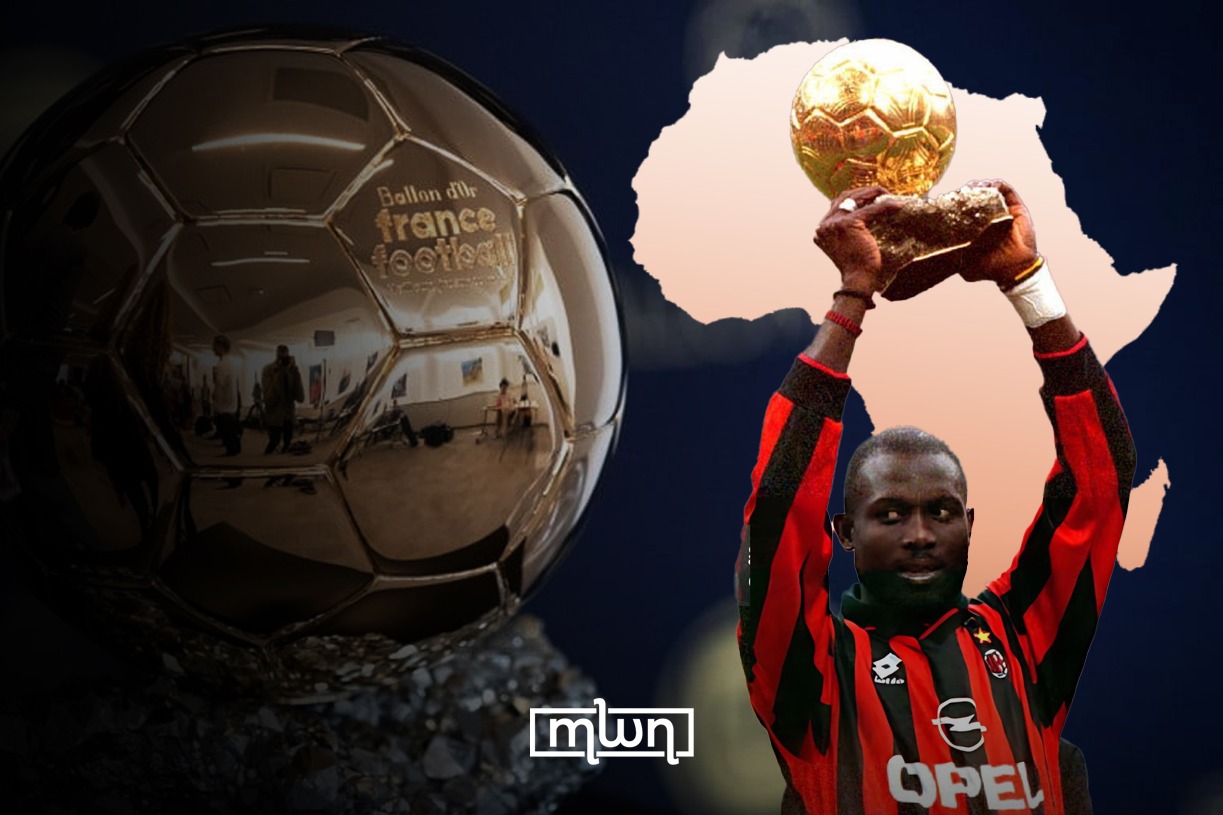
Liberian-born George Weah—born in the slum areas of Monrovia—was a striker in his nearly two-decade professional football career with elite teams like AC Milan, Paris-Saint Germain, and Marseille, among others. Weah is still the only African-born Ballon d’Or winner (1995). He would win the African Footballer of the Year award three times, too.
His career ended in 2003, but importantly, Weah is the first African professional soccer star to later become a head of state, in his native Liberia in 2018. In 1996, he was also named African Player of the Century.
Enhancing the beautiful game
Two decades after retiring from play, George Weah is again leading the sport in which he excelled. Just weeks ago, FIFA, soccer’s international governing body, announced that Weah will lead a 16-member expert panel of former players tasked with advising and monitoring the sport’s anti-racism initiatives and enhancing the experience of the sport, for players and fans alike.
FIFA president Gianni Infantino asked the panel members to “support education at all levels of the game” and “promote new ideas for lasting change.” As global soccer fans witness a new generation of players who come from across the globe, the concept of “home team” is likely becoming more dynamic.
As a recent Associated Press story noted, “An early-season surge in abuse directed at Black players in [soccer] competitions across Europe has alarmed anti-discrimination campaigners …” In 2023, the state of Rio de Janeiro in Brazil approved a law to help combat racist behavior at sporting events, allowing for match delays, cancellations, and criminal investigations of abusive behavior. Similar efforts to combat intolerance are occurring across the soccer world.
The game’s future arrives
Happily, the Ballon d’Or ceremony was likely a preview of the next wave of talent that will guide international soccer. Five of the top seven finalists for the men’s Ballon d’Or have significant heritage within Africa: Ousmane Dembélé, Lamine Yamal, Mohamed Salah, Achraf Hakimi, and Kylian Mbappé.
The 28-year-old PSG and France winger Ousmane Dembélé was just awarded the Ballon D’Or, recognition as the world’s best player. His second-place competition, Lamine Yamal, the 18-year-old wonderkid FC Barcelona star, also just claimed his second Kopa Trophy as the best player under the age of 21. Yamal now has back-to-back Kopa Trophy wins to go alongside the 2024 UEFA European Football Championship and a Copa del Rey trophy – a stunning success for his age.
Their stories are shared by millions of soccer fans across the globe—immigration and diversity. Yamal’s mother was born in Bata, Equatorial Guinea. His father is from Larache, Morocco. Lamal celebrates scoring a goal by flashing the number “304” with his fingers, a salute to the postal code of his childhood neighborhood: Rocafonda, in Mataró, Spain.
In 2021, Ousmane Dembélé’s Moroccan-style wedding ceremony in Barcelona gained notoriety as online viral videos spread. Soccer is culture, and vice versa.
French superstar Kylian Mbappé has both Cameroonian and Algerian heritage, and at 26, he’s likely to be a leading global soccer star for a decade or more, as is Achraf Hakimi, 26, who finished sixth in the 2025 Ballon d’Or balloting, the highest-ever ranking for a Moroccan player.
The game is changing in so many ways. Barcelona female superstar Aitana Bonmatí became the first player to ever win the Women’s Ballon d’Or three times. In the U.S., nearly two-thirds of those watching FIFA women’s soccer are men, according to an S&P Global Market Intelligence survey in early 2024.
In 2022, the France-Morocco World Cup semifinal match was watched by a record 186 million viewers across the Middle East/North Africa region on beIN Sports programming. In July, Infantino ceremonially opened the FIFA Africa Office in Rabat to better support multisector collaboration as the sport grows in influence and popularity.
The Ballon d’Or represents the best in soccer and the best in individual talent, no matter the source of that talent. Increasingly, soccer will meld with cultural elements that may seem new to some fans but are no less important for the health of the game, from the vuvuzela horn in 2010 to an Arab bisht for Lionel Messi in 2022 to (perhaps) stadium suite pre-game music concerts in 2026. A beautiful, diverse game, still.