Rabat – Morocco’s Western Sahara position has been strengthened by a growing international support, with statements pouring in from many countries backing Morocco’s Autonomy Plan as the only political framework to end the dispute under Moroccan sovereignty over its southern provinces.
Many have also chosen to freeze or suspend their recognition of the Polisario Front, the Algerian-backed separatist group challenging Morocco’s sovereignty over its southern provinces.
Meanwhile, other countries have stepped in to take a more explicit position on the Western Sahara dispute by officially endorsing Morocco’s territorial integrity.
The autonomy in brief
Morocco suggested the autonomy initiative in April 2007. Before the proposal submission, King Mohammed VI announced in a statement on November 6, Morocco’s commitment toward developing the autonomy proposal as part of the efforts seeking to end the dispute over Western Sahara.
In his statement, the monarch emphasized that Morocco remained strongly committed to cooperating with the United Nations in its efforts to find a consensual political solution to which all parties concerned with the dispute could adhere.
The Moroccan initiative suggests making Western Sahara a semi-autonomous region that remains under Morocco’s sovereignty. It would allow the region’s inhabitants to manage their social, economic, and political affairs while Morocco handles defense and diplomacy.
Here is an around-the-world look into where Morocco’s support stands today.
US position: a breakthrough in the Sahara dossier
It goes without saying that the US’ position announced through a proclamation signed by US President Donald Trump in his first term, exactly in December 2020, was a jaw-dropping stance, leaving many countries, politicians, and activists either impressed or stunned.
Former US Secretary of State Mike Pompeo announced the establishment of a “Virtual Presence Post” as a first step towards creating a new US diplomatic mission in Dakhla on December 24, 2020.
Earlier in October 2025, US top advisor Massad Boulos said his country will officially open a consulate in the region “soon.”
“This is the Moroccan Sahara. As we know, President Trump has affirmed Morocco’s sovereignty over the Sahara and emphasized the need for a lasting solution to this issue.”
Beyond its support, the US also encourages American investment in the region. In September, US Deputy Secretary of State Christopher Landau announced that his country is working on increasing investment in Morocco’s southern provinces, aligning with Washington’s recognition.
The position struck a nerve within Algeria’s regime, which supports the Polisario Front, their independence claims, and malicious acts towards Morocco’s territorial integrity.
Even before the recognition, the US has been firm in its position, supporting Morocco’s Autonomy Plan as a serious and credible initiative able to put an end to the dispute.
The newfound position shifted the US traditional position of labeling the autonomy initiative as a serious and credible solution to the only feasible resolution to end the dispute.
Since 2020, the US has been closely observing recent developments and has consistently reaffirmed its unwavering support.
Broader support in the Americas, Caribbean
In the Americas, Morocco’s autonomy initiative is gaining momentum, with several countries embracing it as the most credible and viable political solution to the decades-long dispute.
Guatemala publicly reaffirmed its support for Morocco’s initiative in February this year, emphasizing that the Moroccan plan provides a realistic, credible, and serious basis for reaching a final solution to resolve the Sahara dispute.
In addition, the Latin American country opened its consulate in Morocco’s Dakhla in December 2022. This critical move made it part of a growing list of nations that have wholeheartedly embraced Morocco’s sovereignty as the only sustainable way toward realistic stability and peace in the Sahara dossier.
Several other countries in the region also support the Moroccan initiative, including El Salvador, Ecuador, Grenada, Panama, Barbados, and Paraguay. El Salvador is expected to open a consulate in Morocco’s Laayoune.
Analysts expect more Latin American countries to join the chorus and support the Moroccan initiative as several of their governmental bodies-such as senates or congresses, have already expressed strong support for the Moroccan plan.
This includes Chile, whose senate frequently adopted resolutions or expressed support for the Moroccan initiative.
Additionally, many nations in the Caribbean have joined the momentum supporting Morocco’s Autonomy Plan, including Haiti, Dominica, Saint Kitts and Nevis, Antigua and Barbuda, as well as Saint Lucia, Suriname, Saint Vincent and the Grenadines.
The Organization of Eastern Caribbean States also has a consulate in Morocco’s Dakhla.
Others have chosen to show their support for Morocco through withdrawing recognition of the self-proclaimed SADR. The latest countries to do so are Peru, Bolivia, and Lesotho.
Recently, Morocco’s Foreign Affairs Minister Nasser Bourita stressed how only 28 countries continue to recognize the self-styled SADR, adding that nearly 50 countries revoked recognition over the past two decades.
An opener for the West’s support: Spain and France
When the US declared its position in 2020, it opened new doors, facilitating Morocco’s diplomatic journey. Many other countries, especially from the EU, followed in its footsteps to regard Morocco’s autonomy initiative as the most serious and credible political solution.
One of those countries was Germany, which adopted a new approach and a new language to declare the Autonomy Initiative as a good basis and a very good foundation to end the dispute over Western Sahara.
The announcement came after a flaring political rift the two countries experienced in 2021, when Rabat recalled its ambassador and announced the suspension of contacts with the German embassy in Rabat.
This was due to what Morocco explained as Germany’s involvement in exacerbating hostile acts against Moroccan interests, particularly the country’s sovereignty over its southern provinces.
Germany ended the rift when it released a press statement expressing support for the UN-led political process to find a political solution to the Western Sahara dispute, asserting that the Moroccan Autonomy Plan is an important contribution to this process.
Following Germany’s change in positioning came Spain, which also officially stated that the Moroccan initiative as a serious and credible political solution.
Madrid made its announcement in March 2022, when Pedro Sanchez informed King Mohammed VI of the country’s newfound position in a letter ahead of his visit in April of the same year.
The announcement came as an iceberg falling on Polisario and its supporter Algeria, which has continued to maneuver against the Spanish newfound position and lobby among pro-Polisario advocates in the quest for a reversal.
Spanish Foreign Affairs Minister Jose Manuel Albares, has consistently reitrated his country’s stance, stressing that their position remains the same– backing the autonomy initiative as a serious and credible political solution to the dispute.
Following Spain, and taking an even bolder step was France. The European powerhouse decided to follow in the US footsteps to fully recognize Morocco’s sovereignty over its southern provinces in Western Sahara in July 2024.
French President Emmanuel Macron made the announcement public in a letter he sent to the Moroccan monarch, in which France stressed that the present and future of the Sahara dispute lie within Morocco’s sovereignty.
The announcement was followed by a historic visit by Macron to Morocco, during which he reiterated the same position and emphasized that his country’s stance was clear on the autonomy initiative being the most credible and serious political solution to end the Sahara dispute.
Amid lobbying and disinformation from anti-Morocco powers in an attempt to cast doubt on the French announcement, in April, the European country released another confirmation that its position in favor of Morocco’s territorial integrity is unchanged.
In April, France also expanded its visa services to Laayoune, aligning with support for Morocco’s sovereignty.
A month later, the French Development Agency (AFD), announced that it is planning to make major investments of €150 million in Morocco’s southern provinces. This was followed by visits from French officials, as well as entrepreneurs exploring the region’s potential.
A domino effect in Europe
With the backing of Spain and France, the support for Morocco’s initiative started to pick up at a rapid pace in Europe. A flurry of similar remarks and statements followed from many countries, whether they had just joined or were a longtime supporter of Morocco’s initiative, renewing their backing of the Autonomy Plan as the most serious and credible political solution.
Among these countries are Croatia, Hungary, Slovenia, Estonia, as well as Albania and Moldova, which have all renewed their support for Morocco’s cause and initiative between the months of March and April, this year. In May, Slovakia also acknowledged support for the autonomy initiative as a definite basis to end the dispute.
A year before France’s announcement, in October 2023, the Czech Republic became among the EU countries that support Morocco’s autonomy initiative, considering it a good basis for a mutually agreed upon solution between the parties to the dispute.
Many countries, especially in the EU, have made the same comments either in the same period or a bit earlier, when they freshly joined the growing chorus supporting Morocco’s Autonomy Plan.
Fast forward to August 2024, when Finland said that it views Morocco’s Autonomy Plan as a “good basis “ to end the dispute.
The next month in September, Denmark joined the growing chorus supporting the Moroccan initiative, expressing its support for the Moroccan autonomy plan for the first time.
Estonia followed Denmark in October to also express support for Morocco’s autonomy initiative.
Then, in January 2024, Bulgaria announced its support for Morocco’s autonomy plan as the best hope for peace, stability, and prosperity. Months earlier, in June, Slovenia described the autonomy initiative as a “good basis” for achieving a definitive and consensual solution to the dispute.
Several other countries have taken the plunge, hailing the Moroccan proposal as the best way forward in the Western Sahara saga, including the Netherlands, Belgium, Luxembourg, Cyprus, Austria, Belgium, Portugal, Malta, Romania, Slovenia, Slovakia, Poland, Serbia, Italy, and Greece.
In June of 2025, Morocco gained the support of another major powerhouse: the United Kingdom. The UK joined the momentum, endorsing Morocco’s autonomy initiative as a serious and credible political solution to the dispute. The newfound position was considered a breakthrough as the UK has long maintained its traditional stance in support of the UN-led political process and Morocco’s efforts without explicitly naming the autonomy initiative.
Most recently, this year in July, Portugal reaffirmed its support for Morocco’s autonomy plan, joined by Belgium and Poland, who officially endorsed Morocco’s proposal in October as a serious and realistic political solution to put an end to the Sahara issue.
Today, at least 28 EU countries have explicitly and publicly supported the Moroccan initiative, which is also described as “serious and credible” by the UN Security Council for 18 years in a row.
Africa’s momentum
However, the aforementioned international community in the West is far from the only part of the world where the Autonomy Plan is gaining momentum. Morocco is also gaining support on its home continent, Africa, where nearly 40% of African Union member states support the Moroccan initiative and have opened consulates in Laayoune and Dakhla, reflecting their support for Morocco’s Autonomy Plan.
Morocco’s Foreign Affairs Minister Nasser Bourita said in 2024 that only 28 countries continue to recognize the fictitious entity, noting that nearly 50 countries revoked recognition over the past two decades.
Morocco strengthened its diplomatic presence further when it rejoined the African Union in January 2017 after over three decades of absence from the continental bloc.
The country’s return ended “the policy of the empty seat” that Algeria and the Polisario Front, as well as a shrinking list of pro-Polisario advocates, keenly exploited to maneuver against Morocco’s territorial integrity. This campaign also aimed to boost the normalization of Morocco-bashing within the AU while attempting to guarantee a continent-wide support for the separatist group’s claims over Western Sahara.
Morocco’s return to its “home,” as King Mohammed VI described it upon its admission to the AU, helped the country reap fruit at all levels.
The return also challenged and succeeded in ending Algeria’s attempts to incorporate Western Sahara as part of the AU agenda, a far-reaching dream that the Algerian regime and the Polisario Front had been rallying to achieve for decades.
Since Morocco’s AU return, support for the country’s territorial integrity in the Western Sahara has remarkably increased among African countries.
Since 2020, dozens of African countries have opened consulates in Morocco’s southern provinces to stress and assert their unwavering support for the country’s territorial integrity.
As of now, of the nearly 30 countries that have opened their consulates in the two southern regions – Dakhla and Laayoune – at least 22 are African.
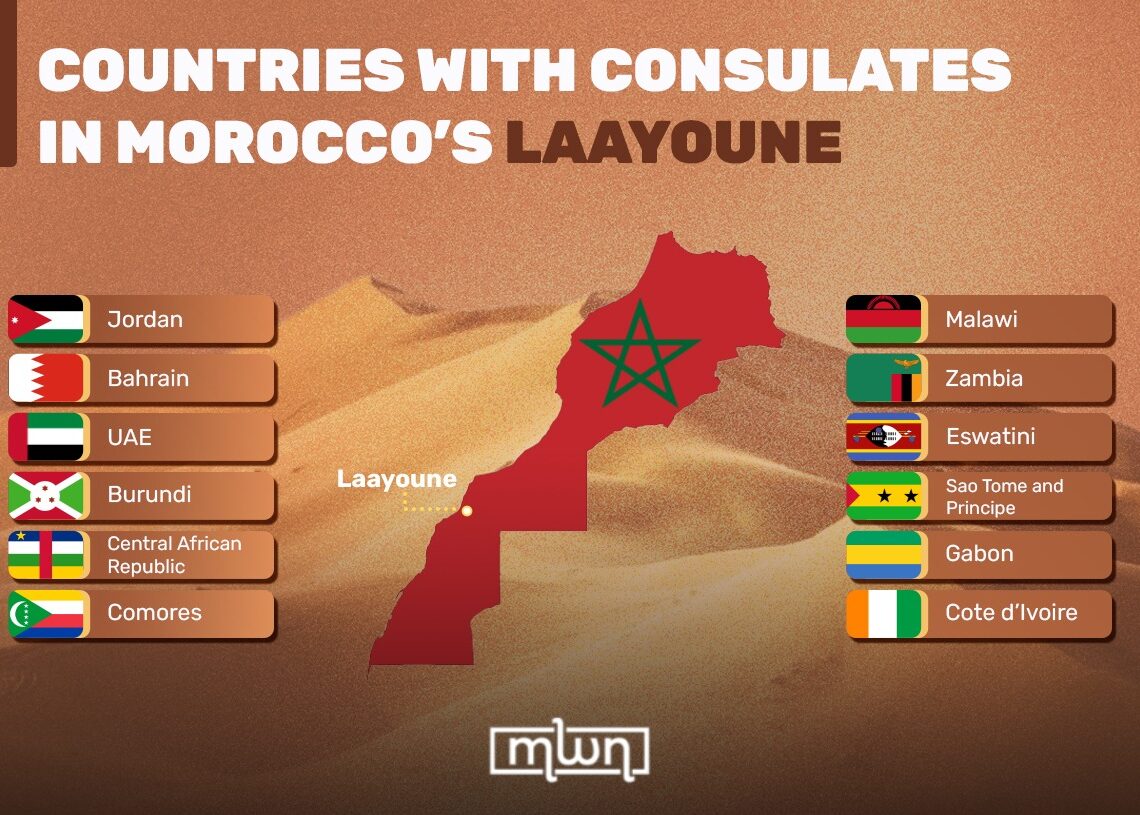
Laayoune hosts 12 consulates, including Comoros, Gabon, the Central African Republic, Sao Tome and Principe, Cote d’Ivoire, Burundi, Malawi, Eswatini, and Zambia.
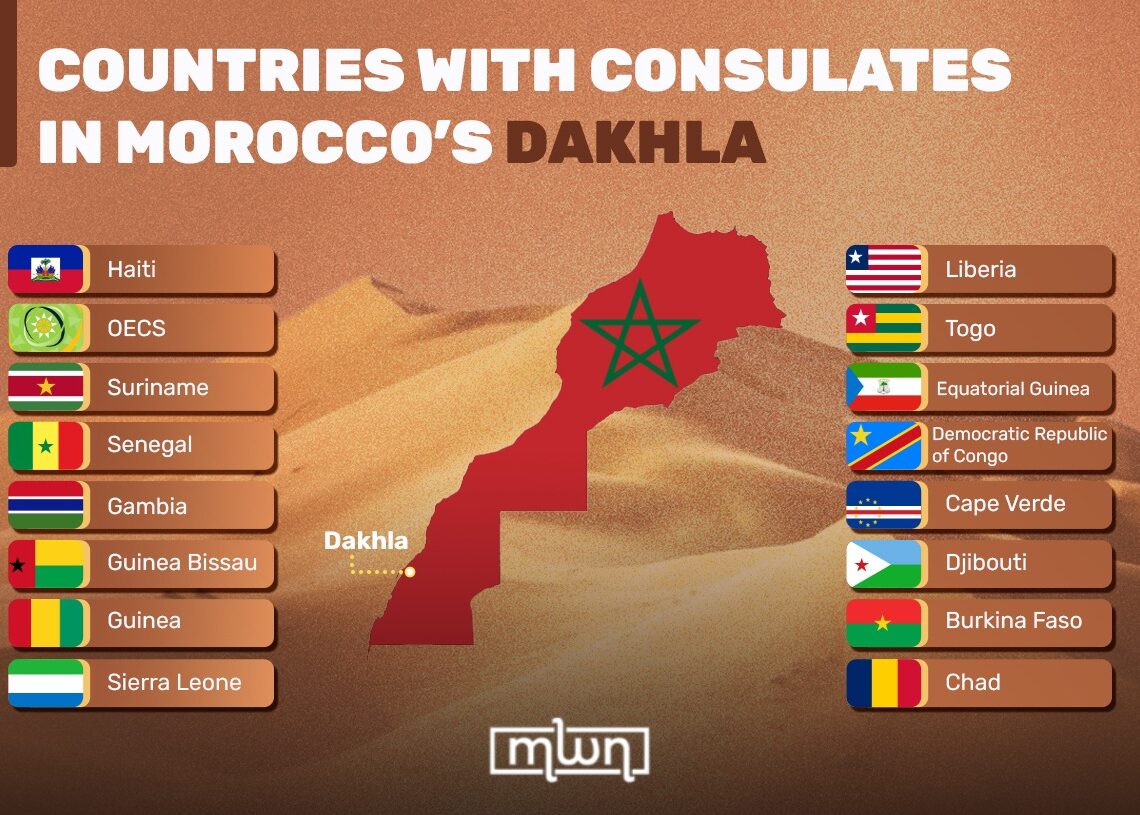
Dakhla is home to the diplomatic representations of many African countries, as well as others from other regions. The city is home to consulates of The Gambia, Guinea, Djibouti, Liberia, Equatorial Guinea, Guinea-Bissau, Burkina Faso, Chad, Cape Verde, Togo, Suriname, Sierra Leone, Senegal, as well as the Democratic Republic of Congo, and Haiti.
The momentum of consulate openings in Laayoune and Dakhla represents nearly 40% of African Union member states.
Countries with consulates in Morocco’s Laayoune and Dakhla
In Dakhla:
In Laayoune:
This is merely the list of countries that have opened their consulates, but those that are potentially following their fellow’s footsteps are numerous, as many others support the Moroccan autonomy initiative.
In May of this year, Kenya emphasized the importance of Morocco’s efforts, endorsing the autonomy initiative as the only credible and realistic solution to the dispute.
Kenya’s Minister of Foreign Affairs, Musalia Mudavadi, announced the decision during his visit to Morocco, welcoming the momentum led by King Mohammed VI in support of the Moroccan initiative.
In January, Ghana suspended ties with Polisario’s self-proclaimed SADR, joining the international community that endorses the autonomy initiative as the only viable political solution to the dispute in June of the same year.
African countries that share the same perspective to describe the autonomy initiative as a serious and credible political solution include:
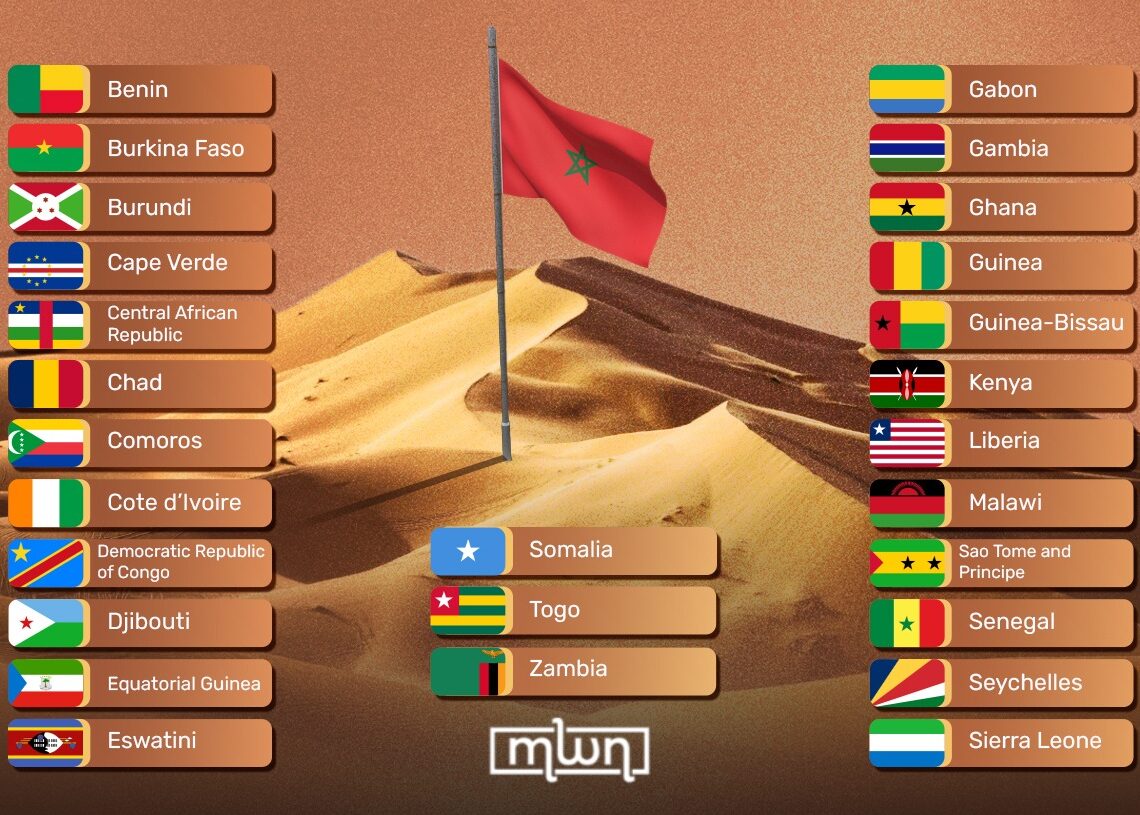
Arab support
A consensus is also shaping in the Arab world not only in North Africa but also the Middle East, where Morocco’s position has gained strength.
Many countries in the Arab world support Morocco’s integrity and sovereignty over its southern provinces in Western Sahara, including the GCC countries.
In the Gulf, the list includes Saudi Arabia, UAE, Bahrain, Kuwait, Oman, and Yemen, as well as Qatar, which all support Morocco’s territorial integrity.
Middle East and North African countries that back the Moroccan territorial integrity also include Egypt, Jordan, Lebanon, and Iraq. Many are now calling on Syria to join the chorus after the collapse of Bashar al-Assad’s regime, who allowed Polisario members to join the country’s military forces during his era.
Israel also explicitly recognized Morocco’s sovereignty over its southern provinces in July 2023. Many, however, have questioned the credibility of this stance, as it has made multiple anti-Morocco maneuvers, including displaying a divided map of Morocco on many occasions.
Asia support
Throughout the years, several countries in Asia have expressed support for Morocco’s autonomy proposal. However, further diplomatic efforts are needed to expand the number of nations backing this proposal.
Countries that support the national initiative in Asia include Cambodia, Azerbaijan, Kazakhstan, as well as Turkmenistan.
In South Asia, the Maldives backs the autonomy initiative as a basis for resolving the dispute, while in East and Southeast Asia, Japan and Singapore view the autonomy initiative as a serious and credible political solution to end the dispute.
Other major developments
Morocco’s autonomy initiative is also viewed as a serious and credible political solution by many countries that have traditionally leaned toward Algeria’s lobbying.
Most recently, Russia’s Foreign Affairs Minister Sergey Lavrov signaled a potential shift in his country’s position, stating the autonomy could be seen as a form of “self-determination.”
Earlier this month, he stated that his country could support the autonomy initiative if it is acceptable to all parties to the dispute.
Another significant development was the visit of Jacob Zuma, former South Africa President, to Morocco in June, during which he endorsed the autonomy initiative as the only political solution to the dispute and recognized Morocco’s sovereignty over its southern provinces in Western Sahara.
During the visit, the leader of Mkhonto weSizwe, also known as MK, announced his party’s support for Morocco’s position, sparking frustration not only among South Africa’s Ramaphosa administration but also Algeria and Polisario.