


 Join on WhatsApp
 Join on Telegram
Conflicts do not arise by chance, but from root causes, some concrete such as territorial disputes or power rivalries, others more abstract such as ideological differences or identity tensions.
The territory remains at the core of prolonged conflicts, much more than power or economic interests, as for the resolution, it is rarely immediate; it depends on major changes in the decision-making structures of the protagonists, such as a change of regime, at the diplomatic level, at the strategic level (a new international order) or even the depletion of the resources of one of the protagonists.
Some so-called “frozen” conflicts, inherited from decolonization and the post-USSR period, are characterized by the absence of a lasting political settlement despite the cessation of hostilities, they persist in a state of latency, reflecting an unstable balance of divergent interests. In light of game theory, they can be interpreted as Nash equilibrium conflicts where each actor prefers to maintain the status quo rather than risk a costly and uncertain escalation.
Although the Sahara conflict has some features of frozen conflicts, it is fundamentally different from them by its nature: first, it is indeed a conflict of decolonization of the Saharan provinces claimed by Morocco since forties by late King Mohammed V (notably in the late monarch’s speech in Mhameed Al Guizlane in 1958) and His Successor late King HASSAN II as part of the progressive completion of its territorial integrity (Tarfaya recovered in 1958, Sidi Ifni in 1969 and the Sahara in 1975), historically fragmented by several colonial powers – Spain in the north and south, France in the center, while Tangier was placed under international status; secondly, a deep geographical, cultural and ethnic similarity links these provinces to the rest of the moroccan territory, giving this claim a robust legal, historical, identity and territorial legitimacy that is not shared by the other frozen conflicts, thirdly if the frozen conflicts stagnate, with the adoption of UN Security Council Resolution 2797 on October 31, 2025, Morocco breaks the Nash equilibrium and moves to a phase of strategic supremacy.
The convergence of the strategic interests of the great powers could play a decisive role in the dynamics and resolution of the “frozen” conflicts resulting from decolonization or the post-USSR period.
Often, the game of the great powers is associated with pivotal states or regional relays that stir up by proxy frictions and the processes of secession and disintegration of states.
In this context, it is worth recalling some of the stratagems frequently used by States sponsoring non-recognized entities, ranging from granting third-country citizenship to the populations concerned, a phenomenon known as “passportization”, to diplomatic support and infiltration into international organizations and conferences, or gradual recognition campaigns. In addition, there are more direct forms of support, such as financing, armament and political-military supervision.
The umbilical cord between client and boss often creates a relationship of vassalage for the unrecognized entity, which sees its diplomatic and political space for maneuver limited or even nil in the negotiation of a possible peace agreement, hence the relevance of negotiating with the sponsor the boss rather than with the vassalized entity.
Frozen conflicts largely transcend the legal framework, in particular the principle of the “right of peoples to self-determination”, often instrumentalized as a lever of influence or as a Trojan horse for hegemonic projects.
Rise in power, Royal diplomacy shift and international context
Since the outbreak of the war in Ukraine and especially since the advent of the Trump administration in the White House, we have witnessed very rapid geopolitical transformations that have impacted several “frozen conflicts” and civil crises (Nagorno Karabakh, Syria, in DRC in Africa, Cambodia and Thailand and to some extend India and Pakistan in Asia etc.) which have found a way to resolution, in particular thanks to the agreement between the great powers and adjustments in the regional balance.
For example, the Nagorno-Karabakh issue between Azerbaijan and Armenia, after decades of conflict, has seen a new chapter in 2023-2024 with Azerbaijani military superiority and comprehensive negotiations encouraged by the EU and the United States. These examples show that the freezing of conflicts can give way to arrangements influenced by great powers, opening the way to final solutions that are more pragmatic than purely legal.
– The conflict in the Moroccan Sahara is an exemplary illustration of the tension between the principles of international law and contemporary geopolitical realities. This dispute has undergone a major strategic turning point in favor of the Kingdom of Morocco since the presentation in April 2007 of the Autonomy Plan, hailed by the United Nations as a realistic, credible and lasting political solution. This diplomatic repositioning has been accompanied by massive investments in the southern provinces, a sustained development dynamic, and a growing recognition of Moroccan sovereignty, particularly through the opening of foreign consulates in Laayoune and Dakhla.
This path change led by HM King Mohammed VI, marks the transition from a diplomacy of management to a diplomacy of transformation. The Kingdom has adopted a global approach diplomacy, breaking with the doctrine of systematic rupture with states recognizing the separatist entity (a kind of “Hallstein” doctrine) and putting an end to the policy of the empty chair within the African Union.
Indeed, Morocco’s new diplomatic strategy, driven by HM King Mohammed VI, is based on a Smart Power approach, skillfully combining soft influence and firmness. It places the defense of territorial integrity at the heart of its priorities, in particular through the promotion of the Autonomy Plan for the Sahara. With its economic, military and cultural assets, Morocco asserts its status as a regional power. He deploys an all-out diplomacy and a resolute and firm line of conduct.
This transformation has resulted in a growing recognition of its sovereignty over its Sahara and a significant strengthening of its influence on the regional and international scene.
This would not have been possible without the Kingdom’s rise to power, the analysis of quantitative and qualitative data reveals that relative power seems to play a crucial role in diplomatic supremacy; a positive correlation has been observed between the growth of Morocco’s power (measured by the Composite Index of National Capability -CINC -) and the Kingdom’s influence index in Africa in particular.
As matter of fact, since 2016, relative power indicators indicate a change of course: Morocco enjoys a strategic advantage over Algeria, both in terms of diplomacy, economic and military power. This shift coincides with the broadening of international support for his autonomy plan and the gradual marginalization of the separatists.
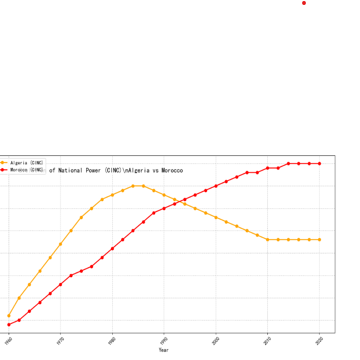
The CINC data reveals a definitive structural shift of national power in North Africa, where Morocco has eclipsed Algeria as the region’s dominant force around 2004/2005; it reveals a historic reversal in the Algeria-Morocco power dynamic. Following Algerian peak around 1990 (~0.0025), its continuous decline and Morocco’s steady progress led to a parity around 2002-2003. The most recent data confirms that Morocco has now surpassed its rival, with a CINC estimated at 0.0014 versus 0.0011 for Algeria in 2024.
This reversal, driven by Moroccan economic diversification and Algeria’s persistent dependence on hydrocarbons, marks a lasting structural change in the strategic balances of power in Maghreb region.
Moreover, it should be stressed that the perpetuation of the Sahara conflict, despite the transition from the Cold War to a détente between the great powers after the fall of the Berlin Wall, can be explained to a large extent on the one hand by the fact that this conflict is at the heart of a regional leadership rivalry in which Algeria wants to set itself up as the hegemon of the Maghreb and on the other hand by the latent function of the conflict and the rivalry with Morocco as a political regulator and internal legitimation for Algeria; the event-based analysis shows a strong correlation between the internal crises of the Algerian regime and escalations with Morocco from the 1963 war to the Hirak of 2019 followed by the diplomatic rupture in 2021.
As concerns military power game, Algeria and Morocco has tried to prove their superiority respectively without crossing the red line of direct conflict (we witnessed direct hostilities in only few cases during Sand war 1963 and Amgala 1&2 in 1976). Our empirical analysis of arms race between this dyad from 1975 till 2024 (based on dyadic simulation of Lambelet & Richardson’s arms race equations) reveals first that three distinct phases characterize this relationship: the intense Sahara conflict period (1975-1989) with peak tensions in 1981 (4.5% for Algeria vs 2.5% for Morocco), the economic détente era (1990-2015) marked by reduced military budgets (2.00% vs 1.40%), and the recent diplomatic crisis (2016-2024) featuring renewed tensions (3.71% vs 2.79% at equilibrium.
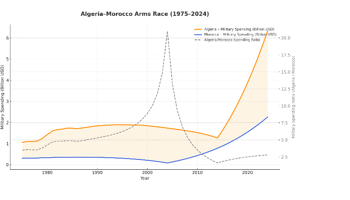
The fascinating finding of arms race is the fact that Algeria, with its economy twice as large, spends an average of 2.65% of its GDP on arms compared to only 1.20% for Morocco, however, Morocco is proving to be more efficient in the use of its resources, obtaining a better security “return on investment”, in other words despite spending 2.2 times less, Morocco achieved an efficiency of 0.2215 compared to 0.1847 for Algeria.
A quantitative analysis covering six decades of Algerian-Moroccan tensions highlights a revealing observation: the rise of Algeria is a determining factor in the fueling of hostilities. The data speak for themselves: the correlation between the increase in Algerian power and the intensification of the conflict directed towards Morocco reaches 0.55, compared to only 0.38 in the opposite direction. In other words, the stronger Algeria becomes, the more tensions are exacerbated, while the impact of Moroccan power on the conflict dynamic remains relatively moderate. This asymmetry is largely explained by the approach of the Kingdom of Morocco, embodied by HM King Mohammed VI, which favors international legality, strategic restraint and the policy of the outstretched hand. Morocco is thus converting its power into soft influence, thus consolidating its regional geopolitical position while avoiding military escalation.
The Moroccan Autonomy Plan, a Game Changer
Resolution 2797, adopted by the United Nations Security Council on October 31, 2025, marks a historic turning point in the Sahara conflict by enshrining the Autonomy Plan under Moroccan sovereignty as the only serious, credible and lasting basis for negotiation, it puts an end to a dispute frozen for more than half a century.
According to legal doctrine, any autonomy arrangement presupposes that a sovereign State voluntarily agrees to share, within a constitutional framework, part of its political, economic and cultural powers with an infra-State entity. It is a mechanism for balancing national unity and diversity within the framework of a decentralized unitary state.
On the legal level, the Sahara issue will migrate, nolens volens, from the perspective of pure international law to a logic of advanced regionalization of territorial autonomy governed by domestic constitutional law based on autonomy under Moroccan sovereignty.
In this perspective, the Moroccan autonomy plan is perfectly in line with the Moroccan Constitution of 2011; by proposing an autonomous region with specific competences, but integrated into the sovereignty and constitutional order of the Kingdom of Morocco where the Central State retains its regal, monetary and religious prerogatives and shares some prerogatives, inherent in local affairs, with the autonomous region which is represented at the international level by the central State.
Morocco’s autonomy plan, an opportunity for the entire region
The autonomy plan proposed by Morocco is part of an ambitious geostrategic vision, that of the revival of the “Greater Maghreb”, as reaffirmed by HM King Mohammed VI in his speech to the Nation on October 31, 2025. Faced with the paralysis of the Arab Maghreb Union (AMU), undermined by Algerian-Moroccan rivalry, the UN’s recognition of the Autonomy Plan as the only serious and credible basis for negotiation is a historic opportunity to overcome antagonisms and initiate a dynamic of regional integration. This revival could be based on a new functional approach to regional integration around structuring and pragmatic projects in the fields of logistics, transport, energy, extractive industries and mining, etc. , in perfect symbiosis with the Kingdom’s Atlantic strategy, which is centered around three concrete initiatives: the Atlantic African States Process (AAEP), the initiative to open access to the Atlantic for the Sahel countries and its corollary, the Dakhla-N’Djamena corridor and the Nigeria-Morocco gas pipeline. These initiatives could make Morocco’s Saharan provinces an industrial and logistics hub but also a heaven of peace and prosperity in a region plagued by insecurity.
By transforming a conflict into a lever for cooperation, the Autonomy Plan goes beyond the national framework: it therefore offers a perspective of shared development for the whole of the Sahel and West Africa, by promoting connectivity with the rest of the world, collective security and regional economic integration.
I will conclude my remarks by referring to the functionalist and neo-functionalist theory of peace, developed by David Mitrany and Ernst Haas, in the context of the realities after the two world wars. These approaches argue that the economic integration of rival states into shared community spaces is one of the most effective ways to reduce tensions and prevent conflicts. By promoting cooperation in technical and sectoral areas, this dynamic makes it possible to replace the logic of power with governance based on common international public services. The gradual and cumulative process of integration is based on the “spill over” mechanism: States engaged in sectoral cooperation are naturally led to extend their collaboration to other areas. In this way, regional integration becomes a vector of lasting peace, strengthening collective prosperity and reducing territorial antagonisms.
The adoption of Resolution 2797 by the United Nations Security Council marks a decisive turning point whose impact would go far beyond the framework of the Sahara. By enshrining the Moroccan Autonomy Plan as a serious, credible and lasting political solution, it is paving the way for a profound geopolitical reconfiguration, based on stability, interconnection and development. From the Atlantic to the Sahel, this resolution ushers in a new era of regional cooperation, collective security and shared prosperity. The Kingdom of Morocco is more than ever a central player, a catalyst for an inter-African continental dynamic.


