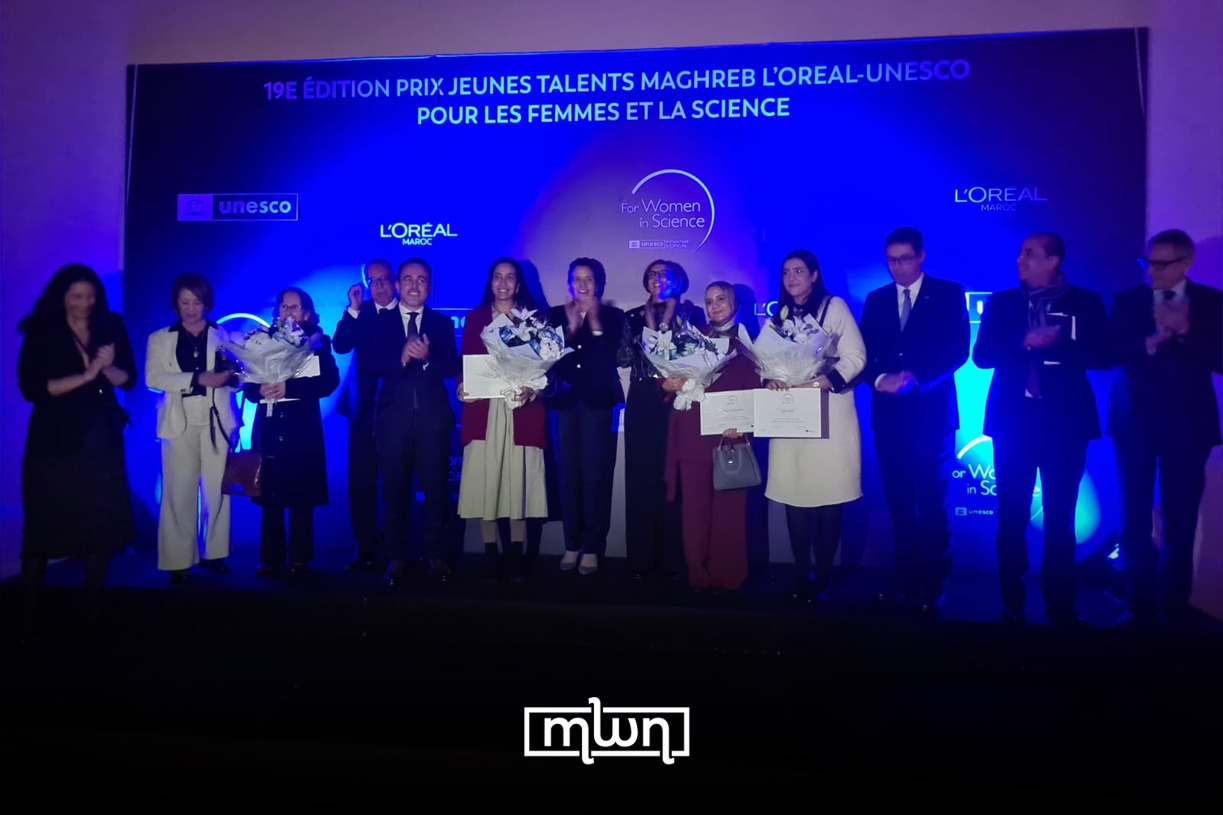
Rabat – L’Oréal-UNESCO held the 19th edition of their program “For Women in Science” in the Maghreb region at the Mohammed VI Polytechnic University (UM6P) campus in Rabat on Monday.
The ceremony honored five women as this year’s laureates. The winners are all from North Africa, including three Moroccans, one Tunisian, and one Algerian laureate. Each winner received a cash prize of €10,000 to help them in their future endeavors in their respective fields of scientific research.
Meet the laureates
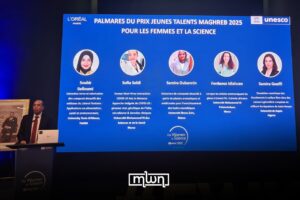
Ferdaous Idlahcen, laureate from the Polytechnic University of Mohammed VI, was recognized for her research regarding the detection of genetic mutations by analyzing images with the help of artificial intelligence. Her research seeks to optimize treatments for genetic diseases like cancer.
Unlike the traditional genetic tests, this method would be faster, more effective, and economical, making it accessible for many patients. Ferdaous hopes that her research will contribute to all patients in the African continent in need of better, more affordable treatments.
Sofia Sehli, laureate from Mohammed VI University of Health Sciences, investigates human host-virus interactions, especially in the context of Morocco. Through her project, Sofia hopes to better understand the genomic, microbial, and clinical determinants of COVID-19 in the country.
Samira Oubannin, laureate from the University of Ibn Zohr, was recognized for her work regarding the extraction of bioactive compounds from medicinal plants to enrich cosmetic products. Through her project, Samira hopes to contribute to making natural cosmetic products of better quality.
Tunisian laureate Souhir Belloumi, from the University of Tunis El-Manar, has worked on green extraction and the valorization of bioactive components within jellyfish on the Tunisian coast. She also seeks to destigmatize the general perception of jellyfish as “harmful creatures.” Her research proved that jellyfish are an underestimated source of bioactive components like collagen, mucins, and antimicrobial compounds.
Samira Gouffi was the Algerian Laureate from the University of Bejaia. Her research seeks to produce a 3D model that produces an accurate simulation of the breach waves of dams that generate rapid water flows, enabling the scientists to anticipate real and extreme flow conditions.
Women of STEM in Morocco and North Africa
The event also emphasized the importance of women scientists. Statistics provided by UNESCO have shown that North Africa is in dire need of women scientists; Moroccan women only account for 34% of scientific researchers worldwide, 40.5% of whom are in the field of health and well-being.
Notably, however, 47% of the Algerian researchers are female, while Tunisia counts 31% females in their population who are involved in scientific research.
Leila Benali, Minister of Energy Transition and Sustainable Development, has stated in her opening speech, “We can not allow the exclusion of half of the population. It is a luxury that we can not afford, especially in sectors that don’t allow that, like energy, the environment, all these sectors that today are at the heart of great economic and social transitions.”
The minister also added that young women should “break the roof made of glass,” alluding to shattering the traditional and classical stereotypes regarding women.
In a separate statement, the representative and head of UNESCO in the Maghreb region, Charaf Ahmimed, stated, “The fact is that women are still under-represented in sciences, there is much to do, and UNESCO has been working in this field for many years at different levels. We are also working on developing public policies and mentorship, like the program of UNESCO and L’Oréal.”
Representatives of the UNESCO-L’Oréal partnership and UM6P expressed that the world is in dire need of women in science who should not only stand behind the microscope, but also operate with compassion and genuine vision for a better world for both men and women.
Leila Benjelloun, head of L’Oréal in Morocco, stated in her speech that “women bring counter perspectives, they work on different problems in different ways, with different angles.” She added that the female laureates’ projects not only seek to heal and protect, but also seek to change lives.
An inspiration for young women
The event served as proof to young African women that they have a rightful place in the world of science and that determination is all they need to flourish as scientific researchers. The president of UM6P, Hicham El Habti, though not phyisically present, expressed through his online speech how female students at the university have been excelling in different fields.
He also honored the female Tunisian scientist Fatima El Fihriya, known as one of the earliest ambassadors for knowledge on the African continent. She is mostly known for founding the University of Al-Quaraouiyine in Fez, Morocco, in 859 CE, which is recognized by UNESCO as the oldest continuously operating university. The example sought to show the power African women of STEM hold.
The UNESCO-L’Oréal fellowship program, which has been running for 27 years, represents the persistent efforts of both organizations to give visibility to young female scientists. It is a stepping-stone towards a future where women have better opportunities and tools in the science field, especially in North Africa.