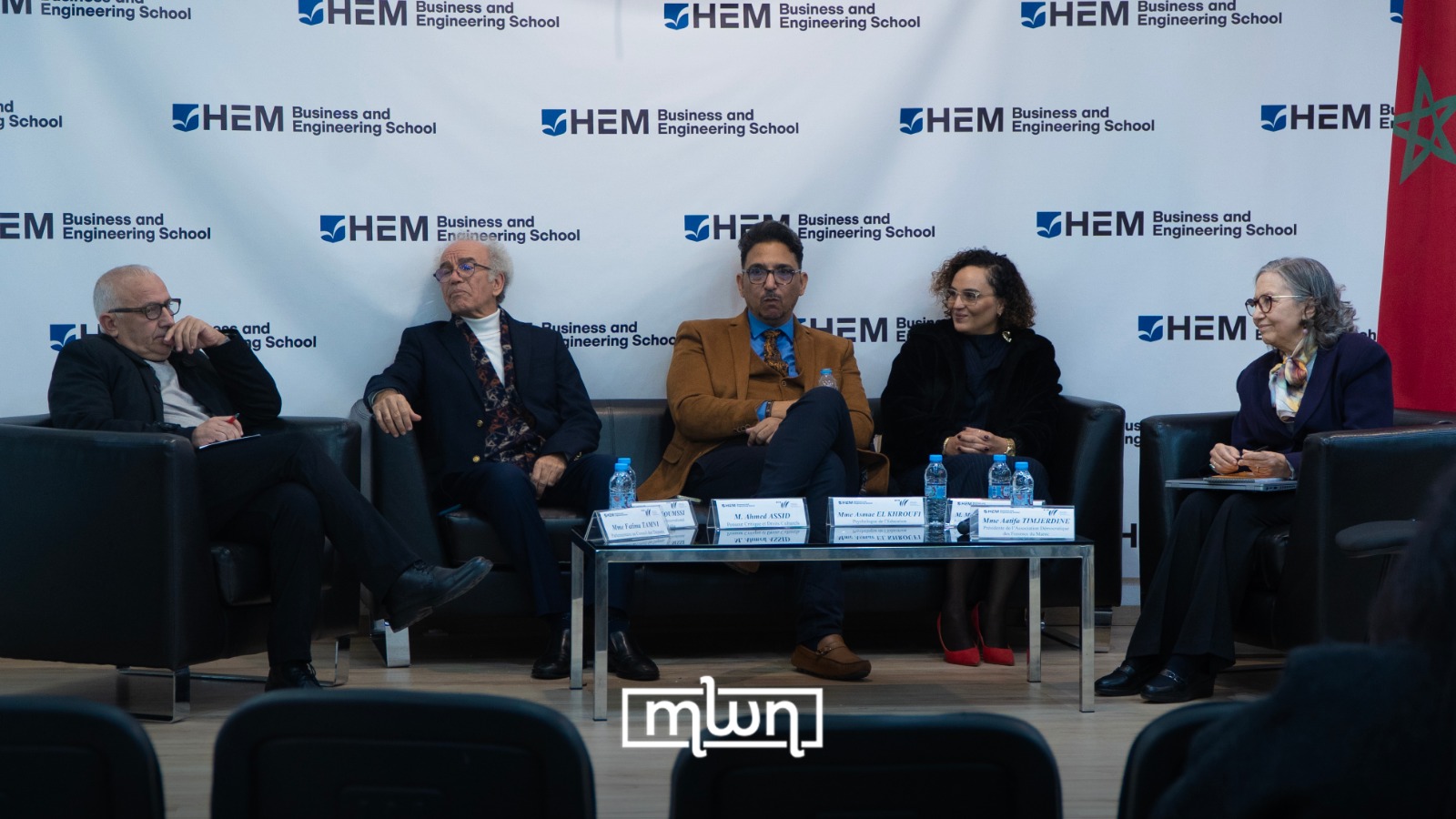
Rabat – HEM Rabat hosted a public debate yesterday, bringing together a diverse panel of Moroccan thinkers and public figures to discuss how national values are evolving in a period of accelerated social transformation.
The panel included writer and rights advocate Ahmed Assid, MP Fatima Tamni, reformist scholar Mohamed Abdelouahab Rafiki, women’s rights leader Aatifa Timjerdine, media specialist Said El Khoumssi, and educational psychologist Asmae El Khroufi.
Organized in partnership with the Moroccan Forum of Young Journalists, the event examined how coexistence, civic culture, and public dialogue can adapt to the country’s changing social landscape.
Assid focused his remarks on what he described as a widening gap between the values Moroccans claim to uphold and the behaviors they practice.
He argued that while Moroccan society has undergone significant socioeconomic shifts, the awareness required to accompany these transformations has not grown at the same pace. The result, he said, is a visible disconnect between thought and action.
“People say things they don’t act upon, and what they actually do is not what they talk about,” Assid explained, attributing this misalignment partly to long-standing shortcomings in education and civic preparation.
A debate rooted in Morocco’s real transitions
Morocco’s current social moment is often described by researchers as transitional. The country has expanded schooling, invested in digital connectivity, and seen rapid urbanization reshape family life and aspirations.
Yet, as the UNESCO Spotlight Report on Morocco notes, the education system — the core institution responsible for transmitting values, civic habits, and essential life skills — faces a mismatch between ambitious national reforms and the realities on the ground.
The report stresses that the country is “at a pivotal moment” in its educational development, with reforms aimed at strengthening foundational learning and citizen formation.
However, it also highlights persistent gaps: directors spend much of their time on administrative work rather than pedagogical leadership, family engagement remains uneven, and many schools struggle with limited resources and territorial disparities.
These challenges show that while Morocco has established strong value-based frameworks — equity, citizenship, equal opportunity — the translation of these principles into everyday schooling remains uneven.
This gap between intention and implementation mirrors Assid’s argument about a broader societal disconnect.
For him, rebuilding civic awareness and maintaining a national culture of discussion are essential steps toward reducing the fragmentation he observes between what Moroccans believe they stand for and how they engage with one another daily.
In the end, the debate at HEM Rabat highlighted more than a clash of ideas — it exposed a deeper tension Morocco is now being pushed to confront.
Assid warned that without stronger civic formation and a renewed culture of dialogue, the gap between declared values and lived behavior will continue to widen.
The UNESCO Spotlight Report reinforces this concern, noting that Morocco’s education system is itself in transition. As the country acknowledges the need for reforms, ambitious policies aimed at strengthening foundations and citizenship often struggle to translate into day-to-day practice.
Read also: Young Moroccans Want to Move Abroad, But They Can’t Find the Visas