
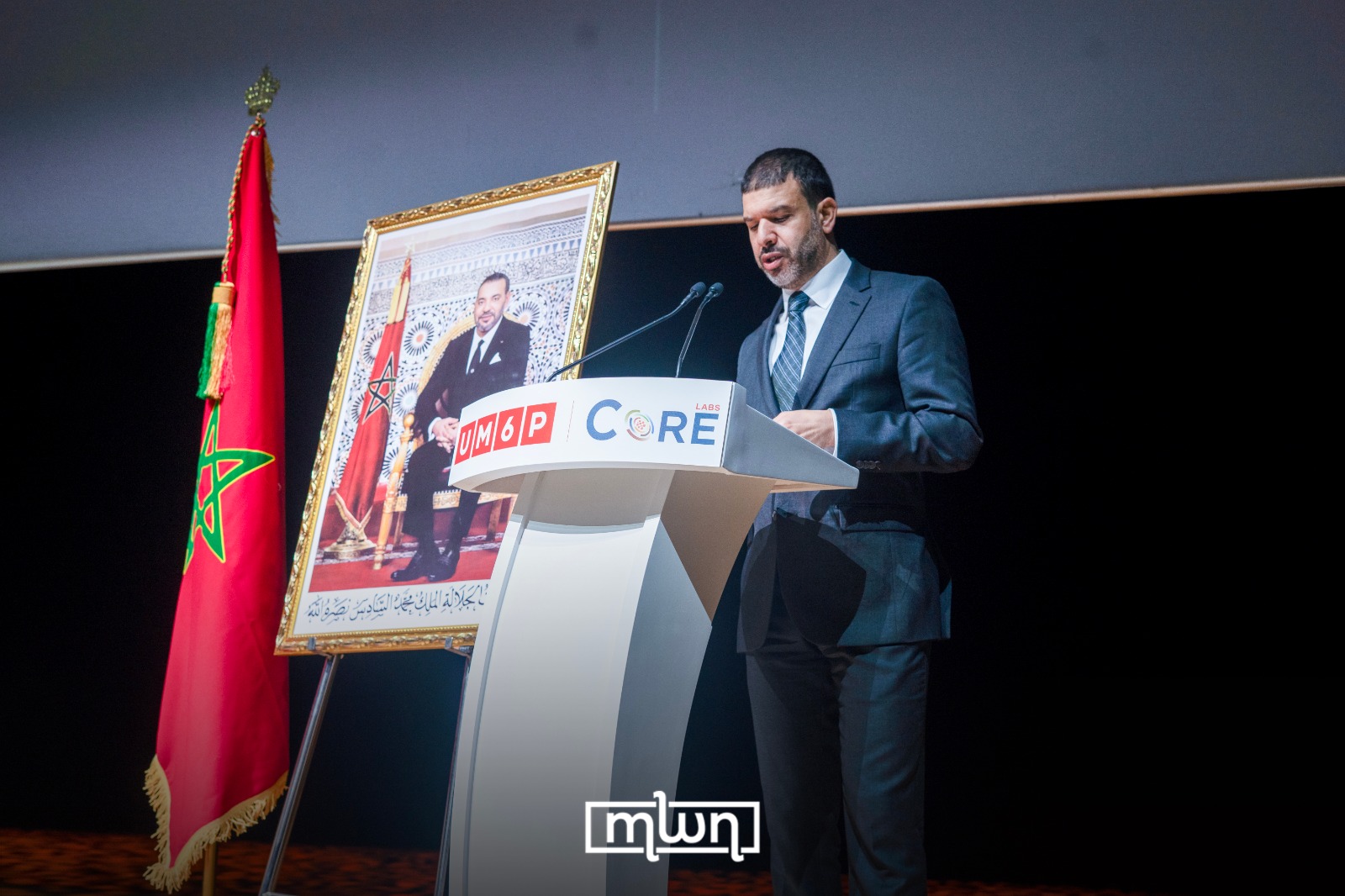
Marrakech – Mohammed VI Polytechnic University (UM6P) inaugurated today the UM6P CoreLabs, a multidisciplinary scientific infrastructure designed to transform the continent’s capabilities in research, innovation, and high-level training.
Located on the university’s Benguerir campus, the CoreLabs represent a decisive milestone in advancing Africa’s scientific sovereignty, strengthening local value creation, and deepening the continent’s participation in global knowledge networks.
Rooted in an understanding that scientific competitiveness increasingly depends on access to advanced infrastructures, data integrity, and analytical capacity, the CoreLabs address a long-standing structural challenge: many African researchers historically relied on facilities abroad, facing restricted access, extended delays, and loss of control over sensitive data.
With this new ecosystem, UM6P offers an integrated environment where all stages of research, from observation to experimentation, analysis, and validation, can be conducted locally according to international standards.
Three pillars of scientific excellent
The CoreLabs are built around three advanced platforms: Imaging & Characterization, Biosciences, and Analytical Chemistry, each equipped with technologies rarely available on the African continent.
Imaging & Characterization CoreLab: This platform provides access to state-of-the-art instruments such as a Transmission Electron Microscope (TEM) and a Focused Ion Beam (FIB) system, enabling nanometric-scale imaging and deep structural analysis.
These capabilities open new horizons in advanced materials, clean energy technologies, precision agriculture, and health research, bridging the gap between fundamental inquiry and industry-ready innovation.
Biosciences CoreLab: With high-throughput sequencing systems and advanced 3D cellular imaging, the Biosciences CoreLab brings unprecedented capacity to decode complex biological systems.
From single-cell analysis to full genome sequencing, this platform will accelerate breakthroughs in precision medicine, biotechnology, genomics, and food security, while ensuring that critical biological data is generated and retained within Africa.
Analytical Chemistry CoreLab: Dedicated to environmental and resource analytics, this CoreLab provides fine-scale detection of pollutants, trace metals, and emerging contaminants in water, air, soil, and food systems.
Its tools convert complex chemical data into actionable insights, supporting decision-makers, industries, and researchers working toward sustainable development and responsible resource management.
A strategic ecosystem for Africa: Beyond equipment, the CoreLabs embody UM6P’s vision of an integrated scientific ecosystem where academia, applied research, and industry converge to generate tangible socioeconomic impact.
The platform encourages interdisciplinary collaboration and strengthens partnerships across African universities, research centers, and industrial actors, positioning UM6P as a continental hub for innovation.
The new facility also complements the university’s broader research architecture, including Toubkal, Africa’s most powerful supercomputer, the Green Energy Park, which tests clean-energy technologies in real conditions, and StartGate and UM6P Ventures, which help transform scientific breakthroughs into market-ready startups.
A vision reinforced by leadership
In his address during the inauguration, the President of UM6P emphasized that the launch of the CoreLabs marks “a new step in a long journey” that began eight years ago, when the university chose to redefine how knowledge serves society.
He highlighted that UM6P’s mission has always been driven by a conviction: science must be rooted in Africa’s realities and designed to address the continent’s most urgent challenges, from soil protection and resilient agriculture to advanced materials, biotechnology, and the energy transition.
While UM6P’s researchers have long demonstrated excellence, he noted that the lack of complex scientific instruments within Africa constrained the pace and depth of certain discoveries.
“The CoreLabs close that gap,” he said, enabling scientists to test, validate, and accelerate their work with the precision required for frontier research.
He highlighted that curiosity remains central to UM6P’s academic culture, but it is a curiosity anchored in real-world needs, demonstrated in research projects spanning drought-resilient crops in Rhamna to salt-tolerant agriculture in Laâyoune.
He also paid tribute to the teams who built and operationalized the CoreLabs, acknowledging their “patience, rigor, and commitment,” and expressing gratitude to the broader scientific community whose efforts laid the foundation for this expansion.
“Thank you for contributing, each in your own way, to a continent where knowledge is produced at home, for the benefit of our societies, and for the strength of Africa’s voice in the world,” he added.