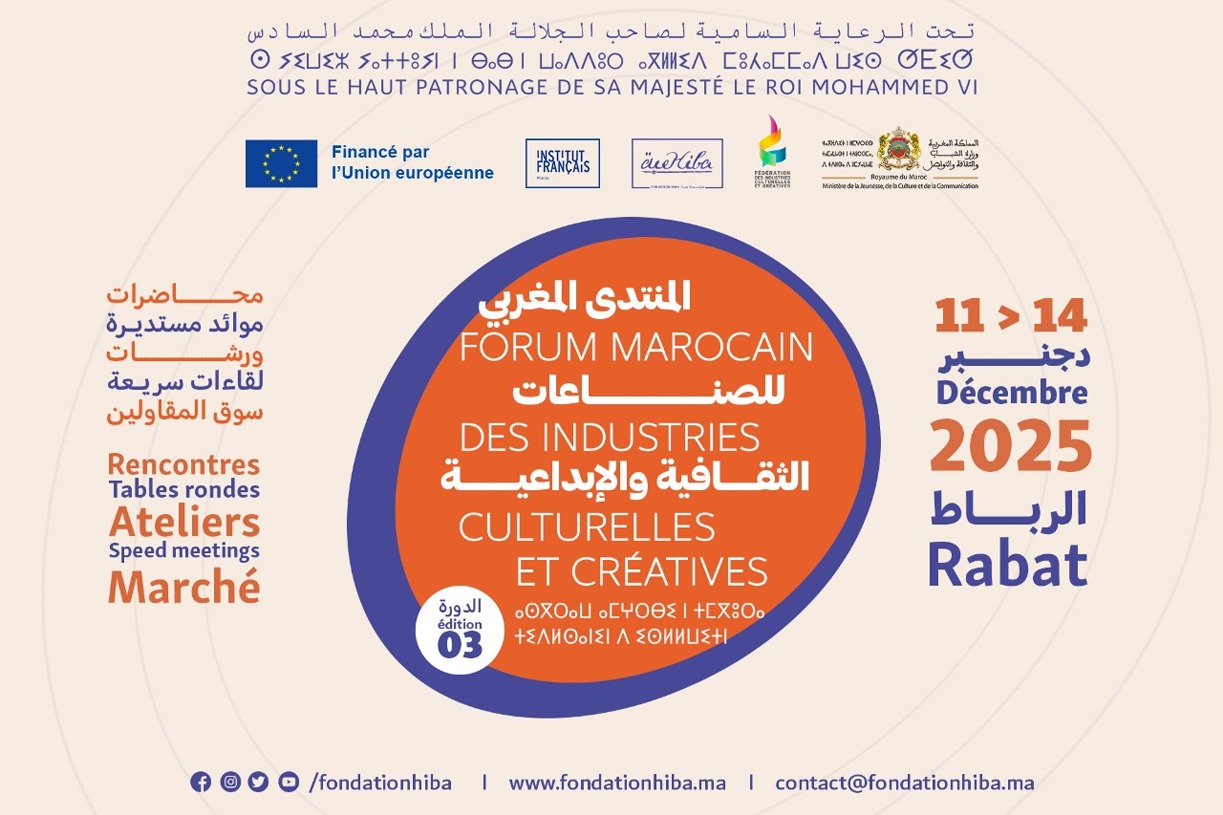
Mohammedia – The Moroccan Forum of Cultural and Creative Industries (FOMICC) opened on Thursday in Rabat for its third edition, bringing together professionals across the creative spectrum — from arts and design to crafts, digital innovation, and project incubation.
Held from December 11 to 14, the event is organized by the Hiba Foundation and unfolds at the newly inaugurated National Institute of Music and Choreographic Arts (INSMAC), a flagship cultural institution in the heart of the capital.
According to figures reported by the press, Morocco’s cultural and creative industries (ICC) generated nearly MAD 50 billion ($5.4 billion), surpassing 2.5% of national GDP.
The forum’s official documentation places the sector’s current contribution at around 2.7%, with a national ambition to reach 5% by 2030.
This year’s edition positions itself not only as a platform for discussion but as a catalyst for concrete action.
It comes at a time when Morocco is preparing for major global events — most notably the Africa Cup of Nations (AFCON 2025) and the 2030 World Cup, co-hosted with Spain and Portugal — presented as opportunities to showcase Moroccan and African creativity at scale.
Three strategic tracks to build a shared 2030 vision
The 2025 FOMICC program is structured around three major thematic tracks:
- Financing creative entrepreneurship
- Export, mobility, and access to markets
- African cooperation
- Sport and Culture
- Digital Arts, Video Games, and Animation
The financing track addresses one of the sector’s core weaknesses: limited public funding, risk-averse banking, and a fragile philanthropic culture. It highlights emerging alternatives such as impact finance, business angels, blended public–private models, and crowdfunding.
The export, mobility, and market access track focuses on boosting the international reach of Moroccan creativity. It explores how “Brand Morocco” can gain visibility across fashion, design, cinema, gaming, and digital arts, and stresses the importance of co-production, distribution, and creator mobility.
The African cooperation track examines how to move from a fragmented continental landscape to more structured alliances, shared advocacy, and integrated value chains across music, cinema, visual arts, and digital creation.
The sports and culture track looks at how ICCs can contribute to major events such as CAN 2025 and the 2030 World Cup, through fan zones, hybrid cultural–sporting experiences, audiovisual production, spatial design, and heritage-focused initiatives.
The digital arts, video games, and animation track explores the country’s emerging digital ecosystem, emphasizing the need for training, infrastructure, incentives, and market development, while encouraging the inclusion of Moroccan heritage in digital storytelling.
Strengthening local ecosystems and setting the stage for 2030
FOMICC’s opening day underscored the forum’s evolution into a true community space for Morocco’s creative sector.
Younes Boumehdi, President of the Hiba Foundation, described the gathering as a living ecosystem where ideas circulate, connections form, and long-term strategies take root.
That momentum is supported by ongoing groundwork across the country, where the Foundation has spent the past three years engaging with technoparks, regional investment centers, universities, artisans, and cultural actors to nurture local creative economies.
At the heart of this year’s program is the Kawaliss incubator, which brings together emerging entrepreneurs through a Creative Entrepreneurship Market, speed-meeting sessions, and hands-on workshops.
Across discussions spanning cinema, contemporary art, digital creation, data, fashion, and Saharan musical heritage, the forum aims to deliver concrete recommendations for policymakers and position Morocco’s cultural and creative industries as a decisive driver of economic, territorial, and continental influence by 2030.
Read also: Morocco’s Gaming Ambitions Take Shape With New Platform Showcasing Local Creators