 Join on WhatsApp
 Join on Telegram
Marrakech – Researchers have discovered fossil remains in Morocco that may represent one of the earliest stages of the human lineage, dating back 773,000 years ago. The findings, published today in the Nature journal, provide new evidence for the African origins of modern humans.
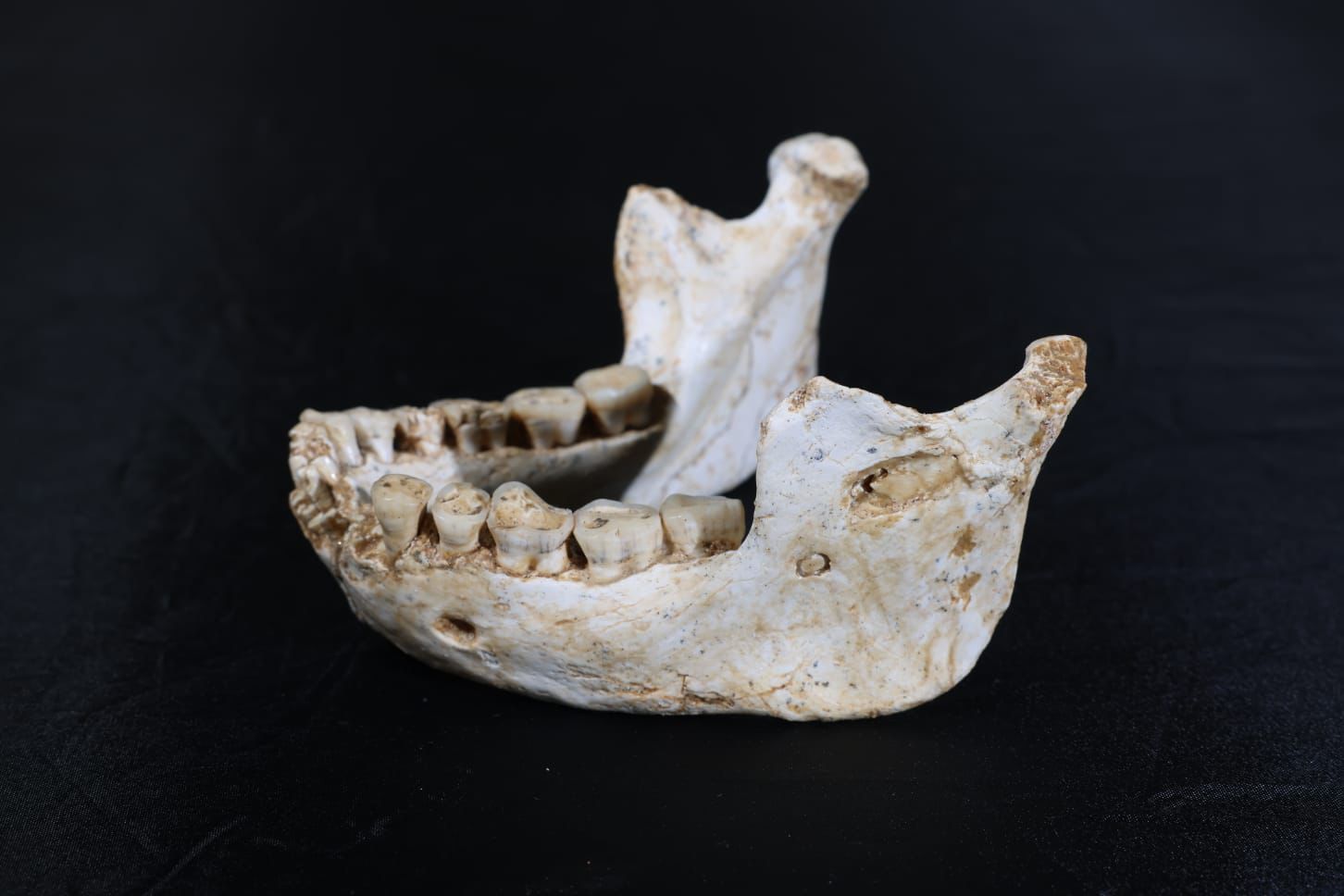
An international team led by Jean-Jacques Hublin excavated the fossils from Thomas Quarry I in Casablanca, Morocco. The specimens include two partial mandibles, several teeth, and vertebrae that offer crucial insights into human evolution during the late Early Pleistocene period.
The discovery challenges existing models about human ancestry. For decades, scientists proposed that Homo heidelbergensis served as the last common ancestor of modern humans, Neanderthals, and Denisovans. However, the Moroccan fossils suggest this ancestral lineage may be older and more complex than previously understood.
“The ThI-GH hominins provide insights into African populations predating the earliest H. sapiens individuals discovered at Jebel Irhoud in Morocco and provide strong evidence for an African lineage ancestral to our species,” the researchers write.
Three decades of systematic excavations
The research draws on systematic excavations at Thomas Quarry, a site with one of North Africa’s richest hominin records. The quarry, carved during a marine high stand and later filled by successive marine and continental deposits, contains multiple stratigraphic levels preserving a dense paleontological and archaeological archive.
The new study focuses on a limited number of fossil specimens recovered over the past three decades from Grotte à Hominidés, a cave within the quarry that gained prominence in 1969, when amateur collector Philippe Beriro uncovered a partial human mandible. That discovery first revealed the site’s hominin significance and prompted decades of scientific investigation.
Thomas Quarry encompasses two distinct archaeological zones. Its oldest area, known as ThI-L, has yielded one of the most extensive early Acheulean stone-tool assemblages in Africa, dated to approximately 1.3 million years ago, representing the earliest confirmed evidence of human toolmaking in northwest Africa.
The younger sector includes Grotte à Hominidés, where the newly analyzed hominin fossils were recovered.
Subsequent controlled excavations at the cave between 1994 and 2015 uncovered additional hominin remains, Acheulean tools, and a diverse faunal assemblage preserved in a secure stratigraphic context.
These modern investigations resolved earlier uncertainties caused by quarrying disturbances and firmly anchored the fossils within the Early-Middle Pleistocene record, allowing the site to assume a central place in debates on early human evolution in Africa.
Challenging previous theories
The fossils represent both adult and juvenile individuals. The fossil mandibles display a combination of primitive and derived characteristics.
The adult mandible ThI-GH-10717 belongs to a gracile, small-bodied individual with a long, low, and narrow corpus and a nearly complete dentition, though heavily worn. The second adult specimen, ThI-GH-1, represents a more robust individual with a partial mandible preserving teeth from the fourth premolar to the third molar.

The juvenile remains, designated ThI-GH-10978, belonged to a child who died at most 1.5 years of age. This fragmentary mandible provides valuable information about early human development. The calcification stages of the child’s deciduous and forming permanent teeth were analyzed using micro-CT scans to determine the precise age at death.
Eight vertebrae were discovered directly underneath the adult mandible ThI-GH-10717, including six cervical and two thoracic vertebrae. Their small size and close spatial proximity suggest they belonged to the same small-bodied adult individual. The vertebrae show morphological features more similar to Homo erectus than to recent human species.
The team used multiple dating techniques to establish the fossils’ age. Magnetostratigraphy analysis placed the remains close to the Matuyama-Brunhes transition at 773,000 years ago. The biochronological data, including 37 mammal species found at the site, supports this dating.
The fauna includes the last known occurrences of the hare Trischizolagus and the rhino Ceratotherium mauritanicum. These species indicate an early age consistent with the Early-Middle Pleistocene boundary.
The faunal assemblage demonstrates that the Sahara was not a permanent barrier during Early Pleistocene times due to recurrent expansion of savanna landscapes across North Africa.
The dental analysis reveals significant differences from contemporary European fossils. The molar size pattern follows M1 < M2 > M3, with strong reduction in the third molar. This pattern contrasts with Homo erectus but resembles later human species, including Homo antecessor, Homo sapiens, and Neanderthals.
Reinforcing evidence from 315,000-year-old Jebel Irhoud remains
The Moroccan specimens are similar in age to Homo antecessor fossils from Gran Dolina, Spain, dated between 950,000-770,000 years ago. However, the North African fossils show distinct morphological differences from their European counterparts.
“Regional differentiation between Europe and North Africa was already present by the late EP,” the researchers note. The Spanish specimens appear more derived toward Neanderthal morphology, while the Moroccan fossils align more closely with the human lineage.
The fossils were recovered from what appears to have been a carnivore den. The abundance of carnivores, numerous coprolites, and carnivore-modified bone remains lacking cut or chop marks, combined with the scarcity of lithic artifacts, point to the presence of a carnivore den. A portion of a femoral shaft shows evidence of scavenging by large carnivores, probably hyenas.
The findings support a pan-African model of human evolution rather than a single-origin theory. The fossils reinforce evidence from Jebel Irhoud, Morocco, where 315,000-year-old remains pushed back the earliest known Homo sapiens.
Genomic studies indicate early human populations had begun diversifying by at least 300,000 years ago. The Thomas Quarry discoveries extend this timeline further, suggesting the human lineage diverged earlier than conventionally assumed.
The discoveries affirm Africa as humanity’s origin
The research was conducted through the Moroccan-French “Casablanca Prehistory” program, involving institutional collaboration between Morocco’s National Institute of Archaeological Sciences and Heritage (INSAP) under the Ministry of Culture and France’s Ministry of Foreign Affairs. The project was co-directed by Abderrahim Mohib from INSAP.
The systematic excavations followed modern controlled methods with spatial data recording of all finds using total station measurements and 3D modeling techniques.
The dental morphology analysis used 3D landmark-based geometric morphometrics to study the enamel-dentine junction shape. The researchers examined multiple tooth positions and compared them to samples of fossil hominins as well as early and recent modern humans.
The anterior dentition shows gracile characteristics similar to modern humans, much smaller than other Early and Middle Pleistocene hominins.
The research team notes that neither the Moroccan fossils nor Homo antecessor can be considered the strict last common ancestor of modern humans and the Neanderthal-Denisovan clade. Instead, they represent closely related lineages positioned near the ancestral node at the onset of new evolutionary specializations.
“The morphology of the ThI-GH hominins places them close to the split between the African and Eurasian lineages,” the authors conclude.
“Our findings not only align with the phylogenetic structure inferred from palaeogenetic data but also highlight the Maghreb as a pivotal region for understanding the emergence of our species, reinforcing the case for an African rather than a Eurasian ancestry of H. sapiens.”
The discoveries add to growing evidence that human evolution began in Africa, with the Moroccan fossils offering crucial clues about the last common ancestor shared with Neanderthals and Denisovans.
The research continues to reshape understanding of when and where the human lineage first emerged, pushing the timeline of human ancestry further back than previously thought.
Read also: Moroccan Researcher Discovers New Ant in Chtouka Ait Baha, Names it After His Wife