
 Join on WhatsApp
 Join on Telegram
Agadir – Ai Everything MEA is set to bring together governments, startups, global tech companies, and investors on February 11-12 in Cairo to showcase advanced AI applications across sectors such as manufacturing, semiconductors, cybersecurity, and digital infrastructure.
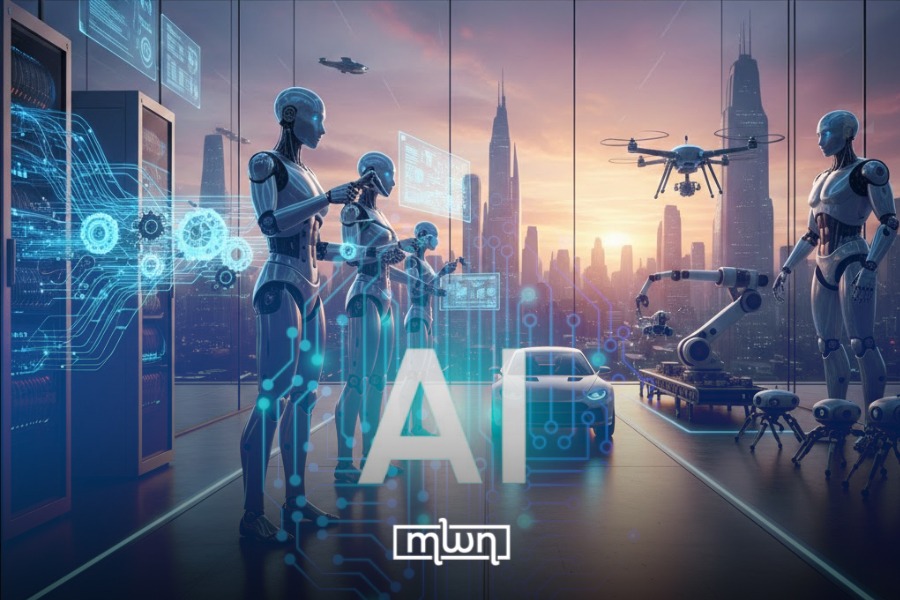
One of the key themes of the event is physical AI, covering robotics, humanoids, autonomous machinery, and self-driving technologies.
The conference aims to position the region as a major player in global AI development while supporting national digital transformation strategies and cross-sector technology deployment.
Artificial intelligence is moving beyond software into physical AI, this technology combines advanced machine learning with robotics, simulation and real-world interaction. The result is a generation of machines capable of perceiving environments, making decisions and performing physical actions with increasing autonomy.
From digital intelligence to physical intelligence
Physical AI refers to artificial intelligence systems that can operate and interact directly with the physical world, rather than existing solely as digital algorithms. While digital AI encompasses applications such as chatbots, recommendation engines, or data analytics platforms, physical AI extends these capabilities into tangible, real-world actions.
Unlike traditional generative AI systems that produce text, images or video, physical AI focuses on producing real-world actions through control of physical devices. This includes everything from industrial robots assembling products on factory floors to autonomous vehicles navigating complex environments, and even humanoid robots capable of mimicking human gestures or assisting in service settings.
Tech firms describe this shift as the embodiment of AI inside devices ranging from humanoid robots to factory equipment and autonomous vehicles, signaling a major evolution from purely software-based intelligence.
New industrial transformations
Physical AI is already reshaping manufacturing and industrial production. Advances in AI models, robotics hardware, and simulation tools are enabling machines to operate in dynamic and unpredictable environments while improving safety, efficiency and precision.
These systems differ from traditional industrial robots, which typically follow fixed instructions. Modern AI-enabled machines can learn through simulation, imitation and trial-and-error, allowing them to adapt to new tasks or environments with less human intervention.
According to leading technology company NVIDIA, the industrial landscape in the Middle East is undergoing a rapid transformation, with AI adoption accelerating faster than the early days of the internet. As the technology reaches a phase of maturity, experts are discovering new capabilities that could reshape almost every sector.
A key trend driving this shift is a “simulation-first” philosophy, in which products and processes are perfected digitally before reaching the factory floor. This notion is already being adopted in the Middle East’s past-paced development culture, where engineers are using high-fidelity digital twins to optimize movements, test scenarios, and refine performance in virtual environments.
By the time a robotic arm is installed in a facility in Abu Dhabi, it has already practiced its tasks millions of times, ensuring peak efficiency from day one and avoiding costly downtime or redesigns.
The convergence of AI with robotics is moving from experimental prototypes toward mass industrial deployment, marking a structural shift in how work is performed across sectors.
Humanoid Robots
Humanoid robots are increasingly viewed as a major milestone in physical AI development. Their human-like form allows them to operate in spaces designed for people, such as warehouses, factories and homes, without requiring major infrastructure redesign.
Industry analysis suggests that the combination of physical AI and humanoid robotics will support hybrid workforces where humans and machines collaborate, particularly as costs become more competitive with traditional labor models.
At the same time, advances in robotics foundation models are enabling machines to perform tasks they were not explicitly trained for, accelerating deployment across industrial and service sectors.
This shift is already taking shape in the Middle East. Humanoid, a UK-based AI and robotics company, recently launched the region’s first dedicated humanoid robotics showroom in partnership with QSS AI & Robotics, a Saudi company focused on localizing advanced technologies.
The initiative forms part of a broader strategy to accelerate the deployment of humanoid robots across key sectors in Saudi Arabia.
During the launch, HMND 01 Alpha Wheeled, the UK’s first industrial humanoid robot, performed live simulation and teleoperation tasks, which allowed attendees to engage directly with human-robot interaction through a “talk to a robot” experience.
Autonomous machinery and self-driving technologies
Physical AI is also accelerating progress in autonomous systems. New AI models can simulate complex physical environments and generate realistic scenarios used to train robots and self-driving vehicles.
These simulation-driven systems help machines learn how objects move, how environments change and how to respond safely to unexpected events, key capabilities for autonomous logistics robots, industrial equipment and driverless vehicles.
In autonomous driving specifically, AI systems are increasingly trained using synthetic data and physics-based simulations to improve decision-making and safety in real-world conditions.
As physical AI moves from controlled simulations to real-world deployment, the emphasis is moving from what the technology can do to how it can be applied at scale, safely, and efficiently.
AI Everything MEA serves as a timely platform for examining how these technologies translate into practical use cases, regulatory frameworks, and long-term industrial strategies, as the region seeks to define its role in the next phase of global AI developments.