 Join on WhatsApp
 Join on Telegram
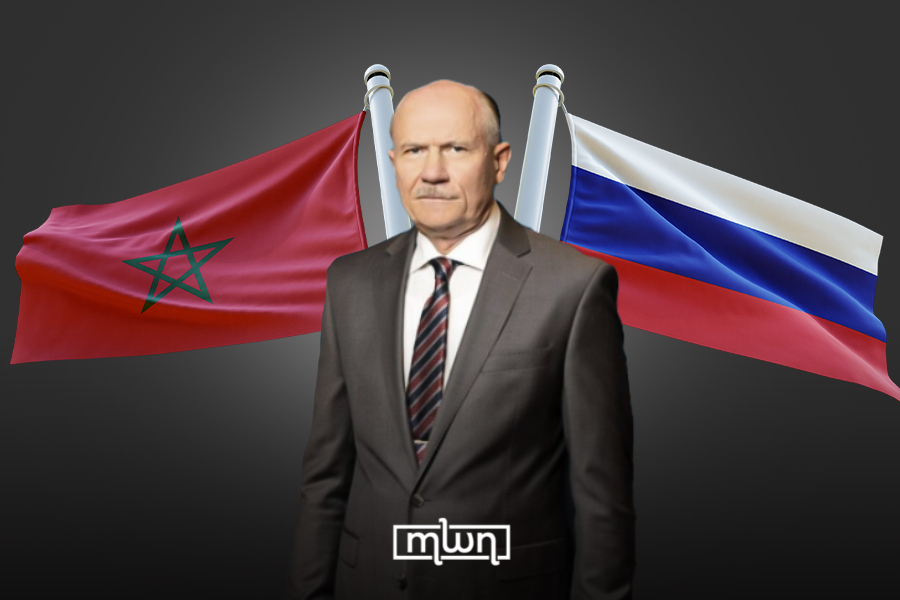
Marrakech – Russian Ambassador to Morocco Vladimir Baibakov said Western countries are attempting to push Russia out of the Moroccan market through sanctions. He made the remarks in a detailed interview with RIA Novosti published today on Diplomatic Workers’ Day.
Baibakov confirmed that bilateral trade between Moscow and Rabat maintains steady levels at $2 billion despite “Western anti-Russian sanctions.” He attributed this resilience to expanding bilateral trade relations and growing Russian business interest in the Moroccan market.
“Western countries shamelessly try to use sanctions to push Russia out of the Moroccan market,” Baibakov stated. He cited a specific example where the United States encouraged Morocco not to purchase Russian coal, replacing it with American coal that he said “smokes and pollutes the kingdom’s atmosphere much more than higher-quality fossil fuel from Russia.”
The ambassador noted that both countries understand these dynamics and work together in a spirit of strategic partnership to find solutions. He said this approach serves the national interests of “both friendly nations.”
Russia exports agricultural products, fertilizers, animal feed, pharmaceutical preparations, electrical equipment, and information technology to Morocco. Morocco primarily exports fruits, seafood, and fish to Russia. The Moroccan side shows particular interest in Russian technologies and investments in energy, infrastructure, and agriculture sectors.
Baibakov acknowledged that sanctions “create difficulties, especially in payment calculations.” However, he said both countries adapt to these restrictions while maintaining trade volumes.
Reflecting on his diplomatic career, the ambassador shared a formative experience from 1995 in Iraq. He worked as part of a UN Special Commission inspection team searching for prohibited missiles hidden by Saddam Hussein’s regime in the mountains of Mosul.
“I fully felt this under the starry sky of Iraq in distant 1995,” Baibakov recalled. “Then I clearly realized that diplomacy is not only a profession, but also a way of life, and in certain cases – a way of survival.”
Iraqi representatives refused to accompany their group due to fears of Kurdish inhabitants and scattered mines in the area. The diplomatic team overcame these challenges through negotiation skills and Arabic language knowledge.
The ambassador also recounted a successful intervention during his tenure as ambassador to Mauritania in 2013. Russian fishing vessels faced potential withdrawal from Mauritanian waters due to new unfavorable fishing regulations.
“I went to extreme measures,” Baibakov explained. He arranged a confidential meeting between the Mauritanian fisheries minister and his Russian counterpart, serving as translator. This informal approach proved successful, leading to a signed agreement that allowed Russia to resume fishing operations in Mauritanian territorial waters.
A global magnet for visitors
Regarding Moroccan citrus fruits, the ambassador noted their enduring popularity in Russia. “Mandarins bearing the ‘Maroc’ diamond were widely loved in the Soviet Union and considered an indispensable feature of New Year festive tables,” he said.
Despite growing competition from Abkhazia, Turkey, and Egypt, Moroccan citrus exports to Russia continue to increase, particularly ahead of the New Year and Christmas holiday season.
The ambassador hailed Morocco’s development under King Mohammed VI’s leadership, saying the country is “stable and developing successfully.” He pointed out that the kingdom welcomed a record 20 million tourists last year, representing a 14% increase from 2024. “For a country with 37 million inhabitants, this figure is huge,” he indicated.
Baibakov downplayed recent protests involving Generation Z in Morocco, describing them as “limited in scope compared to other countries.” He said disputed issues were “defused through dialogue,” preserving Morocco’s stability.
The ambassador recommended Marrakech as the ideal starting point for Russian tourists visiting Morocco, observing that “it is no coincidence the city has effectively become a Mecca for foreign visitors.”
He invoked Winston Churchill’s appreciation for Marrakech’s beauty, recalling that the former British prime minister’s 1943 painting of the Al-Koutoubia Mosque minaret sold for $12 million at a Christie’s auction in London. The ambassador added that “the beauties depicted in this painting, with all due respect to Winston Churchill, are far from the original.”
Baibakov also mentioned other attractive destinations, including Fez, Tangier, where the Atlantic Ocean meets the Mediterranean Sea, and Chefchaouen, known for its distinctive blue streets. He also described Rabat as “the city of storks – birds that value cleanliness, order, and open horizons.”
The ambassador advised Russian tourists to respect local customs in the Muslim country to ensure pleasant experiences filled with positive emotions only.
Morocco as a football power
Regarding football cooperation, Baibakov said Morocco has “fully deserved its status as a global football power,” a recognition recently shown by Gianni Infantino, President of FIFA. He stressed that this achievement is “largely due to the personal role of King Mohammed VI, who pays close attention to the development of football.”
Baibakov commented that football in Morocco is played “by almost everyone, almost always, and almost everywhere – by children and adults alike, in stadiums, courtyards, on the ocean shore, and year-round.”
The country’s recent hosting of the Africa Cup of Nations (AFCON) delivered “strong results” for the Moroccan side, he noted, casting light on Morocco’s preparations, together with Spain and Portugal, to host matches of the 2030 FIFA World Cup.
Baibakov expressed interest in arranging matches between Moroccan and Russian teams, including a potential encounter with Morocco’s national side, the Atlas Lions, and Russia’s national team (Sbornaya).
“In this context,” he said, “it would be interesting for Russia’s national team or a Russian club side to play against Morocco’s world-renowned football team. This is a good idea, and we will try to make it happen.” He added that such a match would contribute to the development of “our traditionally friendly relations, regardless of the result.”
Expanding beyond football, Baibakov also pointed to broader sports cooperation, noting that in January, Rabat inaugurated Africa’s largest Olympic ice complex, built to modern international standards. “We would be happy to welcome our hockey players and figure skaters here as well,” he said.
Baibakov concluded by emphasizing Morocco’s role in regional security, particularly in the Saharo-Sahel zone, and its active contribution to global counter-terrorism efforts through the regional division of the UN Office of Counter-Terrorism operating in the country.