
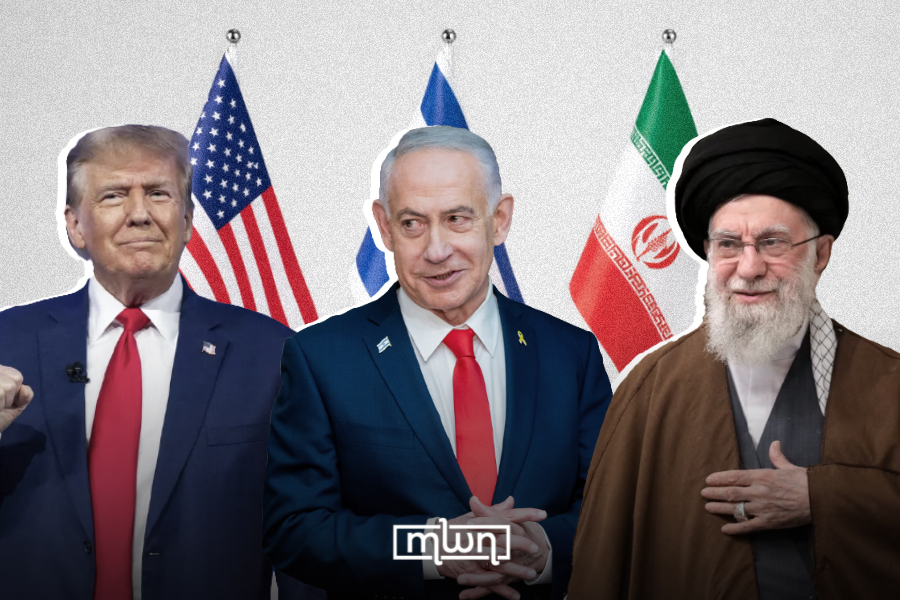
“Wars are conducted in the realm of politics; only their final scenes spill over into the battlefield.” This profound philosophical observation by the Egyptian writer Mohamed Hassanein Heikal aptly captures the delicate moments currently experienced in the Middle East. Today, Washington and Tehran seem closer to a military confrontation than at any time in the past, yet neither stands on the brink of war in the traditional sense.
This paradox has become increasingly evident in recent weeks. Statements by U.S. President Donald Trump calling for “regime change” in Iran have coincided with American military maneuvers suggesting preparation for operations that could extend over several weeks, while Iranian officials continue to insist they will not yield to pressure.
These developments cannot be understood solely through the lens of traditional U.S.-Iran tensions; they must also be viewed within a broader context, as the U.S.-Israel relationship heavily influences America’s approach to Iran.
Israeli Prime Minister Benjamin Netanyahu’s recent visit to Washington to meet with President Trump less than a week after the U.S.-Iran meeting underscores the importance of the Iranian file for Israel. This visit can be seen either as an expression of concern over a potential U.S.-Iran deal that may not satisfy all Israeli conditions, or as an effort to enhance coordination in the upcoming phase, given the shared interest in countering the “Islamic Republic” militarily, if necessary.
Even though Tehran appears willing to engage in dialogue to avoid confrontation, this would require significant concessions, including accepting the U.S. president’s four main demands: ending its nuclear ambitions, halting ballistic missile production, dismantling its regional proxies, and ceasing threats to Israel.
These are not minor details; they lie at the core of Israel’s national security vision. When Trump extends his rhetoric from simply “preventing nuclear enrichment” to “regime change,” it signals a shift from deterrence to reshaping the political environment in Tehran, a goal aligned with Israel’s long-term strategic vision.
Read also: Iran Says US Attack Would Drag Region Into War
Netanyahu sees Trump as a strategic partner who understands Israel’s perspective on Iran as the “primary existential threat.” This perception motivates Netanyahu to push Trump toward politically neutralizing Iran, dismantling its nuclear program, and crippling its military capabilities, including ballistic missiles.
Looking at these demands more closely, it is clear that Tehran’s compliance would essentially mark the beginning of the end of the Iranian project, returning Iran to political isolation and restricting its ambitions within its geographical borders.
Israel’s recent military strikes on Iran, despite damaging parts of the Iranian nuclear infrastructure, were insufficient to completely neutralize the nuclear program especially as most facilities are fortified underground and located in strategically difficult-to-reach areas. This is why Netanyahu exerts maximum pressure on Trump to terminate Iran’s nuclear ambitions.
At the same time, it would be an exaggeration to claim that Israel “controls” U.S. decisions. As a superpower, the United States has its own calculations. While Trump continues issuing verbal threats to Iran, his actions indicate a preference for testing diplomacy.
This alarms Israeli officials, who recognize that any limited nuclear deal that eases sanctions without addressing Iran’s regional military capabilities would constitute a serious failure for them. Consequently, Israel seeks to influence the White House to ensure that any settlement, if it occurs, is comprehensive and stringent.
Close political coordination between Washington and Tel Aviv may not directly create war, but it could raise the threshold of demands, making confrontation more likely. Any prolonged military escalation would likely extend beyond Washington and Tehran, potentially affecting Lebanon, Iraq, the Gulf, and even the global economy.
Overall, Israel’s influence on U.S. decision-makers does not mean it dictates policy outright; rather, it elevates ambitions and objectives from containing Iran to reshaping its behavior or even its political system. The remaining question is: to what extent can this influence push Washington from a policy of pressure toward open confrontation?