 Join on WhatsApp
 Join on Telegram
Marrakech – The United States is pressing hard to close one of the world’s longest-running territorial disputes before summer. Massad Boulos, Donald Trump’s special adviser for African and Middle Eastern affairs, has convened a new round of secret negotiations on Western Sahara for February 23 and 24 in Washington – the third such meeting in under four weeks.
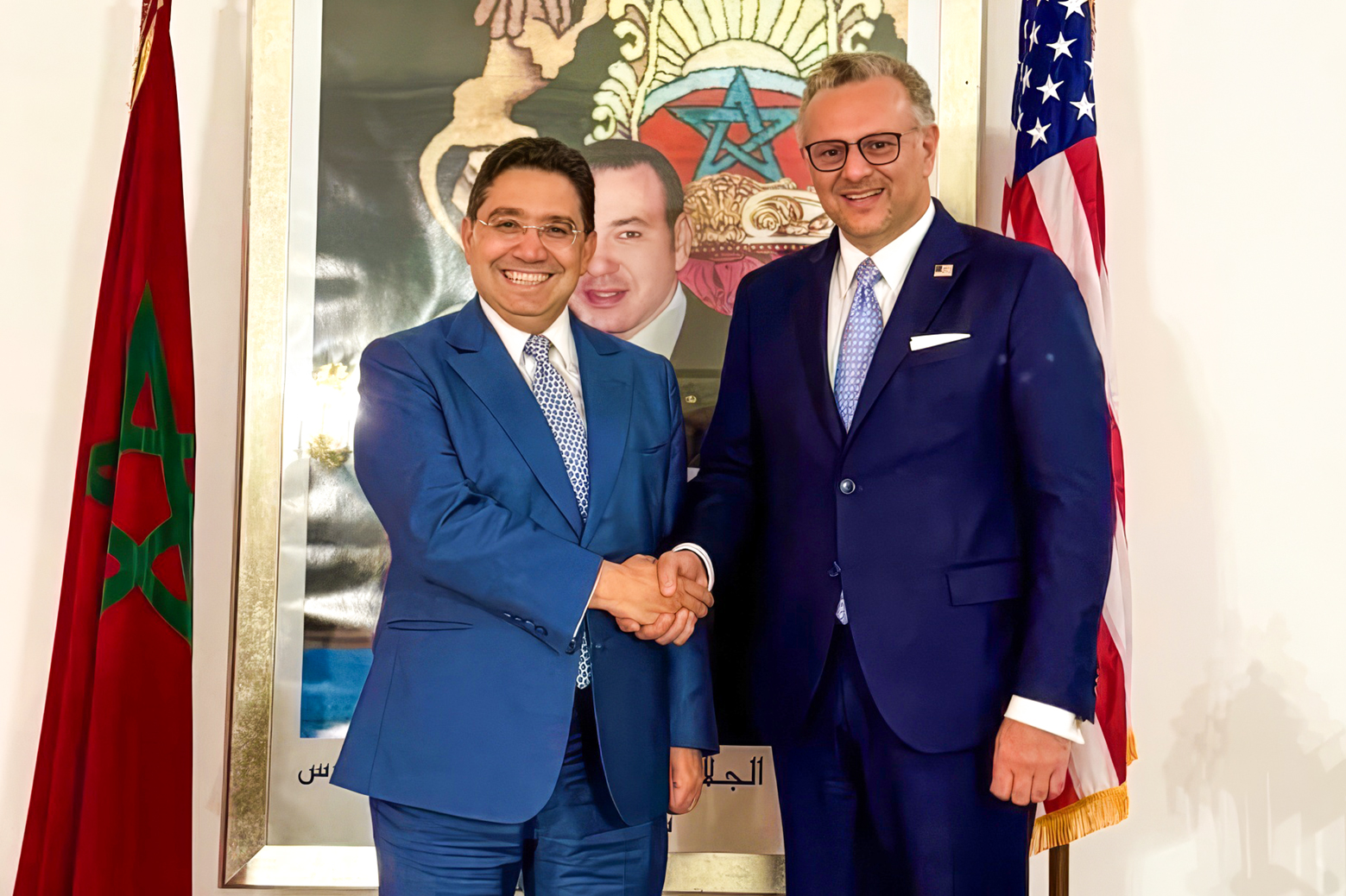
According to El Confidencial, the Spanish news outlet that has followed the recent talks very closely, the gathering will bring together the same four foreign ministers who met in Washington in late January and then again in Madrid two weeks ago: Morocco’s Nasser Bourita, the Polisario Front’s Mohamed Yeslem Beisat, Algeria’s Ahmed Attaf, and Mauritania’s Mouamed Salem Ould Merzoug.
This follows what Boulos had already signaled in recent comments, when he confirmed that the diplomatic track remains active and that further meetings are expected. “These meetings will continue, God willing,” he said, stressing that the objective is not endless dialogue but steady progress.
He added that the United States remains committed to facilitating discussions “as quickly as possible, without rushing the process or wasting time.” The message was calibrated but unmistakable – Washington is not running a talking shop. It is running a closing process.
UN envoy Staffan de Mistura will also attend. Some Iberian media outlets have again rushed to frame the process as one that has sidelined the United Nations – a narrative that US officials have directly and repeatedly contradicted.
Boulos himself has been unequivocal: the entire process is fully framed within the UN-led track, with Resolution 2797, adopted by the Security Council on October 31, serving as its binding compass.
It is that same resolution that consecrates Morocco’s autonomy plan as the basis for negotiations – and it is within that framework, not outside it, that Washington is driving the process forward. One might reasonably ask: is the Security Council no longer part of the United Nations?
El Confidencial also recalls that Spanish Foreign Minister José Manuel Albares received the three foreign ministers separately on the sidelines of the Madrid talks – but pointedly refused to grant an audience to the Polisario delegation. The detail is telling.
When the host country’s top diplomat draws a categorical line between sovereign state actors and a movement that cannot secure a bilateral meeting with a mid-ranking European foreign minister, it speaks volumes about the Polisario’s actual standing in the international arena.
This is not a liberation movement negotiating on equal footing. It is a client militia, politically dependent on Algiers for its survival, financially sustained by its patron, and diplomatically viable only to the extent that Algeria keeps it breathing.
Strip away Algerian sponsorship and what remains is an armed apparatus with no territory, no government, no economy, and no future – a proxy instrument that Algeria has weaponized for five decades to prosecute a regional rivalry it was never willing to own under its own name.
El Confidencial notes the meeting falls squarely in Ramadan, a scheduling detail that has unsettled all four Muslim delegations. Sources close to the talks told the outlet that participants have half-jokingly warned their American hosts that fasting may dull their diplomatic edge, particularly in late afternoon sessions before sunset. Boulos, of Lebanese Maronite origin, is not bound by the fast.
Washington facilitates; it does not dictate
Speaking to Deutsche Welle on the sidelines of the Munich Security Conference on February 14, Boulos broke his public silence with measured confidence. “This conflict requires time,” he said, “but it is already on the path to resolution, and the process may be long or short.”
“We hope it will be short. Our position is always optimistic,” he added, attributing that outlook to “the pragmatism of President Trump’s leadership,” which, he argued, “gives hope for resolving complex conflicts.” Diplomatic sources indicate he aims to reach a settlement before summer.
On France 24 the following day, Boulos was more direct. He reaffirmed that Washington’s recognition of Moroccan sovereignty over the Sahara “is stable and does not change,” describing it as a ceiling above all ongoing negotiations – repeatedly confirmed by Trump, Secretary of State Marco Rubio, and Boulos himself.
At the time, Boulos declined to reveal any details of the autonomy document discussed in Madrid, stating that confidentiality was owed “out of respect for the parties concerned” and that such substance “belongs to the parties involved – primarily Morocco and the Sahrawis.”
He was equally clear on Washington’s boundaries: the United States, he said, “is not mandated to enter into the substance of those negotiations.” Washington facilitates. It does not dictate terms. The parties negotiate. That distinction, deliberate and firm, leaves no room for anyone to accuse the US of imposing a solution – while the framework it has built makes only one solution structurally possible.
On Algeria’s role, he refused the long-rehearsed fiction of Algerian neutrality. UN Security Council Resolution 2797, he stated plainly, names Algeria as a party to the conflict alongside Morocco, the Polisario, and Mauritania. Participation, he made clear, is not a matter of rhetorical preference – it is an international designation.
Resolution 2797, adopted in October, which the US mission to the UN worked intensively to pass, enshrines – for the first time in clear-cut, unambiguous language – Morocco’s autonomy plan as the “most viable” basis for a lasting political solution. It is a formulation that functionally buries five decades of Algerian insistence on an independence referendum.
The framework is no longer debated
At the center of the negotiations is a revised 40-page autonomy document, coordinated by three royal advisers – Taieb Fassi Fihri, Omar Aziman, and Fouad Ali El Himma – on direct instruction from King Mohammed VI following the resolution’s adoption.
The document was accepted as a working technical text in Madrid. A committee of experts from Morocco, Algeria, and Mauritania is now expected to work through it, with a high-level approval meeting potentially targeted for April or May in Washington.
The Spanish outlet Atalayar, known for its proximity to Moroccan diplomatic circles, published a partial account of the document’s contents – though the text has not been officially confirmed and remains in evolution.
According to what Atalayar describes, the plan would grant the region powers covering education, health, culture, urban planning, fishing management, and regional economic development.
A regional parliament would combine directly elected members with representatives designated by recognized Saharan tribes. Regional taxation would draw from territorial levies and royalties on natural resources.
Several contentious provisions remain unresolved. The Polisario opposes the mechanism by which the regional executive would be invested by the King rather than elected directly by popular vote. Algeria has objected to a clause requiring dual regional and national authorization for foreign investments in the territory – a provision Morocco insists is non-negotiable on sovereignty grounds. National symbols – flag, anthem, currency – remain exclusively Moroccan, with no separate regional insignia permitted.
The plan also provides for a committee to organize the return of Sahrawi refugees from Tindouf camps in Algeria, with strict identity verification procedures, alongside a disarmament and reintegration mechanism for Polisario combatants. Any referendum on the statute would be put to the entire Moroccan electorate – not the Saharan population alone – a point the Polisario firmly rejects.
What is no longer in question is the framework. Algeria sat at the table in Madrid. It will sit again Monday in Washington. That fact alone marks the beginning of the end of a strategy built on half a century of obstruction.