 Join on WhatsApp
 Join on Telegram
How does one cover a genocide? What exactly are the words to explain the unthinkable when social media is flooded with images and videos that leave you speechless? And how do you portray the truth when there are conflicting narratives on something that should be as simple as the protection of human rights?
These are the questions journalistic bureaus around the world – Morocco World News included – have tried to answer ever since October 7, 2023.
As journalists are again faced with difficult editorial decisions covering active combat and war crimes between the US, Israel and Iran, which escalated tremendously on February 28, lessons and warnings from reporting a livestreamed genocide still hold true.
The role of the journalist in covering Gaza was and is not merely to report events as they unfold. It is to challenge narratives, confront silence, and hold power to account.
In times of conflict, the language used in journalism becomes a battlefield of its own. Words like “clashes,” “retaliation,” or “self-defense” can serve as linguistic shields, veiling the asymmetry of power and obscuring the reality of systematic violence. This selective vocabulary is more than a mere editorial choice. It is more often than not a form of soft censorship, denying the public the ability to fully comprehend the scale and nature of the atrocities being committed. By framing Israel’s war crimes in Gaza through sanitized, depoliticized language, many mainstream outlets perpetuated a one-sided narrative that dehumanized Palestinian lives and erased the structural context of occupation and apartheid.
What began as mere language from international media bureaus, morphed into a distorted truth concealed as a mainstream and “unbiased” narrative. The casual observer may think nothing of slightly differing headlines among media bureaus covering another Israeli airstrike. But these choices of words came at a grave cost to journalists on the ground in Gaza who were reporting the unfiltered realities of Israel’s war crimes — bombed-out homes, murdered children, families obliterated in a single airstrike, and aid-seekers gunned down deliberately.
By dehumanizing the narrative, story by story, these media outlets empowered and solidified the overarching belief that Israel’s actions were truly all in self-defense, the elimination of Hamas, and the release of hostages, with no ulterior motive. When the public believes this, they are susceptible to believing that Israel’s murdering of journalists was merely accidental casualties in an attack meant to target Hamas. And finally, when this narrative is normalized, normalization leads to inaction, and inaction led to the reality that Israel’s genocide against Palestinians lasted a staggering two years.
Today, these narratives continue to matter more than ever. Almost five months after the ceasefire was implemented in October 2025, Israel continues serial attacks on Gaza. According to Gaza’s government media office, Israel had committed over 1,200 violations of the agreement as of mid-January of this year, continuing their trend of mercilessly shooting and bombing unarmed civilians.
The way this genocide started, the causes for conflict, the actions that unfolded and the way its is getting resolved will forever mark how this tragic story is written in Palestinian history.
A necessary education
Morocco World News has, at its core, been pro-Palestine. As an American journalist and editor who joined the bureau in Rabat shortly after October 7, 2023, I learned first-hand very quickly what that means.
For media workers unfamiliar with the Israel-Palestine conflict, learning how to ethically report on the matter, and handle the magnitude of information, is like drinking through a fire hose. I found myself consuming article after article, one academic journal after the next. Social media proved to be an advantage in my edification on the topic. I followed Palestinian creators and educators, listened to their TikToks and podcasts, consumed their infographics and kept up with their book recommendations. Their firsthand accounts and experiences provided a raw, unfiltered perspective on the situation which would otherwise be inaccessible without social media. When I discovered that my American education had failed in supplying much of this narrative, the more interested I became in the reasoning behind this – thus brought me down the rabbit hole of learning about US allegiance to Israel and how deep those ties permeate into the very fabric of American society.
American Israeli Public Affairs Committee (AIPAC), Israeli lobbies, Boycott Divestment, Sanctions (BDS) movement – these are the key words that kept popping when reading about Israel’s stronghold on American foreign policy – ties that manifest themselves in the nations’ economy and media. Understanding this background helped me to be more skeptical of US media outlets’ reports of Israel’s attacks early-on in the genocide. I started to recognize small but crucial editorial changes in reporting: omitting Israel from headlines about its targeted strikes, adding the mounting Palestinian death toll at the bottom of articles, reiterating Hamas’ October 7 attack on Israel at the top, and repeatedly using quotes from Israeli officials as credibility points for article titles. The mere placement of context in each article symbolized the true agenda of each outlet. As someone who grew up idolizing outlets like CNN as an always balanced, reliable, go-to source for global conflicts, I was both shocked and quickly jaded. I knew that my media education when reporting on this crucial topic needed to diversify quickly in order to produce the most honest reporting that I could.
Everyday choices
For news editors today, striving to support and uplift the rights and solidarity of the Palestinian people, activism comes in the form of everyday editorial choices. As an editor at Morocco World News, especially at the beginning of Israel’s war on Gaza, this meant staunch scrutiny over multiple sources to verify article accuracy. The large challenge is how to elevate the Palestinian narrative at a time when English media — as predominately US-oriented/Western – was not doing so.
What did this look like in the everyday word choice? It means using:
- Israeli Occupation Forces instead of Israel Defense Forces
- Israel’s war on Gaza instead of Israel-Hamas war
- “Bombarbarment, mass air strikes” instead of “targeted strikes against Hamas”
- Gaza Health Ministry instead of Hamas-run health ministry
- Refugee camps, civilian buildings instead of Hamas strongholds
- Humanitarian catastrophe, crisis instead of Israel’s defense campaign
- Hamas, Palestinian militant groups instead of Palestinian terrorists
And the list goes on. This was, and still is, a living and ever-evolving set of editorial choices. Our team had constant meetings to talk about journalist integrity and ethical war-time reporting to ensure accuracy and fairness. Instead of relying solely on global giants like BBC, The Guardian, Reuters and CNN, we also checked a revolving list of Al Jazeera, Palestinian Wafa Agency, and Haaretz. For this global conflict in particular, social media proved to be a substantial supplement when headlines were conflicted amongst other major bureaus. We were able to see first-hand accounts of Gazans on-the-ground talking about their lived realities, in addition to press members’ reports in the area.
However, we still made mistakes. We did not always know which source to trust. And yet, that is the business. You strive hard to continue to educate and learn, hoping that the full narrative will reveal itself sooner rather than later.
Conflicting narratives
Before my time with Morocco World News, I was working in media monitoring and saw first-hand the staunch media slant and conflicting biases between many Western media sources and Arab/Global South sources – especially visible early on in the conflict. One of the most prominent first instances concerned Israel’s attack on Gaza’s Al Shifa Hospital in November of 2023. At the time, for many readers who had no prior education about Israeli occupation or war crimes in the region, the notion that the “only democracy in the Middle East” would deliberately attack a hospital seemed like an anathema. Now, we know that this is a common practice for Israeli Occupation Forces.
| Western Headlines | Global South Headlines |
| “Israel launches military operation inside Gaza’s Al Shifa Hospital” (CNN) | “Israeli Occupation Forces Raid Gaza’s Largest Hospital” (Morocco World News) |
| “Many are killed near a Gaza hospital, its chief says, in a strike the Israelis say was aimed at Hamas.” (New York Times) | “Thousands trapped as Israeli forces raid Gaza’s al-Shifa Hospital” (Al Jazeera)
“‘Hospitals are not battlegrounds’: World reacts to Israel’s al-Shifa raid” (Al Jazeera) |
| “Hospital used as Hamas underground terror HQ likely Israel’s next big battle challenge” (Fox News) | “Israeli airstrikes target Gaza hospitals, kill 6 Palestinians in Al-Shifa Hospital”
(Andaolu Agency) |
This divide exemplified early-on that this conflict would be a battle of narratives for journalists. To the casual media observer, the differences between the two may not seem large if one is consuming a diverse set of sources. But the average media consumer does not usually do this. To take the US as an example, a 2025 Pew Research study revealed that 53% of American adults say they consume their news on social media as the main source. Social media algorithms make it so that it is incredibly easy to fall into the trap of confirmation bias due to media bubbles – one relies on the same sources and therefore assumes that this narrative must be the truth. This divide quickly becomes evident in the harsh discourse between those with differing opinions and views. The increase of fake news is a significant issue as well.
After Al Shifa, it became clear that journalists who wished to continue to uphold the Palestinian narrative would need to work harder than ever to ensure that their stories gained traction in order to counter-balance narratives emerging out of Western giants. At Morocco World News, this drive manifested itself in constant and consistent reporting. Our days quickly looked like checking everyday for reports of Israeli attacks the night before, consuming social media accounts of the remaining health workers and press personnel on the ground in Gaza for details, and updating the evergrowing Palestinian death toll.
Geno-cide
This dedication to constant reporting came at a cost for Morocco World News, as it did for many other news agencies who were reporting about the genocide on social media. The first thing that we noticed was shadowbanning. Suddenly, our Instagram, TikTok, and Facebook stories on Gaza – which typically received hundreds of views – dropped to five or zero views. We noticed a similar trend in other accounts – if we posted non-Gaza related content in large quantities in-between our Palestine posts, this helped, but our algorithm was still affected. This came at at time when our editor-in-chief made the decision early-on that we needed to call out Israel’s war on Gaza for what is: a genocide. This was a slow but staunch shift that permeated throughout many major news channels, starting in the Global South. It is a shift that has still, over two years later and a declared ceasefire, not manifested itself in many Western media giants.
Our editor-in-chief sat down with us to talk about how we could fix the Meta censorship problem, and we came up with a list of fail-safe words in hopes of dodging the blocks: “geno-cide” for genocide, “w_ar” for war, and sometimes even using the watermelon emoji, a common trend from other pro-Palestine creators. The long and slow battle to keep reporting through censorship remains, but journalists continue to find new creative avenues to release the stories that matter.
The ultimate cost
Yet, the loss of content to censorship for bureaus reporting on the genocide from afar is nothing compared to the cost for journalists on the ground in Gaza.
A September 2025 UN report confirmed the sobering reality: the Gaza genocide is the deadliest conflict in histroy for journalists. According to a report by the Watson Institute for International Public Affairs’ Cost of War Project, more journalists have been killed in Gaza than both world wars, the Vietnam War, wars in Yugoslavia, and the war in Afghanistan combined. To date, more than 220 journalists have been killed in Gaza at this time of writing, according to Reporter Sans Frontiers.
Israel’s deliberate targeting of marked members of the press reveals a deeper, more sinister narrative. Their deaths are not random – but rather part of a broader strategy to suppress independent documentation and dismantle the flow of information from the inside. These reporters risk everything to expose the horrors that Israel is trying to conceal.
A more recent report released by The Committee to Protect Journalists (CPJ) in February of this year shows that this trend is ongoing, despite the ceasefire in place. The report indicates that out of the 129 media workers killed worldwide in 2025, Israel was responsible for more than two-thirds – 84 in total – showing “a persistent culture of impunity for attacks on the press.”
The true number is expected to be higher. “With much contemporaneous evidence now destroyed, the true number of Palestinian journalists in Gaza who were deliberately targeted by Israel may never be known,” the CPJ acknowledged.
In the bureau, reporting on these killings comes with heavy heart for our journalists. As an editor, I take each report as further motivation to make sure I am writing as much as possible about the war crimes, bringing awareness to the false and conflicting narratives, and making calculated, everyday choices, in the words I edit and scribe.
‘We recognize the State of Palestine’
Words hold power, and this genocide has proven that in the world of media more than anything. If utilized correctly, they can turn into action, as what was seen in the UN General Assembly last September. The 2025 gathering saw the largest number of nations standing up to recognize the State of Palestine than has been in the country’s history. Among them, historic allies of Israel, including France, Canada and the UK.
These recognitions were historic yes, but as media workers who had been reporting on these atrocities from the beginning, we looked at these with critical, watchful eyes.
I asked myself the question – finally, but why now? What was the last straw? Was it that final news report of yet another child starving to death due to Israel’s blockade? The social media video of a father holding plastic bags of his child’s remains? The UN confirmed report that this is, in fact, a genocide? Or was it none of these, but merely a grasp for these nations to join the “trend” of solidarity at a time when support for Prime Minister Netanyahu’s war machine is increasingly met with isolation?
The keepers of power
“We recognize the State of Palestine.” These words hold power, but to whom they are giving this power will be the ultimate question.
Will the power transcend into much needed action, to uphold Palestinian dignity in an age where they are being de-humanized in the media? Will Palestinian families struggling to survive in a now-destroyed Gaza be able to finally see these leaders’ actions as more than just words, but a promise to act in support of their rights and humanity?
Or will the power take a darker, normalized turn, shifting the narrative to make it seem in history books that these nations were always on the “right side of history”? Will these words essentially wash off the blame of not months but years of supporting Israel and sanitizing its war crimes? And what’s worse, as Gazans continue to suffer in this “post-genocide” limbo, did these words bring no tangible change at all?
Upholding the words that matter post-genocide
On October 9, 2025, renowned Palestinian journalist and content creator Bisan Owda posted another one of her regular updates, starting with the words “This is Bisan from Gaza, I am still alive,” but this time saying “This is not an update, but a result,” adding that this was the official announcement day of the ceasefire.
Although she was optimistic that one day her people will be free from Israeli occupation, and from the worry that they will be killed tomorrow, she warned all watching that “we must not be naive.”
“We don’t have any authority, any sovereignty, any rights, any existence…even now in Gaza,” she asserted, painting a picture of the reality for Palestinians, despite the symbolic words in the UNGA or the lofty speeches uttered by world leaders designing US President Donald Trump’s “peace” plan.
Bisan’s cautions came at a time when Trump’s lofty words of self-praise and promises for the Palestinian people, a people that were murdered by billions of dollars worth of American weapons at the hands of Israel for the past two years, filled the Israeli parliament (Knesset). “At last, not only for Israelis but also Palestinians, the long and painful nightmare is finally over,” Trump claimed at the time, amid a round of politicians cheering his name and calling him “Trump the Peace President.”
The missing seat
Later, Trump attended a summit in Egypt to discuss post-genocide Gaza, an event that observers described as a dystopian show of PR fanfare rather than a formidable strategic gathering. World leaders whose in-actions had enabled the genocide to last two years too long sat clapping behind a large sign that read “Peace 2025.”
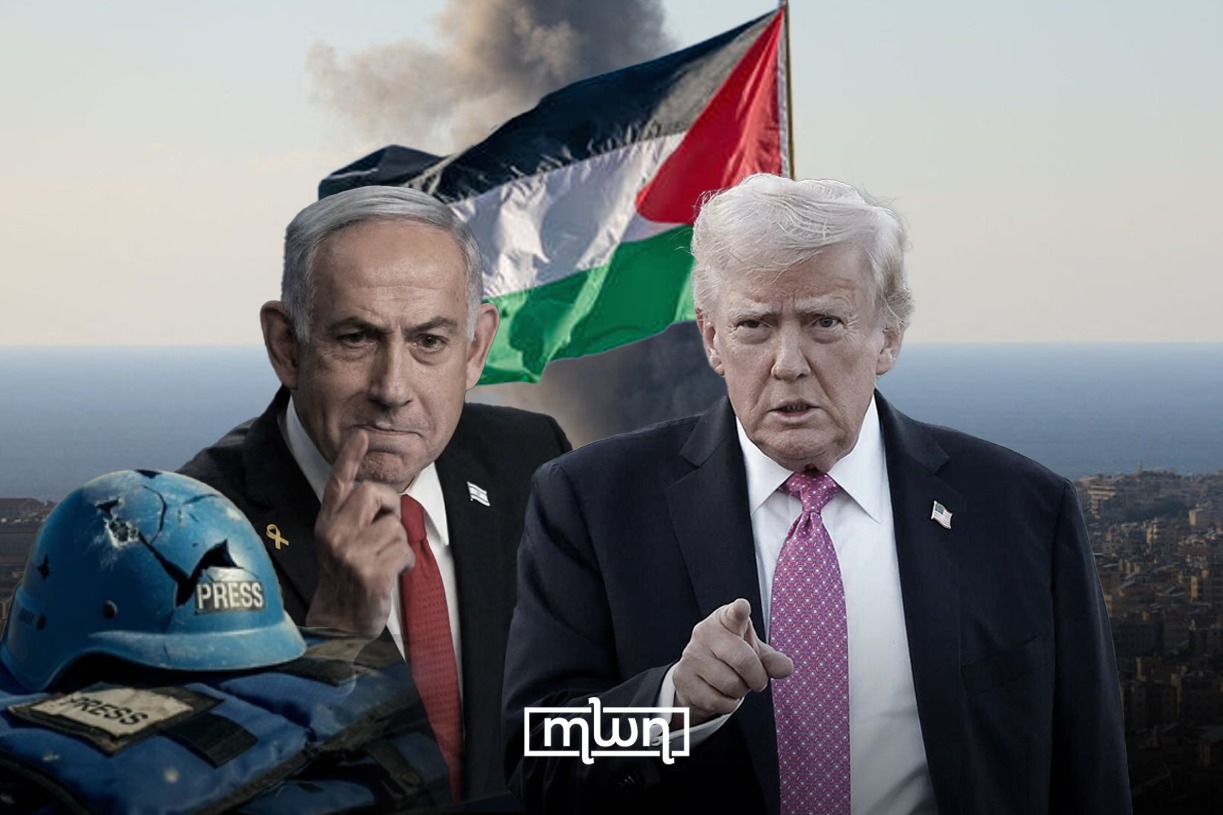
Fast forward to 2026 and Trump would eventually inaugurate his “Board of Peace,” established through his 20-point Gaza plan – a broad roadmap that the president claims will bring “peace in the Middle East.” On February 19 in Washington, world leaders, including genocide architect Netanyahu himself, would gather to discuss next steps for the enclave, ultimately holding critical discussions over the future fate of Gazans – without any form of official Palestinian representation.
While MWN was reporting on this, I could not help but remember Bisan Owda’s dark warning to fellow Palestinians right after the ceasefire came into place: “Don’t be manipulated by the system telling you they will stop killing you.”
As Palestinians in both genocide-torn Gaza and the occupied West Bank continue to suffer from illicit attacks by both the IOF and illegal settlers many months after the supposed ceasefire – and are are not even given a seat at the negotiating table to determine their future – these words of caution are more relevant than ever.
“We have the dignity of fighting until the end…this is a pause of the killing of Palestinians, it’s not what we [ultimately] want, it’s not what we deserve. After all the sacrifices, my people deserve a free Palestine..” Owda added.
The ‘peace’ president?
On Saturday, February 28, “Trump the Peace President” – a label the White House had also awarded him on a socials post shortly after the Gaza ceasefire – continued his brand of bringing “peace to the Middle East.” This time, not with a lofty “peace” board and 20-point plan, but in a series of airstrikes on Tehran as part of Israel’s bidding. Called Operation Fury, Trump and Netanyahu claimed that the strikes were necessary to take out “imminent threat,” aimed to degrade Iran’s missile capabilities, destabilize proxies and ensure that Tehran never gets a nuclear weapon.
In a larger sense, this was a tangible escalation of a long standing ideological war between Tehran and Washington. Supporters rejoiced in celebration when news broke that the strikes killed Iran’s Supreme Leader Khamenei. Masked with altruism, Trump is touting regime change, promising the Iranian people liberation and that “this will be probably your only chance for generations.”
Yet again, in a series eerily recalling sanitizing war crimes during the genocide, I am seeing first-hand the editorial choices twisting the narrative and shirking blame.
“At least 153 dead after reported strike on school, Iran says,” read a BBC headline. As part of their “liberation” campaign, the US-Israeli operation reportedly struck an Iranian school, killing 165 schoolgirls in the southern city of Minab.
Israel claims they were not aware of the strike, a usual suspicious trend that Al Jazeera notes was typical during the Gaza genocide, only for the IOF to later admit their war crimes when refutable damage emerged.
The question in this developing conflict now: will bureaus make the same grave editorial mistakes as they made during the Gaza genocide? Will Western media giants continue to tout Israeli propaganda, only to backtrack later when all sources point otherwise? As the active combat continues, if and when war crimes occur on all sides, will journalistic institutions keep bias at bay in effort to report the facts to the best of their ability?
For journalists, it is our responsibility to frame our words carefully in how we report this sequence, because they have the power to shape the narrative of history.