
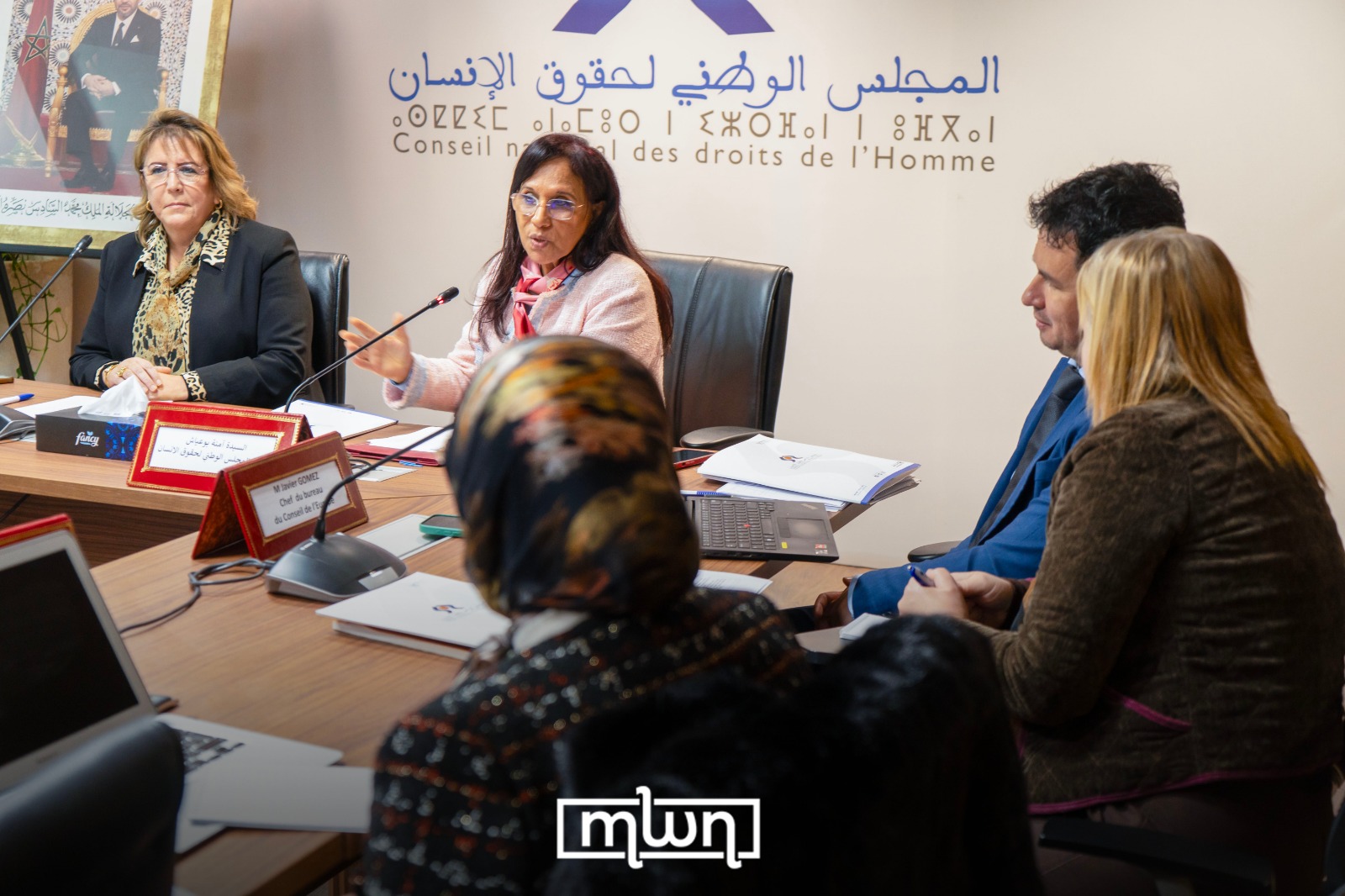
Rabat – The National Council for Human Rights (CNDH) launched a national initiative today to strengthen women’s access to justice in Morocco.
The meeting, under the banner “Fair Justice: Pathways to Women and Girls’ Access to Justice,” coincided with International Women’s Day and marked the start of a series of regional discussions scheduled throughout March under a unified national program led by the CNDH and its regional committees.
The initiative seeks to address legal, social, cultural, and institutional barriers that prevent women and girls from fully exercising their rights and to foster an environment where justice becomes a practical, accessible reality.
Persistent gaps in legal equality
Amina Bouayach, president of the CNDH, noted both the achievements and shortcomings of Morocco’s legal framework for women.
“We refer to the legislative achievements, as well as the mechanisms and procedures that have encouraged women to access justice with the available resources,” Bouayach said.
“However, reports, testimonies, and monitoring over past years show that significant obstacles remain. Today, we added spatial justice as one obstacle preventing women and girls from reaching the justice system.”
Bouayach placed emphasis on rights beyond legal texts. “We question not only the laws but also the entire social system. We need a framework that ensures women can access justice, protects their rights, and fosters their sense of full citizenship in the country,” she explained.
Data from the UN indicates that women worldwide enjoy only 64% of the legal rights available to men, with gaps evident in work, property, mobility, safety, and family rights. Morocco’s national reports show a similar pattern, reflecting that legal equality has yet to become a lived reality for many women.
Judicial processes and access challenges
The initiative also examines judicial procedures and their ability to respond to women’s specific needs.
Malika Zekhnini, parliamentarian and member of the Justice and Legislation Committee, stressed that legal frameworks are only part of the solution. “National legal frameworks have seen significant progress regarding the enforcement of women’s human rights, but the key entry point remains access to justice,” she said.
Zekhnini pointed to procedural hurdles. “Are women able to reach justice, or do social and cultural obstacles block their path? The legal perspective matters, but so do societal conditions. Our goal today is to produce actionable recommendations that make justice truly accessible for women. Justice safeguards women’s rights and completes the legal framework.”
Reports by the CNDH note that civil and criminal procedures remain complex, costly, and slow, creating barriers to women, particularly in cases of violence. Effective access requires simplified procedures, protection of victims, and adherence to international human rights and gender equality principles.
Structural, social, and cultural barriers
The CNDH emphasized that legal reform alone cannot guarantee equality. Bouayach noted that social, economic, and cultural barriers often prevent women from fully claiming their rights.
“Justice is not only a legal issue. It is a foundation for ensuring all rights of women and girls, legal, social, and economic,” she said.
Past campaigns led by the CNDH, including a nationwide caravan from November to December 2025 to encourage reporting of violence, showed disparities in how courts address similar cases and highlighted the rise of digital violence, which remains underreported due to fear of stigma and lack of trust in the judicial system.
The initiative aims to move beyond diagnosis. It seeks to establish a holistic framework where women and girls experience justice as a practical reality, with guaranteed protection, recognition, and dignity.
Toward effective and fair justice
The CNDH’s program will extend into regional meetings, allowing local committees to examine challenges and propose actionable solutions.
“Our discussions today will help build practical recommendations to ensure fair and effective justice, granting women and girls full rights and protection,” Bouayach said.
The initiative signals a new stage in Morocco’s strategy for women’s rights, linking legal reforms with societal transformation. By addressing structural, judicial, and cultural obstacles, the CNDH seeks to create conditions where women can claim their rights safely, confidently, and equally.