
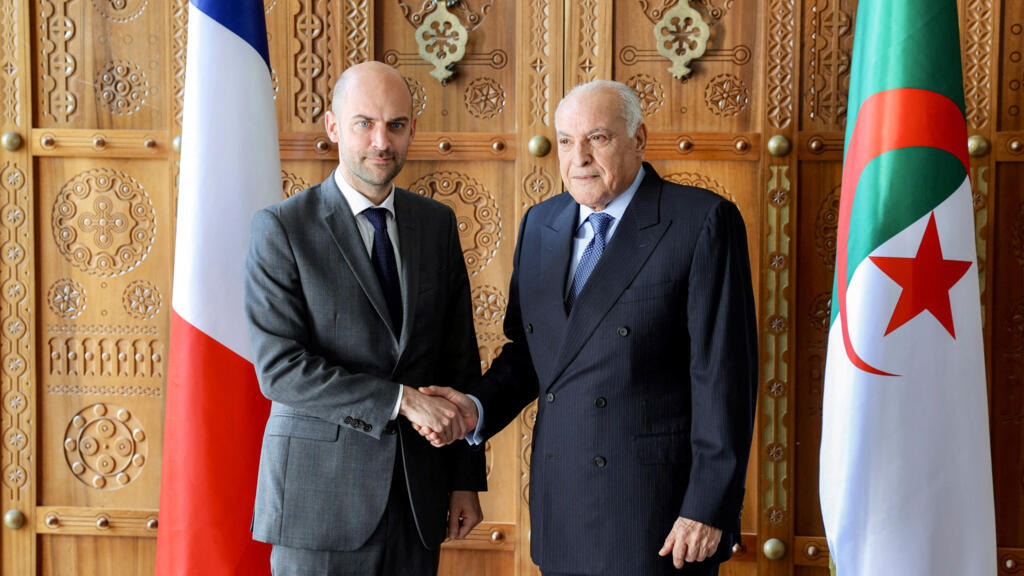
Marrakech – Algeria has capitulated. After nearly two years of diplomatic belligerence, retaliatory posturing, and calculated hostility toward Paris, Algiers has quietly conceded defeat and moved to restore bilateral relations with France – all while the Western Sahara question it once weaponized now advances firmly on Morocco’s terms.
French Foreign Minister Jean-Noël Barrot spoke by phone on Sunday, March 15, with his Algerian counterpart Ahmed Attaf. It was their first direct exchange in months.
The Quai d’Orsay confirmed that both ministers discussed the resumption of bilateral cooperation, particularly on security and migration. Barrot was explicit: Paris expects “tangible results” from this renewed engagement.
The call also touched on the escalating regional crisis around Iran and – critically – the recent high-level discussions on the Sahara. That the Sahara featured at all in a Franco-Algerian call is itself a measure of how far Algiers has fallen from its former obstructionist perch.
A crisis of Algeria’s own making
The diplomatic rupture traces back to the summer of 2024, when France formally recognized Morocco’s autonomy plan under Moroccan sovereignty as the basis for resolving the Western Sahara dispute – a stance now uniformly adopted by all 27 member states of the European Union since January 29, 2026.
It was a seismic shift that saw Paris aligning itself with the direction history had already taken, and in doing so, stripping Algiers of the one geopolitical fiction it had sustained for half a century.
Algeria’s response was visceral, almost reflexive – the diplomatic equivalent of a cornered state lashing out with everything in its arsenal short of actual warfare.
It recalled its ambassador. It expelled French consular agents. It weaponized migration, refusing to repatriate its own nationals under French deportation orders. It even mobilized social media influencers in a desperate campaign of digital subversion, as though keyboard mercenaries could undo what sovereign nations had decided in broad daylight.
None of it altered a single comma in France’s position. Paris did not flinch or equivocate, did not walk back, did not offer the kind of carefully worded diplomatic retreat Algiers had grown accustomed to extracting from European capitals. The Sahara stance held. And the broader international current – Washington, Madrid, London – surged unmistakably against Algiers.
Then came the decisive blow. UN Security Council Resolution 2797 did not merely reaffirm the political process – it buried the ambiguity Algeria had exploited for decades and dismantled what remained of the military junta’s diplomatic leverage on the issue.
The resolution locked negotiations into a single framework: Morocco’s autonomy plan, under UN auspices, with no parallel track, no competing proposal, no room for the separatist phantasm Algiers had financed, armed, and diplomatically ventilated through the Polisario Front since 1975.
It was, in diplomatic terms, what the fall of the Berlin Wall was to Soviet satellite doctrine – the moment the architecture of a long-sustained illusion simply ceased to hold. Algeria’s entire Sahara strategy, built on obstruction, deferral, and the perpetuation of strategic obfuscation, found itself without a single institutional foothold left to stand on.
A slow, grudging thaw
The consequences materialized swiftly. Quadripartite negotiations were held first in Madrid in early February, then in Washington, bringing together Morocco, Algeria, Mauritania, and the Polisario under American mediation and UN oversight.
The discussions were no longer about whether the autonomy plan would serve as the framework – that was settled. They were about how to implement it.
For Algeria, participation in those talks amounted to an implicit acknowledgment that the political ground had shifted irreversibly. The question was no longer independence or self-determination as Algiers had long framed it. It was modalities of autonomy under Moroccan sovereignty.
The Barrot-Attaf call did not happen in a vacuum. It followed a methodically sequenced French diplomatic effort – and earlier olive branches that Algeria had repeatedly slapped away.
In mid-February, French Interior Minister Laurent Nuñez visited Algiers and met President Abdelmadjid Tebboune. That visit reactivated what Nuñez described as a “very high-level security cooperation mechanism” between the two countries. It was the first visit by a French interior minister to Algeria since Gérald Darmanin’s trip in late 2022.
Days before the Barrot-Attaf exchange, French and Moroccan diplomacy was already in motion. On March 10, Barrot met Morocco’s Foreign Minister Nasser Bourita in Paris on the sidelines of the World Nuclear Energy Summit. During that meeting, Barrot praised the quadripartite negotiations on the Sahara and reaffirmed France’s alignment with Resolution 2797.
Reports have also circulated in recent days about the imminent return of French Ambassador Stéphane Romatet to Algiers. Romatet had been recalled to Paris by President Emmanuel Macron in April 2025 after Algeria expelled French consular staff.
Gleizes and the outstanding leverage
Barrot also raised the case of Christophe Gleizes, a French sports journalist serving a seven-year prison sentence in Algeria on charges of “apology for terrorism.” The case has become a persistent irritant in Franco-Algerian relations and a symbol of the coercive tactics Algiers deployed during the crisis. France’s insistence on his situation signals that normalization will come with conditions.
Algeria’s strategic climbdown and recoil is now beyond dispute. Every retaliatory measure it deployed – the ambassador recall, the consular expulsions, the weaponization of migration flows, the blackmail campaign, and the information warfare through proxy influencers – amounted to a textbook case of compellence failure.
Algiers escalated on every front available to a mid-tier power short of military confrontation, and on every front, it was met with strategic indifference from Paris. The cost-benefit calculus collapsed entirely: maximum provocation yielded zero concessions.
France’s landmark 2024 recognition of Morocco’s sovereignty over the Sahara was the starting point. What followed shifted the tide in Morocco’s favor – the UN codified the autonomy framework, and the international order moved on.
Algiers, having exhausted every lever of asymmetric pressure in a losing hand, has now simply folded – not from a position of negotiated compromise, but from the sheer bankruptcy of alternatives.
Read also: Boualem Sansal: ‘I Was Assaulted by Algeria’s Regime’