
 Join on WhatsApp
 Join on Telegram
Rabat — Against the vibrant backdrop of the 31st International Publishing and Book Fair (SIEL), the stand of the National Human Rights Council (CNDH) hosted a timely and thought-provoking discussion that placed migration and cultural diversity at the center of public debate.
Titled “Cultural Diversity in the Context of Migration,” the seminar brought together voices from academia, journalism, and human rights advocacy. Moderated by Abdelrafie Hamdi, Director of the Directorate for Monitoring and Protection of Human Rights at CNDH, the session explored the intersections between identity, mobility, and coexistence in an increasingly interconnected world.
As migration continues to reshape societies across continents, speakers examined how cultural diversity can be both an enriching force and a governance challenge requiring inclusive and thoughtful approaches.
Migration as a human and cultural journey
Journalist, writer, and university professor Talha Jibril, originally from Sudan, highlighted the narrative dimension of migration and the role of storytelling in shaping perceptions.
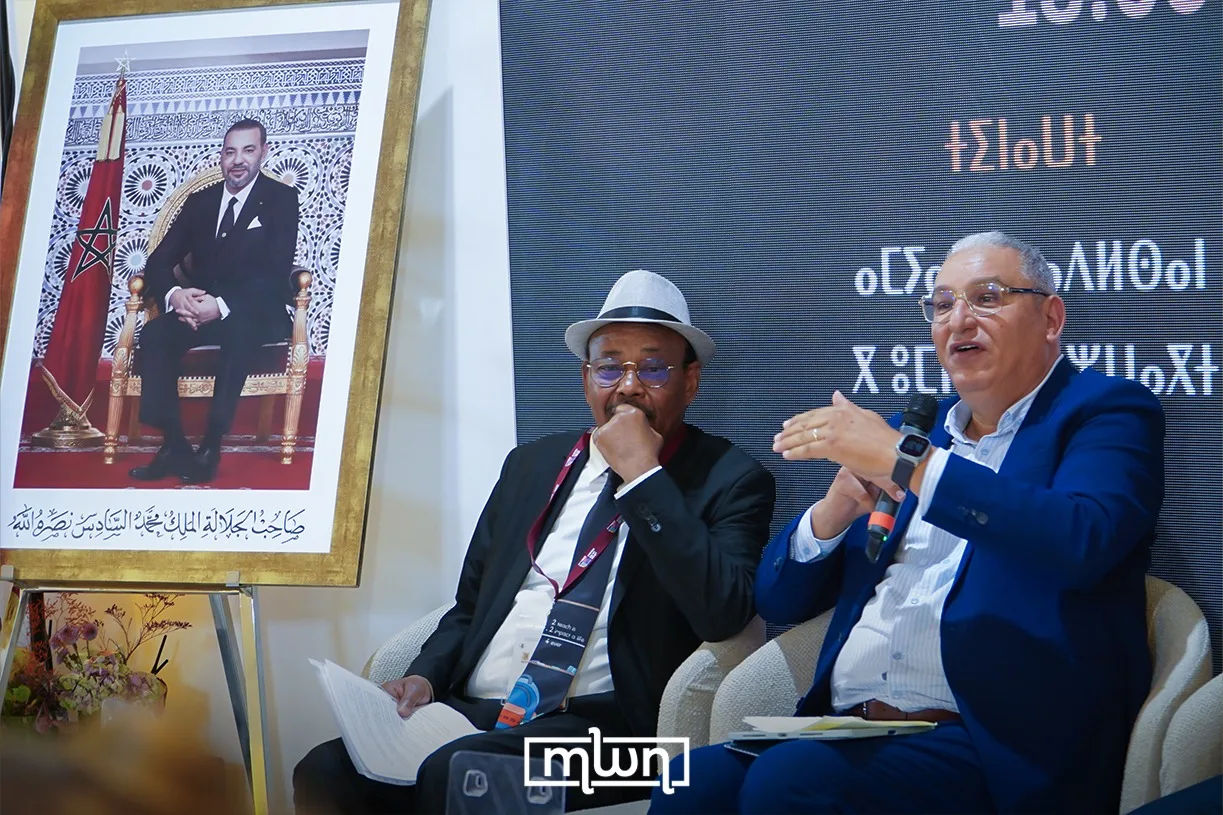
Reflecting on his personal experience as a migrant in Morocco, he said the country provided him with what he considers the most valuable foundations of his life: education and family stability. He noted that his experience of migration shifted unexpectedly, moving from an initial plan of return to a life deeply rooted in his host country.
“Migration is not just crossing borders or changing an address; it is a journey toward the self and toward the other, toward a world that goes beyond the geography of birth,” he stated. “When a person leaves their homeland, they carry with them childhood memories, their mother tongue, and unfulfilled dreams. And when they arrive in a new land, they discover that migration is a search for meaning, and that cultural diversity is the fruit of this journey.”
Rethinking diversity as a foundational condition
Approaching the subject through Sociology and Anthropology, Abdelrahim Al-Atri, research professor at Mohammed V University in Rabat, challenged dominant perceptions of migration and cultural diversity.
“We often forget that cultural diversity is the original condition—we were created within diversity. Migration, in this sense, should be understood as a real laboratory for discovering how this diversity operates,” he said.
The journalist added that migration is too frequently framed as a problem, while cultural diversity is similarly reduced to a challenge, instead of being seen as an opportunity and a space where new meanings emerge through interaction and difference.
“Migration is still too often presented as a problem, and cultural diversity is also framed as a problem, rather than being seen as an opportunity, a space of tension where new meanings can emerge and where we can better understand ourselves through others,” he noted.

Human rights activist Reuben Yemoh Odoi, founder of Minority Glob, brought a field-based perspective, highlighting the lived realities of migrants, including integration challenges, discrimination, and access to rights. He called for stronger coordination between institutions, civil society, and local communities to ensure that cultural diversity translates into inclusion rather than exclusion.
Between Policy and Practice
Speakers converged on the need to treat cultural diversity as an asset rather than a challenge, emphasizing the role of education, media representation, and civic engagement in fostering mutual understanding.
The discussion also highlighted Morocco’s dual role as both a country of origin and destination for migration, positioning it as a space of cultural exchange that requires balanced approaches combining human rights protection with socio-economic considerations.
In remarks to Morocco World News(MWN), Talha Jibril stressed that the book fair itself offers a fitting environment for such debates, drawing a parallel between literature and mobility:
“Books are, in a sense, migrants,” he said, “as they travel across borders and cultures rather than remaining confined to their countries of origin.”
In a separate interview, Abdelrahim Al-Atri emphasized the need to “liberate” conceptual approaches to cultural diversity, warning against its politicization or commodification. He called for renewed readings that restore diversity as a social reality rather than a contested label.
In the dynamic setting of the Rabat book fair—where ideas, books, and narratives circulate freely—the discussion offered a nuanced contribution to one of the most defining debates of contemporary societies.