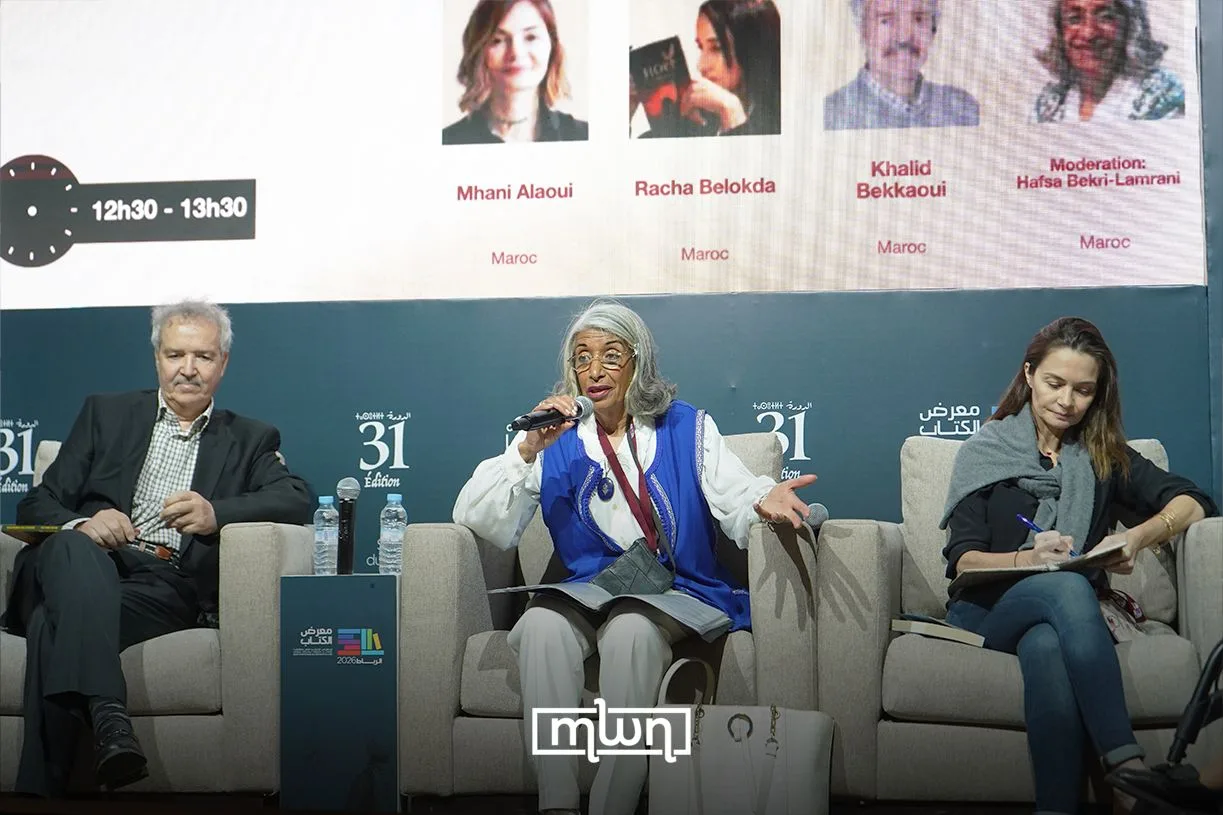
Rabat – At this year’s International Publishing and Book Fair (SIEL) in Rabat, a panel titled “African Anglophone Literature: The New Moroccan Trend” offered a sustained interrogation of language, visibility, and cultural authority in contemporary writing.
The session brought together Moroccan author Mhani Alaoui, Moroccan author and university professor at the Faculty of Arts and Humanities, Dhar El Mehraz, Khalid Bekkaoui, and Moroccan poet Racha Belkoda under the moderation of Hafsa Bekri-Lamrani, as part of a series that, over the past three editions of SIEL, has traced the expanding presence of English in Moroccan literary production.
The discussion began with a disquieting comparative observation about global literary recognition that among African Nobel Prize laureates in literature, only one wrote in Arabic, while the majority wrote in English. The remark functioned as an entry point into a deeper question about which languages are permitted to circulate at the highest levels of symbolic legitimacy.
The implication lingered in the room that literary value does not circulate independently from linguistic geopolitics.
Politics of language authority
Bekkaoui situated the discussion within a longer intellectual genealogy that links language to power. Drawing on his work on Orientalism, colonial discourse, and Anglo-Maghrebi encounters, he argued that linguistic systems operate as structures of cultural authority rather than neutral vehicles of expression.
“There is a language hierarchy that mirrors a cultural hierarchy,” he suggested, describing English not only as a global lingua franca but as part of a broader system of symbolic dominance.
Yet his reading resisted cultural fatalism. Bekkaoui recalled Morocco’s historical condition as a multilingual space, where Arabic, Amazigh, French, Spanish, and other linguistic influences coexist across centuries. “Moroccans have always mastered several languages. This is part of our intellectual memory,” he noted, positioning multilingualism not as a recent adaptation but as a constitutive feature of Moroccan cultural history.
He drew a distinction between academic research and literary creation. While scholarship often operates through conceptual constraints, he argued, fiction opens a space in which language becomes exploratory rather than purely analytical. Within that space, English becomes not an external imposition but a medium of reconfiguration, where inherited categories of representation may be unsettled.
Emotional geography of English
If Bekkaoui approached the question through structural critique, Alaoui introduced a more intimate cartography of language, shaped by lived experience. Recalling her time in the US, she described an environment marked by intellectual expansion and social dislocation.
“It was a very complicated time for Arab students in the United States,” she said, describing a space where academic openness coexisted with forms of exclusion and discomfort.
Yet her relationship to English is not defined by contradiction alone. “I am in love with the English language,” she stated, in a formulation that shifted the discussion from utility to affect. English, for her, does not function merely as a tool of communication, but as a literary atmosphere that enables different relationships between writer and reader.
She also drew a comparative distinction between Anglophone and Francophone literary worlds. Without dismissing French literature, she suggested that it often operates through more rigid cultural codes in which legitimacy is closely tied to institutional lineage. English, by contrast, appeared to her as more porous, less bound by inherited cultural hierarchies.
The question, then, is not only which language is used, but which literary spaces feel accessible to those writing from outside traditional centers of authority.
Continuity between science and poetry
Belkoda introduced a different register, one that blurred disciplinary boundaries. A mechanical engineer by training, she refused the idea that her trajectory represented a rupture between technical rationality and poetic expression.
“I have been writing poetry since I was very young, since I was about ten,” she recalled, suggesting continuity rather than conversion.
Her intellectual identity, she explained, cannot be reduced to a binary between engineering and literature. Mathematics and structural thinking, she argued, coexist with poetic sensibility, each informing the other in ways that resist classification.
Her choice of English emerged within this continuity. Rather than a deliberate ideological shift, it appears as part of a broader linguistic environment in which English circulates among younger Moroccan writers as an increasingly natural medium of expression.
The tension she pointed to is less linguistic than corporeal and social. The difficulty of inhabiting technical professions while sustaining a literary voice that does not conform to disciplinary expectations.
English as expansion rather than replacement
Across the panel, the question “why English now?” returned repeatedly, without settling into a single answer. Instead, it opened a constellation of interpretations, global circulation of texts, accessibility to wider readerships, and evolving linguistic practices among younger generations.
Bekkaoui offered a philosophical inflection, describing language as something almost sacred within certain intellectual traditions. In that sense, multilingualism becomes not fragmentation but expansion of interpretive possibility, a way of multiplying rather than narrowing modes of articulation.
What emerged collectively was not a rejection of French or Arabic, but a recalibration of literary space. English does not appear as a replacement, but as an addition and another register through which Moroccan writers negotiate visibility, readership, and intellectual belonging.
A literary field in motion
The panel did not seek closure. Instead, it mapped an evolving literary terrain in which language choice is no longer simply inherited but actively negotiated.
What SIEL brought into view is not a definitive “trend” but a shifting condition: Moroccan literature now operates across multiple linguistic vectors, each carrying its own histories of prestige, exclusion, and circulation.
Within this landscape, English functions less as endpoint than as passage, a medium through which Moroccan writers rearticulate questions of authority, expression, and cultural address in an increasingly global literary field.