
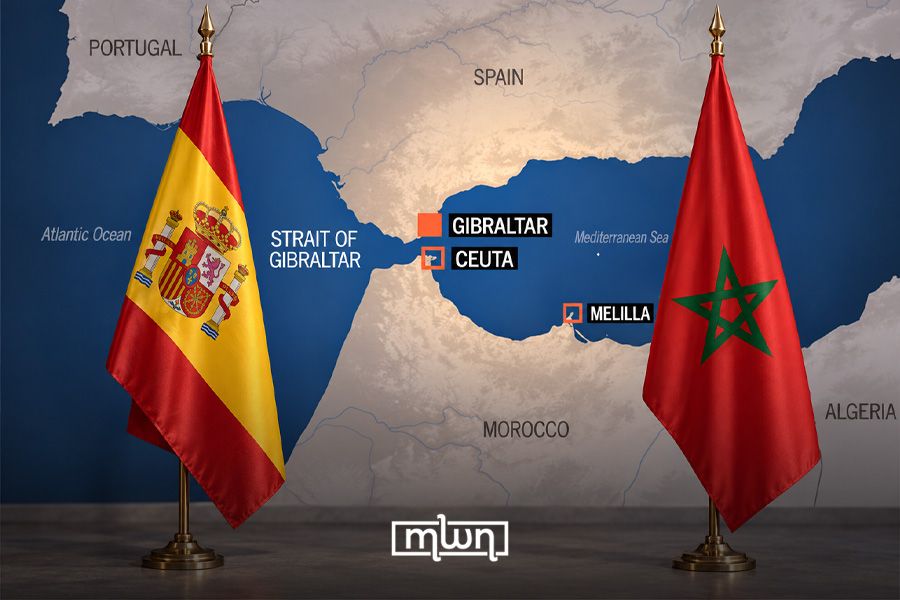
Marrakech – Spain retains a clear overall military advantage over Morocco, but Rabat’s buildup is changing the cost of limited crises rather than pushing the two neighbors toward war, according to a report published Wednesday by Filippo Sardella on the Istituto Analisi Relazioni Internazionali (IARI).
The analysis by the Italian researcher separates equipment inventories from combat-ready capability and places economic interdependence at the center of the relationship.
Sardella treated the two states as economic partners before rivals. He cautioned against reading arms spending as hostile intent, writing that “the claim that ‘Morocco is arming itself to attack Spain’ cannot be substantiated from expenditure data.”
A more plausible reading, he argued, is that Rabat “may seek an improved negotiating position in bilateral disputes without pursuing armed confrontation,” with pressure applied through diplomacy, migration policy, trade, and maritime legal disputes rather than force.
The spending gap remains wide. SIPRI figures reproduced by Euronews put Spain’s 2025 military expenditure near €34.287 billion against €5.645 billion for Morocco, a ratio closer to six to one than the “three times” cited in some reporting. Real growth reached 50% in Spain and 6.6% in Morocco. Measured against GDP, the order shifts to about 2.1% for Spain and 3.54% for Morocco.
Sardella warned against mixing accounting categories. Morocco’s often-quoted 10.28% is a share of government spending, not GDP, he pointed out, and the 2026 finance law’s MAD 55.3 billion ($5.53 billion) in payment appropriations is not the same as its MAD 157.17 billion ($15.72 billion) in multi-year commitment authorizations.
Morocco holds the edge in manpower, with an estimated 195,000 to 200,000 active personnel and 150,000 reservists, supported by conscription reinstated in 2019. Spain counted 116,739 serving members in early 2025. The report dismissed a Global Firepower claim of 400,000 Moroccan troops as uncorroborated.
Numbers alone decide little, Sardella argued, because “the relevant asymmetry is the force that can actually be mobilized in a given theater and timeframe – not total national personnel strength.”
In the air, Spain fields 81 EF-18 Hornets and 67 Eurofighters, with 45 more on order. Morocco is modernizing along a different path. Lockheed Martin announced the first flight of its F-16 Block 72 on October 6, part of a 2019 US authorization for 25 new jets and 23 upgrade kits.
Sardella treated that milestone with caution, since “an aircraft in flight testing is not yet deployable by the receiving air force.” He classified reports of a 32-aircraft F-35 deal as speculation. Rabat has also received 12 of 24 AH-64E Apaches and three Israeli Barak MX air-defense batteries.
On land, Spain operates about 220 Leopard 2Es and 50 Leopard 2A4s, while Morocco has roughly 200 Abrams with 150 more planned.
The widest gap favors Rabat in rocket artillery: Spain retired its last system in 2011, whereas Morocco has bought Chinese and Israeli launchers, including PULS. A 2023 US approval covered 18 HIMARS launchers and associated missiles worth $524.2 million, though approval is not delivery.
At sea, Spain’s advantage is structural. It operates five Álvaro de Bazán-class frigates, the Juan Carlos I assault ship, and the S-81 Isaac Peral submarine, commissioned in November 2023. Morocco has no operational submarines. Sardella corrected a common error, clarifying that air-independent propulsion was integrated in the third S-80 boat, not the second.
Economic ties form the report’s core. Citing EFE, Sardella placed 2025 bilateral merchandise trade at €22.757 billion, with Spanish exports of €12.33 billion and imports of €10.43 billion.
The automotive sector links the two economies most closely, as Tanger Med suppliers feed Renault and Stellantis plants in Vigo, Barcelona, Valencia, and Valladolid. A prolonged dispute, he warned, would hit production and jobs on both shores.
Rabat’s spending is not centered on Spain alone. SIPRI recorded Algerian military expenditure of about $25.4 billion in 2025, against $6.3 billion for Morocco, which ties much of the investment to the North African balance and the Western Sahara dispute.
Sardella added that NATO’s Article 6 does not name the occupied cities of Ceuta and Melilla, though it does not bar allied assistance in a crisis.
His conclusion framed the trajectory as “not a comprehensive reversal of the balance but the transformation of some regional asymmetries.” Short-term signals to watch, he wrote, include the F-16 Block 72’s entry into service, HIMARS timelines, the Barak MX batteries’ status, and delivery of Spain’s second submarine.
Read also: Madrid’s Moroccan Obsession: Spain Arms to the Teeth, Then Dreads Rabat Doing the Same