
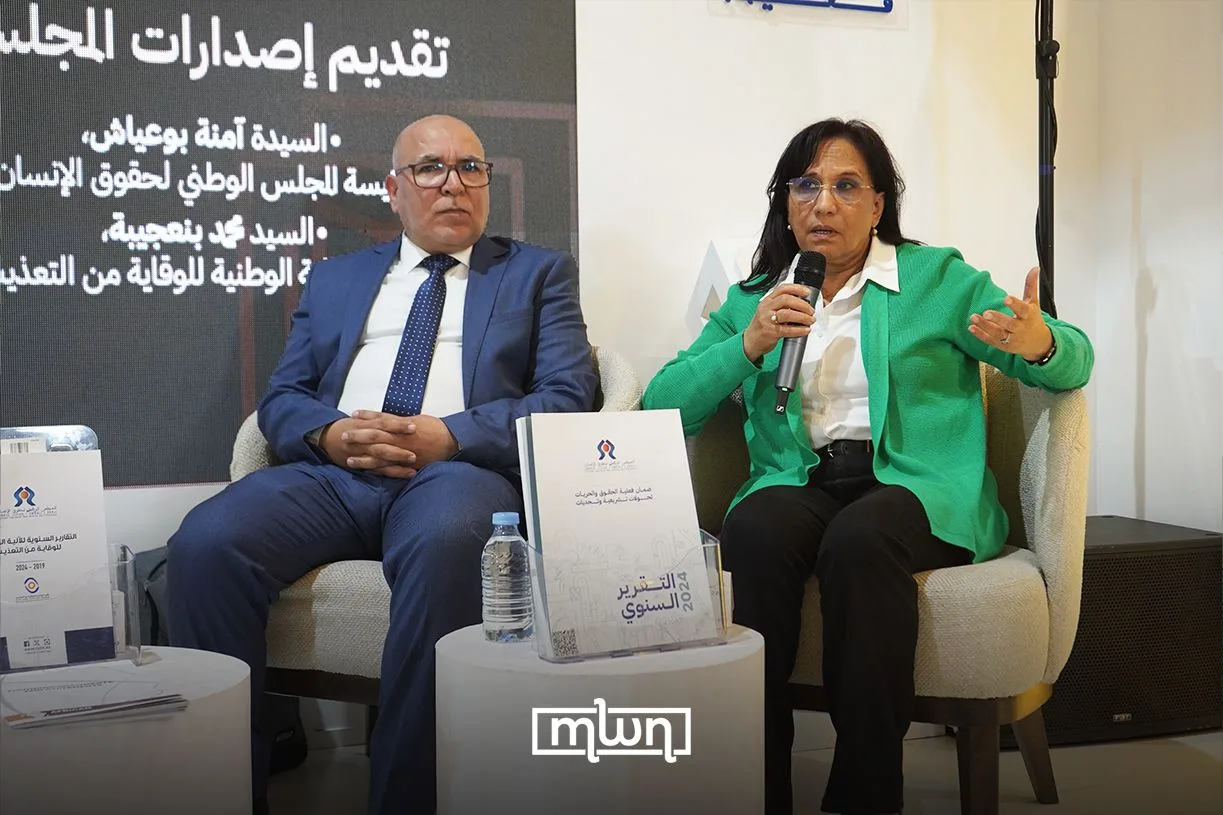
Rabat – Morocco’s National Human Rights Council (CNDH) presented today a series of publications during a dedicated panel on human rights in places of deprivation of liberty. The session took place as part of the ongoing 2026 International Publishing and Book Fair (SIEL), bringing together institutional representatives working on monitoring, prevention, and legal reform around detention conditions.
The discussion moved between legal evolution, field observation, and institutional practice, with a shared concern for how rights function in spaces where liberty is restricted.
Legal safeguards in arrest procedures
Panelists described a shift in the legal framework governing arrest. Rights are now formally integrated into the process from the first moment of custody.
“Today, anyone who is arrested receives a chart enumerating all their rights,” said CNDH President Amina Bouayach. The same framework is now applied across detention centers nationwide, making legal guarantees more visible and operational in practice.
Fieldwork at the core of prevention
The National Mechanism for the Prevention of Torture (NPM), an independent body established in 2019 within CNDH, to monitor, prevent, and combat torture and cruel treatment in places of deprivation of liberty, relies on direct access to detention environments. These include prisons, police custody facilities, child protection centers, and social care institutions.
Mohamed Benaajiba, Physician and Director of the National Center for Blood Transfusion, underlined that prison visits form the foundation of the mechanism’s work. They allow teams to observe conditions on site, engage with staff and detainees, and collect information that cannot be captured through reports alone.
These visits, which reached 166 across different types of institutions, feed directly into the mechanism’s annual reporting process.
Bouayach on shift in detention oversight
On the sidelines of the panel, Bouayach told Morocco World News (MWN) that the NPM marked a turning point in the monitoring of detention.
She recalled its launch in 2019, noting that “its first visit took place during the COVID-19 crisis and has continued since then.”
“There has been significant progress in the protection of persons held in places of deprivation of liberty,” Bouayach argued, adding that abuse allegations are now examined and may lead to judicial investigations.
Contrasting this with the past, when “issues related to torture were often hidden and access was restricted,” the CNDH president stressed that “unannounced visits are possible today, allowing direct observation of conditions in detention facilities.”
She described the mechanism as “one of the National Human Rights Council’s key achievements,” saying it contributed to “transforming places of deprivation of liberty into more open spaces marked by dignity and oversight.”
Annual reports as structured documentation
The annual reports presented during the panel reflect a combination of field data, institutional coordination, and national dialogue. They do not function as mere statistical records but as structured documents that track developments over time.
Benaajiba described them as tools that translate field observations into analysis and policy proposals. The aim is to support institutional reforms that strengthen safeguards in places where liberty is restricted.
Detention and the question of dignity
A recurring point throughout the discussion concerned the meaning of detention itself. Bouayach insisted that deprivation of liberty cannot extend to the erosion of dignity or basic rights.
“Deprivation of liberty is a punishment in itself. It should not be accompanied by harm to dignity or denial of fundamental rights,” she said, adding that legal protection remains attached to the individual regardless of their place of detention.
The discussion placed this principle within national legal standards and international human rights frameworks.
Prevention through cooperation and oversight
The CNDH, together with its prevention mechanism, works in coordination with institutions responsible for law enforcement and detention management. This includes access arrangements for monitoring bodies, training initiatives, and institutional exchanges.
The panel described this cooperation as essential to ensuring that rights frameworks are not limited to legal texts but are applied within operational settings.
Publications presented at SIEL 2026
The session also marked the presentation of thematic publications produced by the NPM. These documents draw on field visits and institutional work across a range of detention environments.
Far from administrative reports alone, they function as analytical outputs intended to inform public policy and support efforts to improve conditions in places of deprivation of liberty.
The panel at SIEL 2026 emphasized the gap between legal standards and daily practice. The discussion repeatedly returned to the idea that detention does not suspend dignity, and rights remain present even in restricted spaces.