 Join on WhatsApp
 Join on Telegram
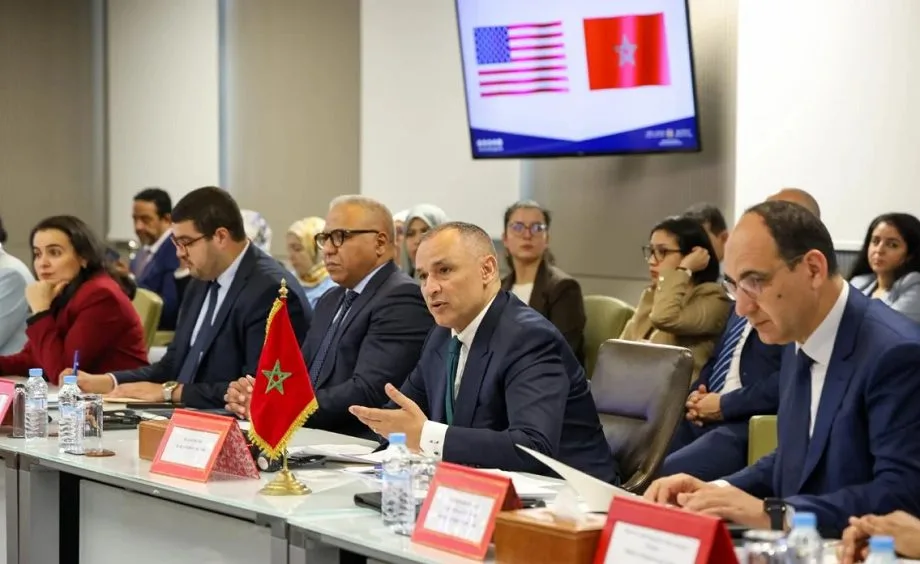
Marrakech – Morocco and the United States held the ninth session of their Free Trade Agreement (FTA) Joint Committee in Rabat on Monday. The meeting brought together Morocco’s Minister of Industry and Commerce, Ryad Mezzour, and a delegation from the Office of the United States Trade Representative (USTR), alongside senior institutional officials from both countries.
The session focused on strengthening bilateral commercial ties and addressing the trade imbalance between the two nations. Mezzour told reporters after the meeting that both sides discussed ways to streamline trade transactions and facilitate access for Moroccan products to the American market. Customs-related issues were also on the agenda, with particular attention to the impact of recent US tariff decisions on bilateral trade flows.
View this post on Instagram
The meeting comes at a particularly sensitive time for Morocco-US commercial relations. In April 2025, the Trump administration imposed a blanket 10% tariff on Moroccan imports as part of its “Liberation Day” trade policy.
Morocco received the baseline rate – the lowest tier applied – while regional neighbors Algeria and Tunisia faced tariffs of 30% and 28%, respectively. The move nonetheless raised concerns about its impact on key Moroccan export sectors, including agro-food, fertilizers, and automotive components.
Mezzour addressed this new trade environment directly, calling for concrete solutions to ensure better balance in bilateral commerce. He also presented Morocco’s position as a strategic hub and gateway to the African market – a point of growing relevance as Washington seeks to diversify its trade partnerships on the continent. Morocco remains the only African country with an FTA with the US.
The agreement, signed on June 15, 2004, and in force since January 1, 2006, eliminated duties on more than 95% of all goods and services between the two countries. Two decades on, the trade relationship has expanded considerably, though the balance has tilted heavily in Washington’s favor.
View this post on Instagram
According to USTR data, US goods exports to Morocco reached $5.5 billion in 2025, up 4.2% from the previous year. US imports from Morocco stood at $1.9 billion, down 2.1%. The US goods trade surplus with Morocco climbed to $3.7 billion in 2025, a 7.7% increase over 2024. In services, bilateral trade totaled an estimated $2 billion in 2024.
This persistent trade gap has drawn scrutiny. A Brookings Institution analysis published in late 2025 found that the FTA has had an overall negative effect on Moroccan exports, including in strategic sectors such as agro-food and automotive. The study attributed this partly to the asymmetry of tariff commitments, with Morocco’s reductions far exceeding those of the US.
Monday’s session – the first since the eighth meeting held in Washington on July 1, 2024 – offered both sides an opportunity to recalibrate. Discussions covered the development of a shared vision for trade facilitation and explored mechanisms to improve the positioning of Moroccan goods under the current tariff landscape.
Morocco’s role in sectors like electric vehicle batteries, which rely on critical minerals found in the North African country, also positions it as a potential partner in US supply chain diversification strategies.
On April 28, US Senator Roger Marshall introduced the Lowering Input Costs for American Farmers Act, a bill to eliminate tariffs and countervailing duties on Moroccan phosphate fertilizer imports to reduce costs for American farmers hit by rising input prices driven in part by the Middle East war and the near-total closure of the Strait of Hormuz.
Trade at the heart of a 250-year bond
The commercial dimension of the relationship has received increasing attention in recent months. In March, US Ambassador Richard Duke Buchan met with Mezzour in Rabat to discuss partnerships aimed at deepening economic ties. Buchan noted at the time that Morocco offers “boundless opportunities for US firms looking to invest.”
Speaking at GITEX Africa in Marrakech in April, he described the economic opportunity in the region as “unlimited,” framing it within Washington’s continued recognition of Moroccan sovereignty over Western Sahara – a position first declared in December 2020 and repeatedly reaffirmed since.
During the opening of Africa’s largest tech summit, he took the message further, telling attendees that US deals “don’t come with strings attached – trade, not aid, not loans, real high-quality investment that lasts.” He called Morocco “the only country in Africa with an investment-grade rating” and urged investors not to wait.
That investment interest now extends to Morocco’s southern provinces, where Washington’s engagement has taken a tangible turn. “American investors are contacting our embassy and consulate non-stop, ready to invest in the Sahara,” he confirmed.
That momentum carried when US Deputy Secretary of State Christopher Landau visited Morocco on his first official trip to the country.
During a joint press conference with Foreign Minister Nasser Bourita in Rabat on April 29, Bourita noted that bilateral trade has multiplied sevenfold since the FTA entered into force. He also announced Morocco’s decision to join the US-launched “Trade Over Aid” initiative.
Landau, for his part, called Morocco “an essential, stable, and strategic partner.” He later attended the inauguration of the new $350 million US consulate compound in Casablanca, now the world’s newest American diplomatic facility, while the oldest remains in Tangier.
“From Tangier to Dakhla, the US stands with Morocco,” Buchan stated at the opening of the new US consulate in Casablanca. Earlier this month, the diplomat attended the first-ever African Lion humanitarian mission in Dakhla.
The convergence of trade, diplomatic, and defense engagements this year reflects the expanding scope of the partnership as both countries mark the 250th anniversary of US independence. Morocco was the first country to recognize American independence in 1777.
With total US government investment in Morocco now exceeding $500 million and more than 1,000 staff working for the US mission in the country, the FTA Joint Committee session adds a concrete commercial track to a relationship that has broadened well beyond its original dimensions.
The FTA’s Joint Committee serves as the primary institutional channel for managing the agreement and resolving bilateral trade issues.
Read also: What Did US Department of State Say in Its 2025 Investment Climate Report on Morocco