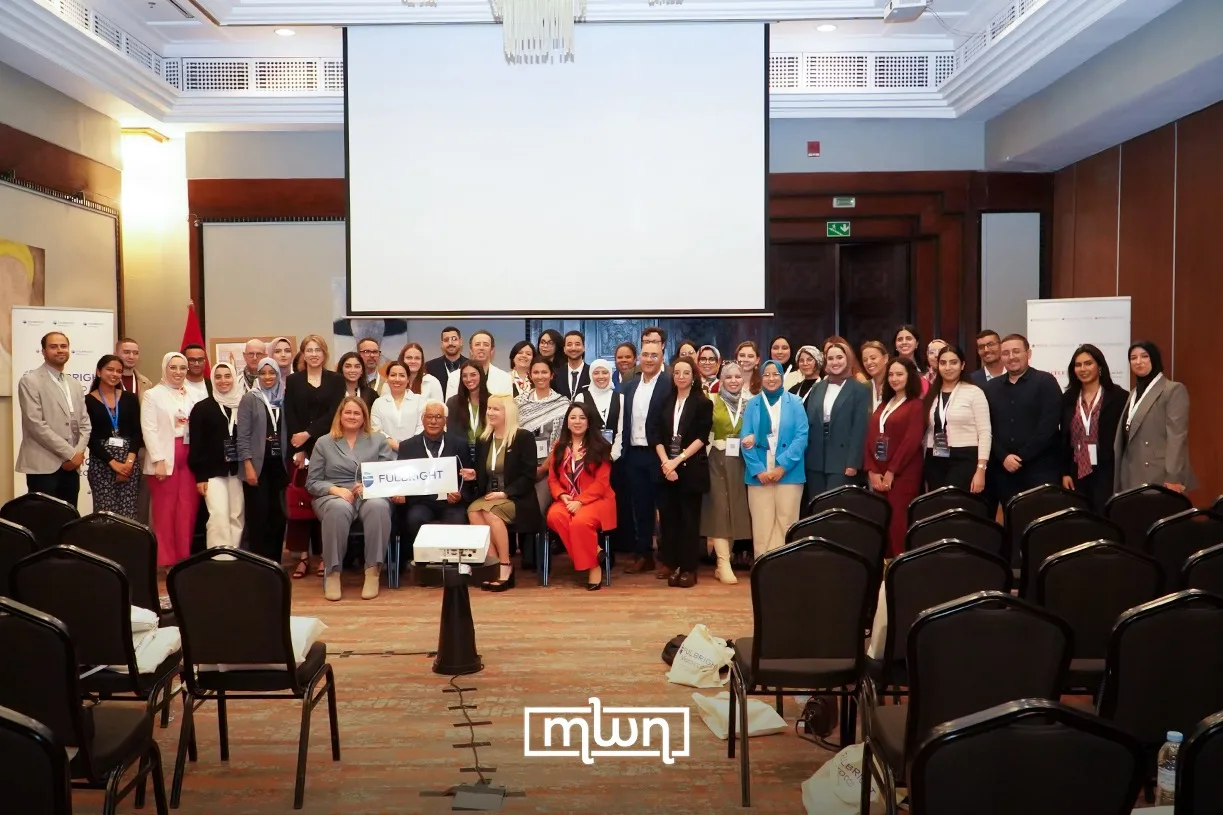
Casablanca – Fulbright scholars, alumni, and academic representatives gathered on Monday at Casablanca’s Marriott Hotel for the first day of the 2026 Fulbright Research Symposium, organized by the Moroccan-American Commission for Educational and Cultural Exchange (MACECE).
Held under the theme “Knowledge Without Borders: Innovation and the Future of Higher Education,” the two-day symposium brings together researchers from different disciplines to present their work, exchange perspectives, and engage in conversations around the future of research and higher education.
The event opened with remarks by Rebecca B. Geffner, Executive Director of MACECE, and Nick Barnett, Public Affairs Officer at the US Embassy in Rabat, followed by a keynote address from Hamid Bouabid, Director of Scientific Research and Innovation at Morocco’s Ministry of Higher Education, Scientific Research and Innovation.
The lasting value of academic exchange
In her opening remarks, Geffner addressed Fulbright scholars and alumni on the lasting value of academic exchange and the importance of maintaining strong people-to-people connections through research, education, and cultural dialogue.
Reflecting on the growing challenges facing the world today, she stressed that exchange programs such as Fulbright go beyond academics. “Nowadays, this people-to-people diplomacy is critical to tackle the world’s challenges, which seem to be getting greater and more difficult every single day,” Geffner emphasized.
She also encouraged participants to remain connected to the Fulbright community beyond the duration of their grants, noting that alumni become part of a network of more than 4,000 individuals linked to the program between Morocco and the United States.
Speaking to Morocco World News (MWN) on the sidelines of the event, Geffner reflected on the special meaning this year’s symposium carries, as it coincides with the 80th anniversary of the Fulbright Program, as well as 250 years of Moroccan-American relations.
“This is so important not only for our people-to-people diplomacy, but also for supporting research and knowledge transfer across communities,” Geffner told MWN.
Ecology and environmental systems
Bringing together Fulbright alumni, current scholars, researchers, and academic partners, the symposium quickly shifted from formal remarks into conversations driven by research, fieldwork, and lived experience.
The first day opened with a panel on ecology and environmental systems, where speakers tackled environmental questions through sharply different lenses. Discussions moved between flood and drought resilience, biodiversity and agriculture, water-related challenges, and Morocco’s earthen architectural heritage.
Each speaker offered insight into research shaped not only by academic interest, but also by real environmental and societal concerns affecting communities today.
Though grouped under a broad theme, the presentations approached their subjects from very different angles, reflecting the diversity of the Fulbright research community itself.
Inside the symposium’s AI and engineering panel
The second panel shifted the conversation toward AI and engineering, exploring both the opportunities and concerns surrounding rapidly evolving technologies.
One of the presentations focused on how AI models can support breast cancer diagnosis and treatment by integrating diverse medical data, including clinical reports, imaging, and genomics. The research examined how multimodal AI systems could help improve accuracy and deliver more personalized analysis for patients.
But the discussion around artificial intelligence was not limited to innovation alone. Another presentation turned attention toward the growing safety and security risks tied to AI systems, from misinformation and deepfakes to privacy concerns and biased decision-making.
Through real-world examples, the speaker explored how AI models can sometimes be manipulated, misclassify information, or unintentionally expose sensitive data, raising broader questions about what it truly means for AI systems to be reliable and safe.
The panel also reflected the wide range of directions AI research is taking today. Other presentations explored the role of artificial intelligence in civil engineering and construction, as well as its use in group decision-making and consensus-building within complex collaborative environments.
Long-standing ties beyond academia
Beyond the presentations themselves, the symposium highlighted the work, collaboration, and curiosity that define the Fulbright experience. More than a space for sharing research findings, the event created room for dialogue between scholars working across disciplines and borders while reflecting on the evolving role of higher education in a fast-changing world.
The symposium also reflected the broader significance of Moroccan-American academic exchange, particularly as both countries mark 250 years of diplomatic ties, dating back to Morocco’s recognition of the US’s independence.
“The Fulbright program is really the pinnacle of U.S. exchange programs and the breadth and strength of the program here is reflective of the strong relationship between Morocco and the United States,” Barnett Nick Barnett told MWN.