
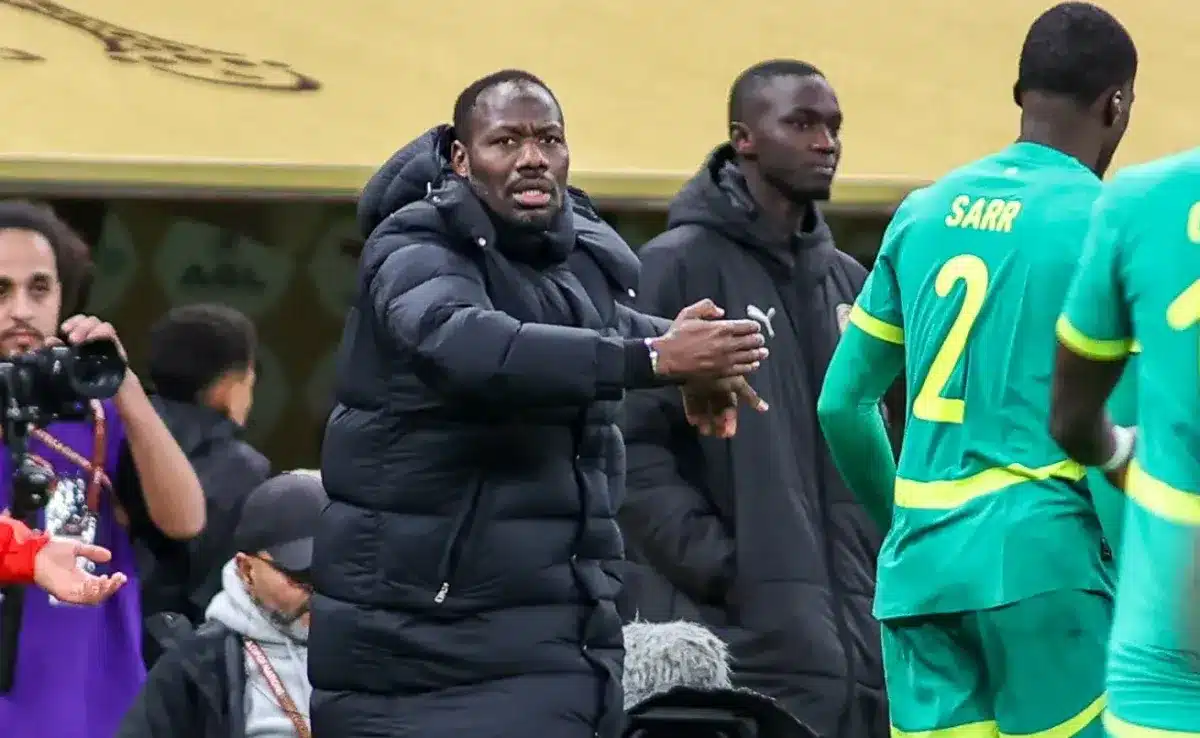
Rabat – At a decisive moment in the ongoing legal battle surrounding the 2025 Africa Cup of Nations (AFCON) final, Senegal head coach Pape Thiaw has once again shifted the narrative surrounding his team’s walk-off.
Months after the AFCON final descended into chaos, and following his own post-match admission in which he stated that “he made a mistake during the 2025 Africa Cup of Nations final in Rabat when he asked his players to leave the pitch after Morocco were awarded a late VAR-confirmed penalty,” Pepe Thiao now claims that Senegal’s temporary withdrawal from the pitch had nothing to do with the refereeing decisions or the penalty awarded to Morocco.
He alleged that his team’s withdrawal was due to security disturbances inside the stadium involving both Moroccan and Senegalese supporters.
“During the Africa Cup of Nations final, we partially left the field because it was impossible to finish the match in that atmosphere,” Thiao said. “There were disturbances in the stands caused by Moroccan supporters and some Senegalese supporters, and we did not leave the field to protest against the referee or his decisions.”
The statement represents yet another version of events in a case that has already seen multiple justifications emerge from the Senegalese side since the final ended in controversy.
Before the match itself, Senegalese officials and media close to the camp repeatedly raised concerns regarding logistics and accommodation conditions in Morocco. Following the match, the discourse shifted toward allegations of injustice and refereeing controversy. Now, with the case entering a pivotal stage before the Court of Arbitration for Sport, the explanation has evolved once again, after the observed failure of all other narratives, this time toward security concerns inside the stadium.
The timing of the statement is significant.
Just days ago, the Royal Moroccan Football Federation officially submitted its legal response to CAS in Lausanne regarding Senegal’s appeal against the decision that upheld Morocco’s AFCON title. Moroccan sources denied reports suggesting the federation had missed legal deadlines, insisting all procedures were respected according to applicable regulations.
Morocco’s legal argument remains centered on CAF’s disciplinary rules, particularly the provisions stating that any team refusing to continue a match is considered to have forfeited the game. CAF’s Appeals Committee had consequently awarded Morocco a 3-0 victory after Senegal’s players stayed off the field for more than 15 minutes following the penalty decision, according to the Guardian.
What increasingly weakens Senegal’s position in the public eye is the succession of changing narratives surrounding the withdrawal itself.
Initially, discussions focused heavily on alleged organizational failures and accommodation complaints. Then came allegations of injustice linked to the decisive penalty. Now, the latest explanation attempts to disconnect the walk-off entirely from the referee by presenting it as a reaction to crowd disturbances.
However, critics argue that the sequence raises serious questions about consistency. If security concerns were truly the central issue behind the withdrawal, why was the controversy initially framed around refereeing and tournament conditions rather than stadium safety?
The evolving explanations risk reinforcing the perception that Senegal’s camp is searching for legal and moral justification after the fact rather than presenting a stable and coherent account of what happened during the final.
Meanwhile, Morocco’s position has remained largely unchanged since the incident occurred. The Moroccan federation continues to rely on CAF’s regulations and official match reports, arguing that the issue is ultimately straightforward from a legal perspective, which is a team abandoning the game during an official continental final.
Beyond the legal dimensions, the controversy also continues to overshadow what was otherwise considered the most commercially successful edition in AFCON history. Hosted by Morocco, the tournament broke major broadcasting, attendance, and sponsorship records, generating unprecedented global visibility for African football.
Yet despite the tournament’s historic success, the image of the final remains deeply tied to the moment Senegal left the pitch, a decision that now appears to be followed by illogical justifications over how history will remember it.
You can read also: 2025 AFCON Final: The Truth About Senegal’s Walk-Off, Logistics Claims, and a Decisive Rulebook