Fez– Morocco has launched a new digital platform aimed at reshaping how foreign trade is handled, in a move designed to cut delays, simplify procedures, and strengthen the country’s position in global logistics.
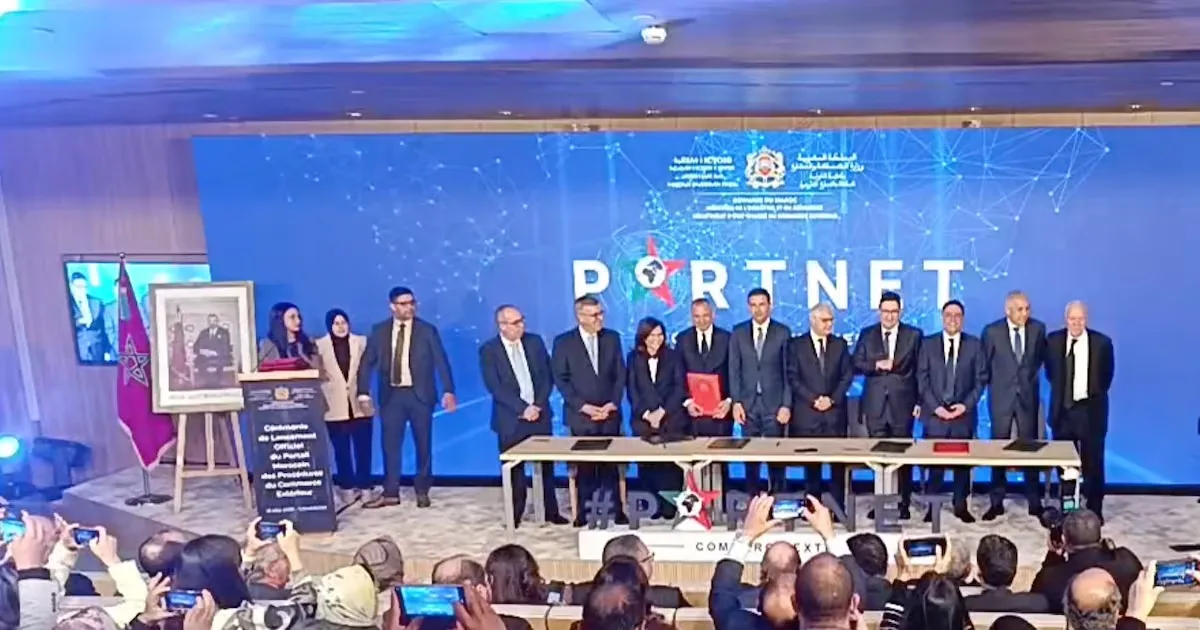
The new system, called the PortNet Commerce Extérieur platform, was officially introduced on Monday, 18 May 2026, at the headquarters of the National Ports Agency in Casablanca.
Built as a unified digital gateway, it brings together import and export procedures that were previously spread across multiple administrations and systems.
Officials say the platform marks a shift in how Morocco manages its external trade, at a time when competitiveness is increasingly defined not only by production capacity, but by speed, coordination, and digital efficiency across supply chains.
At the center of the reform is the ambition to reduce fragmentation.
Until now, operators had to deal separately with customs, ports, banks, logistics companies, and various government departments.
The new system is designed to replace that structure with a single access point for all procedures.
According to government officials, the platform could reduce processing times for trade operations by 20% to 50%.
It is also expected to handle around 40 million documents per year, reflecting the scale of Morocco’s growing trade flows.
The reform comes as Morocco’s foreign trade continues to expand, with exports alone reaching hundreds of billions of dirhams.
Authorities see digitalization as essential to managing this volume more efficiently and reducing hidden costs linked to delays and paperwork.
A key role in this ecosystem is played by the National Ports Agency , alongside the digital trade platform PortNet Commerce Extérieur, which acts as the central interface for the new system.
The project also brings in major port actors such as Tanger Med Port Authority, reflecting the strategic importance of Tanger Med in national and international shipping flows.
Tanger Med remains a key pillar of Morocco’s logistics system, handling hundreds of thousands of trucks annually and millions of containers each year.
According to le360, officials stressed that any modernisation of trade procedures must take into account this scale of activity, as well as the broader port network, including ongoing developments at Nador West Med and Dakhla Atlantique.
The platform is also the result of coordination between several government departments and private sector representatives.
Business leaders, including the General Confederation of Moroccan Enterprises, have described administrative delays as a hidden cost that affects export performance and overall competitiveness.
Officials involved in the project said the system is designed to eliminate duplication of data entry and reduce the need for multiple interfaces.
Instead, operators will use a single dashboard to track operations in real time, submit documents, and follow the status of their shipments.
The rollout follows more than a year of technical coordination between institutions, including dozens of meetings and system integration work involving multiple agencies.
Several procedures are already live on the platform, while additional services and institutions are still being added.
A pilot phase will continue in the coming weeks before the system is fully deployed nationwide.
Authorities say the transition must be carefully managed, given the sensitivity and scale of trade operations.
Beyond administrative reform, officials present the platform as part of a wider strategy to position Morocco as a regional logistics hub.
The goal is not only faster procedures, but also better integration between ports, transport networks, and digital systems.
In this context, the launch of PortNet reflects a broader direction in economic policy: a trade system built on speed, coordination, and data-driven management, rather than fragmented processes and paper-based workflows.