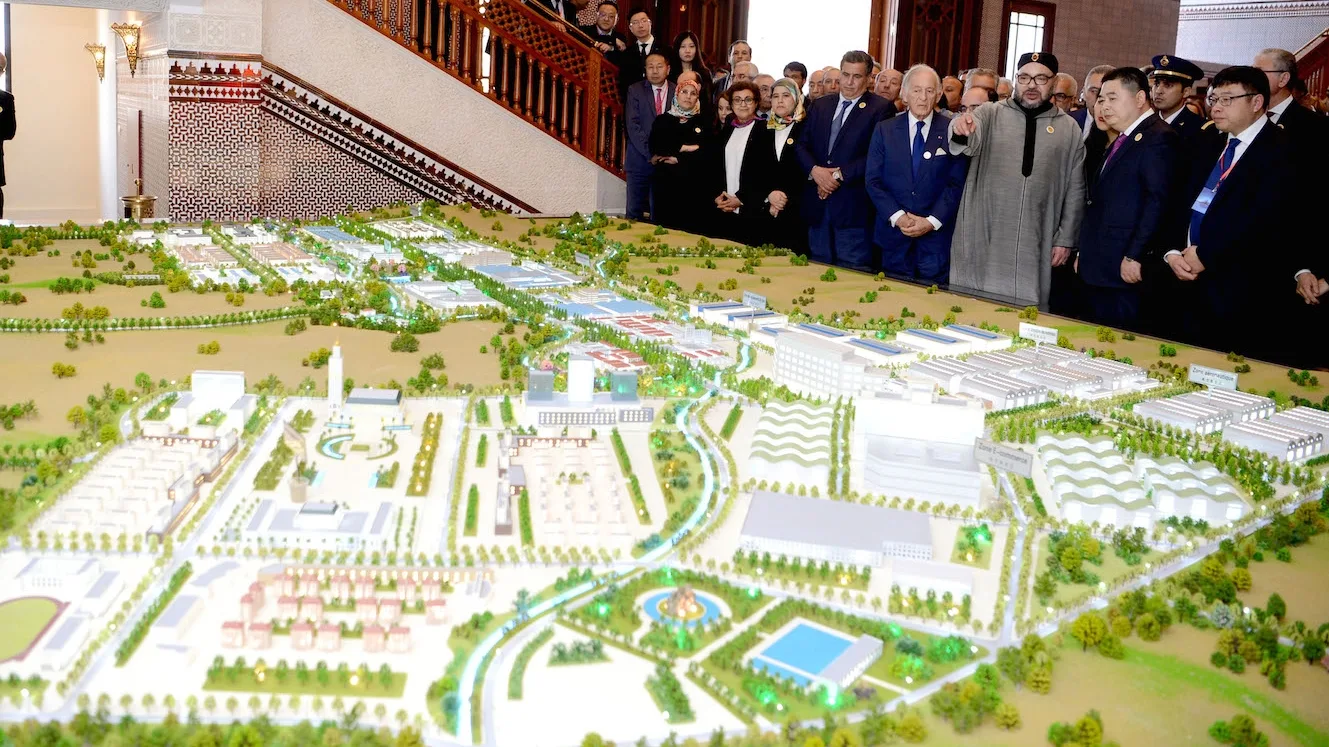
Marrakech – Outside the Moroccan port city of Tangier, Chinese auto-parts manufacturers are erecting factories at speed across a 500-hectare industrial zone carved from farmland.
Tanger Tech City already hosts nearly a dozen Chinese firms producing tires, brakes, and battery components. A Sentury Tire plant is operational. BTR New Material Group, the world’s largest supplier of battery anodes, is building another. APG, a Chinese brakes manufacturer, plans to open a $70 million facility in the zone this year.
The cluster accounts for only a fraction of roughly $6 billion in Chinese capital that has poured into Morocco since the pandemic, according to Rhodium Group data. That surge now alarms EU policymakers who fear Beijing is exploiting Morocco’s free trade agreements to route subsidized goods into European markets while dodging steep tariffs.
EU Trade Commissioner Maroš Šefčovič told the Financial Times the investment amounted to “transshipment” of Chinese overcapacity through trade partners. “It’s becoming a big, big issue for the European economy,” Šefčovič warned.
Brussels has imposed tariffs of up to 45% on Chinese EVs. The OECD estimates China subsidizes industry at three to eight times the rate of its member countries, often through soft loans that evade detection.
Last year, the European Commission penalized aluminium wheel exports from Morocco after concluding they received unfair subsidies from both Rabat and Beijing’s Belt and Road Initiative.
Yet targeting Morocco carries considerable risk. Both Renault and Stellantis run major assembly plants in the country, embedding it firmly in European automotive supply chains. The EU remains Morocco’s largest trade partner, absorbing one-third of its exports, worth more than €26 billion in 2025. Over half of that total originated from the machinery and transport sectors.
Further along the Atlantic coast, Chinese battery maker Gotion High-tech, 25% owned by Volkswagen, is constructing a $1.3 billion gigafactory in Kenitra. Morocco’s trade minister, Ryad Mezzour, declared last December that the country expected a “complete value chain” serving up to 500,000 electric vehicles annually by the end of 2026.
Junjie Cai, project director at APG, argued that European, Moroccan, and Chinese companies can “all share the benefits of this collaboration.” The plant would combine local labor and materials with Chinese supplies and technology, delivering competitively priced components near European factories, he added.
Morocco counters tariff leakage claims with rules and incentives
Moroccan officials rebuff the notion that the country functions as a conduit for Chinese manufacturers to penetrate EU markets unchecked, and firmly contest the backdoor accusation.
Yassine Elahyani, head of emerging industries at the Moroccan Investment and Export Development Agency (AMDIE), reminded Chinese investors at a Dentons-organized conference in Casablanca that exports destined for Europe must observe and satisfy stringent rules of origin, requiring goods to undergo substantial local transformation before qualifying for tariff-free access to the bloc.
Morocco’s pitch includes a five-year business tax holiday, a young workforce, green energy inputs that reduce EU carbon tax liabilities, and access to 2.5 billion consumers through some 50 free trade agreements.
Mehdi Laraki, chair of the Morocco-China Business Council, noted that delegations of potential Chinese investors have arrived at a rate of two to three per week since the pandemic.
Geopolitical analysts, however, urge caution. Ahmed Aboudouh of Chatham House warned that China can “dominate the whole vertical supply chain” in Morocco, from phosphate processing for batteries to port infrastructure. “This is what concerns the EU, and it should,” Aboudouh pressed.
Bob Savic of the Global Policy Institute contended the aluminium wheels case exposed China’s strategy of routing mid-value goods through North Africa. “This dynamic could turn North Africa into a more contested economic space, where EU efforts at ‘de-risking’ intersect with Chinese strategies to offshore industrial capacity,” Savic cautioned.
A regulatory test looms with the Commission’s proposed Industrial Accelerator Act, which would restrict certain public procurement to products with European content. The European Association of Automotive Suppliers (Clepa) is lobbying for non-EU countries to qualify only if they reject distortive subsidies and adhere to equivalent regulatory standards.
New Stimson Centre research, reported by Business Insider Africa on May 30, identified Morocco as a critical node in China’s green industrial expansion, with investment accelerating after Rabat joined the Belt and Road Initiative in 2017. The country’s massive phosphate reserves, established automotive sector, and proximity to Europe reinforce its appeal.
The publication separately reported on May 31 that the situation poses a regulatory dilemma for Brussels, since penalizing Moroccan exports risks disrupting supply chains for European carmakers operating there.
The African Development Bank’s (AfDB) 2025 Africa Industrialization Index, released May 25 in Brazzaville, ranked Morocco as the continent’s top industrial economy, overtaking South Africa on the strength of sustained industrial upgrading and export diversification.
The accompanying Africa Industrial Investment Barometer found North Africa captured 56% of cumulative continental industrial investment between 2020 and 2025, with Morocco and Egypt at the forefront.
Read also: NYT Explores How Morocco Became China’s Gateway to Tariff-Free Europe