
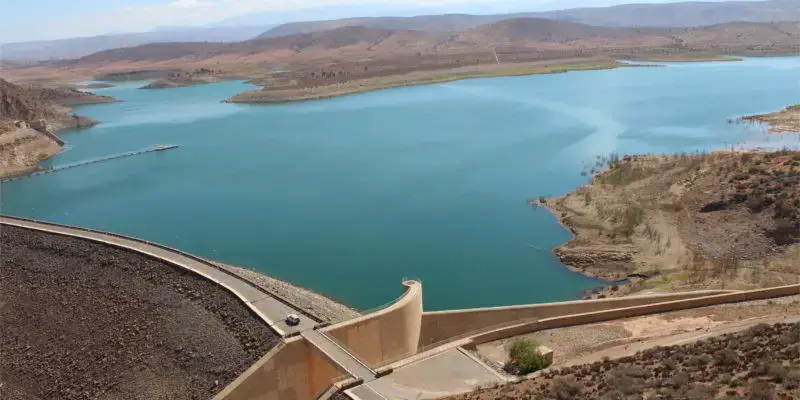
Rabat – Morocco’s dam system reached a national fill rate of 75.7% as of June 1. Total stored water surpassed 12.8 billion cubic meters, according to recent data from the “Maadialna” platform under the Ministry of Equipment and Water.
The figure represents a sharp annual rise of 94%, a sign of recovery after several dry years that strained national water supply.
The overall picture suggests a return of abundance in several northern basins. At the same time, conditions remain uneven, with southern and south-eastern regions still under pressure.
Northern basins near full capacity
The Loukkos basin ranks among the strongest areas in the country, with a fill rate of 90.8% and about 1.78 billion cubic meters stored. Several dams in the basin approach full capacity. Charif El Idrissi, Chefchaouen and Nakhla reach 99% each. Dar Khroufa and Smir reach 98%. Oued El Makhazine, the largest reservoir in the basin, holds 89% of its capacity, equal to roughly 624 million cubic meters. A few sites remain far lower, such as Joumoua at 27% and Ben Abdelkrim Khattabi at 54%.
The Moulouya basin posts a rate of 72.7%, with more than 510 million cubic meters in storage. Sur Oued Za reaches full capacity. Sfisif records 98% and Rkiza 88%. Mohammed V dam holds 84% with about 139 million cubic meters. Hassan II remains at 58%, while Injil stays at 22%.
Sebou also shows strong reserves, with 88.1% fill and 4.733 billion cubic meters stored. Bouhouda reaches full capacity. Sahla reaches 99% and Bab Louta 98%. Idriss I holds 94% and more than 1 billion cubic meters. Al Wahda dam, among the largest in Africa, reaches 88% with 3.063 billion cubic meters. Lower levels appear at Sidi Echahed at 67%, Asfalou at 61% and Michlifen at 54%.
Central basins show mixed balance
Oum Er Rbia records 66% and more than 3.3 billion cubic meters of reserves. Hassan I and Sidi Idriss reach 99%. Bin El Ouidane reaches 94% with about 1.2 billion cubic meters. Ahmed El Hansali reaches 86%, while Moulay Youssef reaches 90%. Al Massira, the second largest dam in the country, remains at 43% despite a large volume of 1.14 billion cubic meters. Imfout stays low at 29%.
The Tensift basin shows a notably high rate of 94.6% with 192.1 million cubic meters stored. Abou Abbass El Sabti reaches 99%. Yaacoub El Manssour records 98%. Lalla Takerkousst reaches 93%, and Moulay Abderrahmane reaches 92%. Ben Slimane El Jazouli remains at 80%.
The Bouregreg basin, which supplies drinking water to Rabat and Casablanca, reaches 88.8% with 1.309 billion cubic meters available. Tiddas reaches 92%, Sidi Mohamed Ben Abdellah 88%, Tamesna 87% and El Maleh 83%. El Hmer remains a weak point at 23%.
Southern and eastern basins under strain
Souss Massa records a fill rate of 54% with 390.8 million cubic meters stored. The basin remains under pressure due to heavy agricultural demand. Moulay Abdallah reaches 94%, Ahl Souss 93%, Dkhila 93% and Oulouze 87%. Youssef Ben Tachfine reaches 49% with 142.5 million cubic meters. Abdelmoumene stands at 36% with 72.3 million cubic meters. Med Mokhtar Soussi remains the lowest at 10%.
Draa Oued Noun shows one of the lowest national levels at 38.4% and 402.8 million cubic meters stored. Agdez reaches 49%. Mansour Dahbi reaches 45% with 200.7 million cubic meters. Touizgui Ramz remains at 25%, while Sultan Moulay Ali Cherif drops to 21%.
Guir Ziz Gheris records 51.3% and 281.2 million cubic meters. Hassan Addakhil reaches 71% and 204.2 million cubic meters, which supports the basin’s overall balance. Kadoussa remains at 32%. Toudgha stays in a critical state at 10% with 3.6 million cubic meters.
The national figures point to a strong recovery in water reserves after years of drought stress.
The contrast between regions defines Morocco’s water map, where abundance in the north sits alongside persistent scarcity in the south and east.