 Join on WhatsApp
 Join on Telegram
Marrakech – Tamwilcom, Morocco’s public financial institution, on Wednesday launched its 2026-2030 strategic plan, dubbed “Jossour 2030,” targeting MAD 300 billion ($30 billion) in total financing and MAD 170 billion ($17 billion) in commitments over the five-year period.
The plan also aims to channel over MAD 60 billion ($6 billion) in cumulative private investment and support the creation of 45,000 gross jobs annually.
By 2030, the institution expects to reach roughly 435,000 beneficiaries – of whom 330,000 will be micro and very small enterprises – through its expanded interventions. The strategy rests on three pillars: guarantee, territories, and public policy accompaniment.
The launch ceremony, held in Salé, was presided over by Minister of Economy and Finance Nadia Fettah, who also chairs Tamwilcom’s board of directors.
Tamwilcom Director General Said Jabrani described the plan as a “collective work” shaped by partners’ “needs, comments, proposals, and constructive opinions.”
He framed the name itself as a statement of purpose: “We bridge entrepreneurs and financing, project holders and support structures, territories and development. It is Jossour in the plural – not one bridge, but bridges between different ecosystems.”
Jabrani also outlined new operational measures taking effect June 4. The guarantee threshold expands from enterprises with up to MAD 200 million ($20 million) in turnover to those reaching MAD 500 million ($50 million). The guarantee ratio for very small enterprise loans rises from 70% to 75%.
Tamwilcom will also accelerate co-financing programs targeting women entrepreneurs, Moroccans abroad investing domestically, and energy transition projects. Two additional areas of focus, Jabrani added, are export financing and supply chain management.
From national reform to regional financing reach
Fettah noted that the new strategy arrives at a moment defined by Morocco’s ongoing economic and social transformation under the vision of King Mohammed VI. Despite successive crises, geopolitical tensions, and disruptions to the global economy, Morocco has demonstrated a resilience acknowledged by its international partners and financial markets, she argued.
That resilience, the minister maintained, stems from a long-term vision, continued structural reforms, and the preservation of macroeconomic balances – all while reinforcing investment and national economic competitiveness.
Fettah placed the private sector at the center of Morocco’s emergence trajectory, contending that a strong private sector requires “fluid, inclusive and efficient” access to financing.
She recalled the 2020 reform of the national guarantee system that transformed the former Caisse Centrale de Garantie (CCG) into Tamwilcom. The shift was designed to turn the guarantee mechanism into a lever for investment, entrepreneurship, and growth.
The primary beneficiaries of that transformation, she explained, are very small, small, and medium enterprises (VSMEs), which form the backbone of the national economic fabric.
The minister also called for a collective mobilization across the broader financial ecosystem – banks, financing companies, microfinance institutions, investment funds, and fintechs – to accelerate private investment.
“Jossour 2030” carries a vision of “more inclusive, accessible and innovative” financing, Fettah stated, in line with the national financial inclusion strategy. The ambition, she added, is to leave behind no territory, no enterprise, no entrepreneur, and no young talent.
Jabrani identified employment, financial inclusion, sustainability, and territories as the plan’s four strategic priorities.
He singled out territorial customization as especially urgent, arguing that the current uniform approach to guarantee and co-financing products no longer fits Morocco’s diverse economic landscape. “Each territory has its specificities, its fabric, sectors that are more of a priority than elsewhere, he noted, announcing that Tamwilcom will begin adapting its offerings region by region.
The institution also plans to build a formal impact measurement practice and share its data across the financial ecosystem. “It does not belong to us. It belongs to everyone, so we can make the right decisions and the right choices,” Jabrani declared.
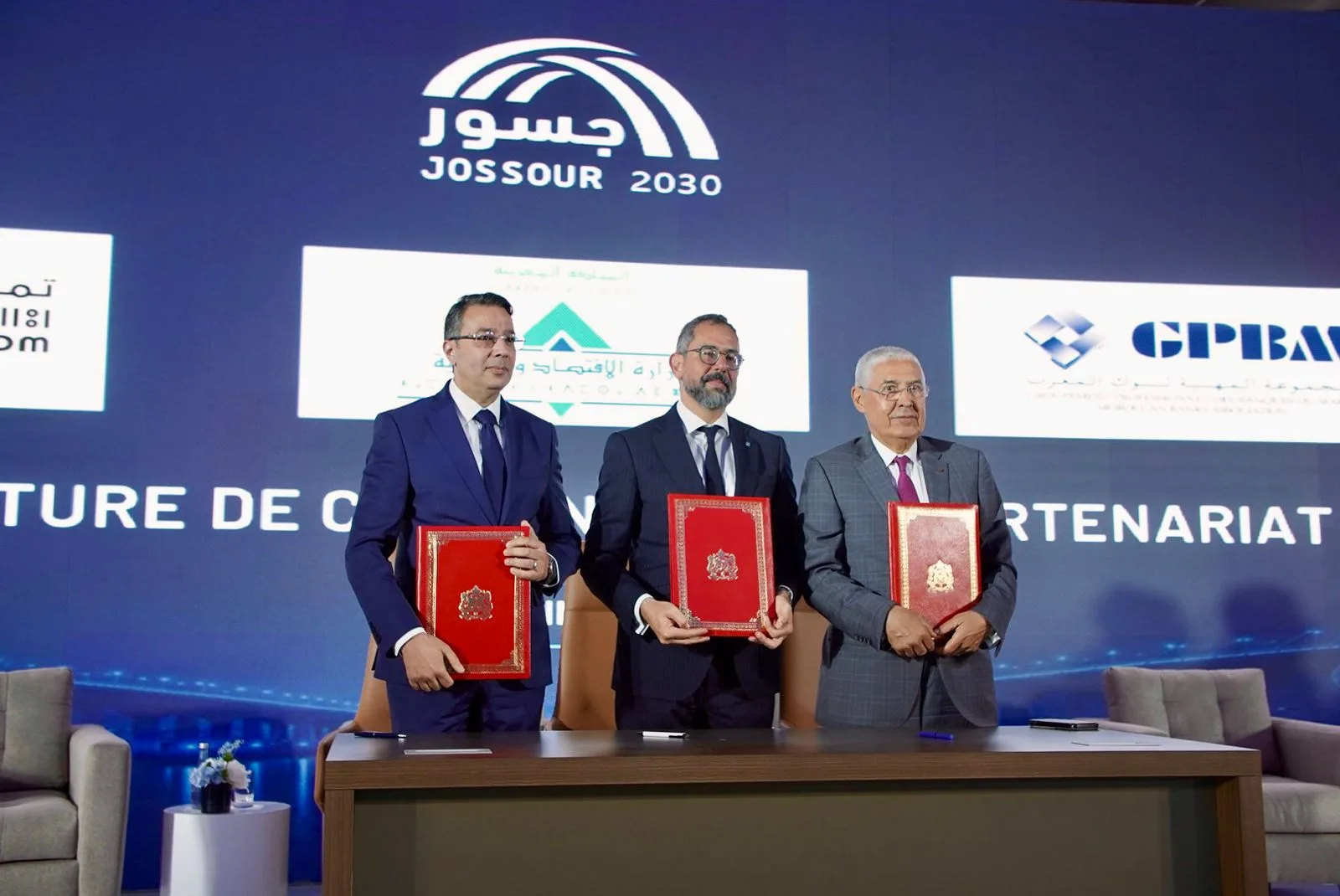
The event also featured the signing of two partnership agreements intended to operationalize the plan’s key orientations.
The first, concluded with the Association of Regions of Morocco, seeks to bolster support for territorial economic dynamics by developing financing solutions tailored to the needs of each of the country’s twelve regions.
The second agreement, signed with the Ministry of Economy and Finance and the Professional Group of Moroccan Banks (GPBM), targets the expansion of financing for mid-sized enterprises – newly brought within Tamwilcom’s scope of intervention – while strengthening the banking sector’s engagement in VSME financing.
Through both partnerships, the signatories reaffirmed their shared commitment to supporting the rollout of “Jossour 2030” and broadening access to financing for enterprises, entrepreneurs, and territories across the kingdom.
Read also: IFC, Tamwilcom Launch $300 Million Initiative to Boost SME Financing in Morocco