Marrakech – Morocco’s national railway operator, ONCF, is adding retired Italian intercity carriages to its fleet as it works to expand rail capacity before the 2030 FIFA World Cup.
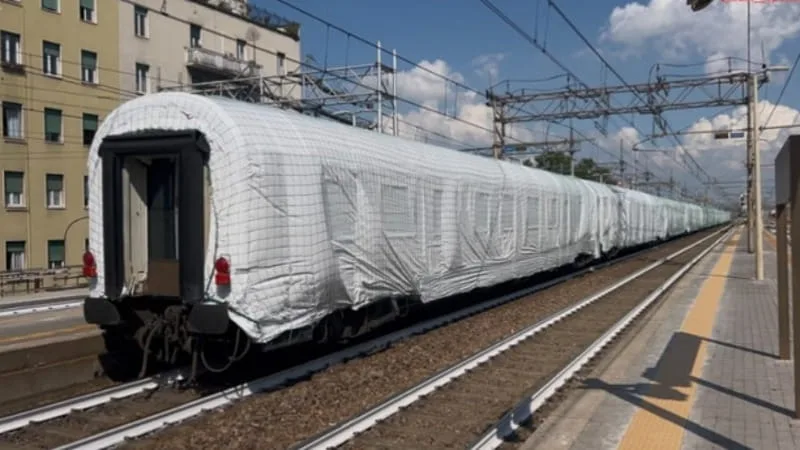
According to Italian media, a convoy of 11 Trenitalia intercity carriages was recently spotted at Parma station. The cars were wrapped in white nylon sheets and secured with green protective netting. They departed from Alessandria Smistamento, one of Italy’s largest rail hubs, headed for the port of Ravenna. From there, they will be shipped to Morocco.
ONCF previously acquired Italy’s TAF trains, high-frequency regional units that served Trenitalia’s commuter lines for years. For the Italian rail operator, the sales eliminate demolition costs typically handled at its San Giuseppe di Cairo facility.
The company is replacing its aging intercity stock with new ETR 108 trainsets. Twelve units will serve routes linking Umbria, Tuscany, and Lazio. Another 22 will run regional services.
For Morocco, the retired Italian rolling stock serves a transitional purpose. ONCF has committed $2.9 billion to acquire 168 new-generation trainsets from Alstom, CAF, and Hyundai Rotem. The order includes 18 high-speed trains, 40 intercity units, and 110 urban rail vehicles. Until those deliveries arrive, the Italian carriages will help boost capacity on existing lines.
The acquisition fits within a broader $9.6 billion investment program centered on the Kenitra-Marrakech high-speed rail line. The 430-kilometer route will link Rabat, the Grand Stadium of Benslimane, Casablanca, Mohammed V Airport, and Marrakech. Construction has reached 30%, Transport Minister Abdessamad Kayouh told parliament last month.
One year since King Mohammed VI launched the project, ONCF said last April that land acquisition along the corridor is complete. Some 20 million cubic meters of earthwork have been executed. Fifteen viaducts are under construction. Work on 92 rail and road bridges has begun. Track-laying is underway on several segments.
ONCF expects all station construction to start by July. The line carries an infrastructure budget of $5.3 billion. Delivery is set for September 2029.
Once operational, travel time between Tangier and Marrakech will drop from six and a half hours to three and a half. Rabat’s city center will reach Mohammed V Airport in 35 minutes.
ONCF reported record financial results for 2025. Total revenue crossed $500 million for the first time. Passenger traffic hit 55.6 million travelers. Al Boraq, Africa’s only high-speed rail service, carried 5.6 million passengers and posted $84.8 million in revenue. Freight volumes rose 6% to nine million tons. Phosphate transport jumped over 12%. EBITDA climbed to $217.3 million.
Studies for a further extension to Agadir are complete. Roughly 70% of that route requires bridges and tunnels through the High Atlas. The estimated cost stands at $5.5 billion. ONCF is working to secure international financing.
Around 150 companies are currently mobilized on the project. Nearly two-thirds are Moroccan firms. A new industrial site is also planned in Benguerir, dedicated to locomotive maintenance and manufacturing, targeting 62% local integration with future export ambitions.