Marrakech – Charlemagne, the Carolingian emperor who forged a continent, is credited with the axiom that “to have another language is to possess a second soul.” Nelson Mandela, centuries later and from a prison cell on the other side of the world, refined the thought with crystalline clarity: “If you talk to a man in a language he understands, that goes to his head. If you talk to him in his language, that goes to his heart.” And Ludwig Wittgenstein, the philosopher who spent a career interrogating the architecture of meaning itself, offered perhaps the most unforgiving formulation of all: “The limits of my language mean the limits of my world.”
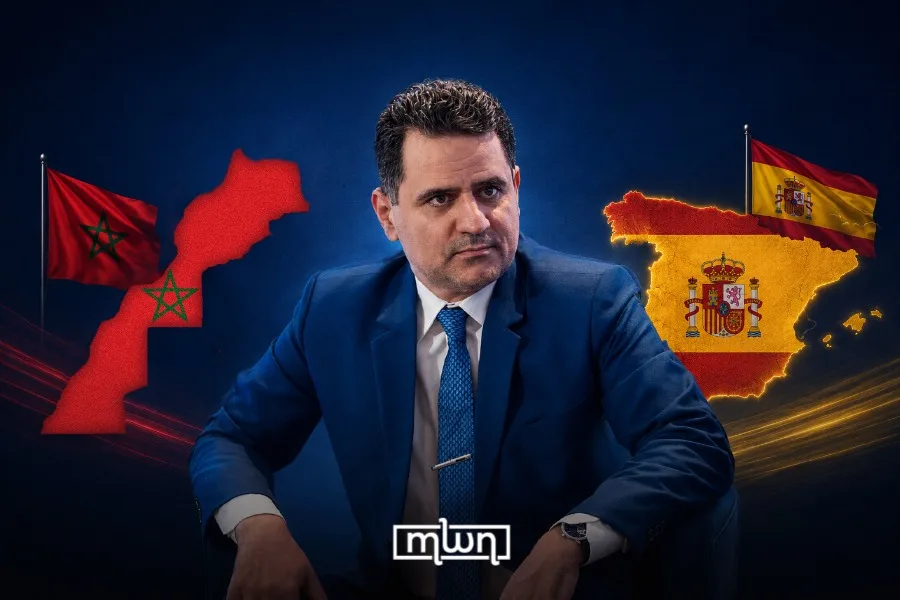
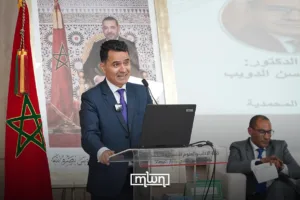
It is through this prism – language as power, language as intelligence apparatus, language as the indispensable skeleton key to the adversary’s psyche – that political analyst and author Dr. Samir Bennis delivered one of his most strategically consequential public addresses on Thursday at the Faculty of Arts and Humanities in Mohammedia (FLSHM), part of Hassan II University of Casablanca (UH2C), during a lecture entitled “Spain and the Moroccan Sahara Question: Between the Duty of Memory and Collective Forgetting.”
The intervention was not a polite academic rumination. It was more of an alarm, calibrated and unsparing, about a vulnerability so glaringly obvious that its persistence borders on institutional negligence.
View this post on Instagram
Morocco, a country separated from the Iberian Peninsula by a mere fourteen kilometers of Mediterranean water, is hemorrhaging its capacity to speak, read, write, and think in Spanish – the very tongue of its most proximate, most politically inescapable, most geopolitically immediate, most diplomatically sensitive, most historically burdened, and most psychologically entangled neighbor.
“It is unreasonable that Spain is Morocco’s first trading partner while, at the same time, Morocco does not have enough specialized professors, academics, and journalists who master the Spanish language,” Bennis told the audience with aphoristic eloquence and lapidary precision. The observation landed with the force of an indictment precisely because it is arithmetically indisputable.
Spain commands the apex of Morocco’s bilateral commercial architecture. Madrid and Rabat share borders – not figurative ones, but physical, contested, militarized borders at Ceuta and Melilla. Their histories are not merely intertwined; they are fused at the bone, bound first by eight centuries of Moorish civilization that left an indelible Moroccan and Maghrebi imprint on Iberia (al-Andalus), then scarred by the violence of the Reconquista, the expulsion of Muslims and Jews, Spanish colonial occupation, and territorial wounds that remain deliberately unhealed to this day.
Morocco’s Spanish-language atrophy as a self-inflicted wound
And yet, as Bennis made laceratingly clear, the number of Spanish-language specialists in Morocco “is in decline.” The kingdom is, in effect, voluntarily surrendering its capacity to decode the very society with which it shares its most volatile and emotionally freighted bilateral relationship – forfeiting the Spanish fluency needed to read, parse, and dismantle, in real time, the narratives being written about it in Madrid and Barcelona.
The historical substratum here is neither decorative nor incidental; it is the longue durée that continues to structure the Moroccan-Spanish encounter, giving today’s diplomatic frictions their emotional voltage, symbolic density, and unresolved historical charge. Spain’s relationship with Morocco is saturated with a civilizational trauma and psychodrama that no amount of diplomatic pleasantry can fully anaesthetize.
The Reconquista – that seven-century campaign to expel Muslim rule from Iberia, culminating in the fall of Granada in 1492 – did not simply end; it metastasized into a foundational mythology that continues to pulse through Spanish national consciousness. The annual Moros y Cristianos festivals, in which Spaniards reenact the defeat of the “Moor,” are not quaint folklore. They are rituals of civilizational self-definition, performed in the twenty-first century with costumes, pageantry, and an unmistakable undercurrent of triumphalism.
From the moment of conquest, Spain pursued a zealous Catholic orthodoxy that treated every trace of Moroccan Muslim civilization not as heritage to be respected but as heresy to be erased – mosques seized, minarets rechristened, entire communities forced to convert or flee. The Great Mosque of Seville offers a case study in this cultural obliteration: captured alongside the city by Ferdinand III in 1248, the Almohad mosque was immediately consecrated as the Cathedral of Santa María de la Sede, its magnificent minaret repurposed as the bell tower now known as La Giralda, its courtyard preserved only as the Patio de los Naranjos.
But what happened next defies belief. In 1401, Seville’s clergy looked upon one of the finest mosques the Almohad dynasty had ever raised – a monument of extraordinary architectural sophistication that had stood for over two centuries – and declared it not grand enough. Over the next 105 years, they systematically demolished nearly the entire structure, tearing down its prayer halls, its arches, its vaulted ceilings, to erect in its place the colossal Gothic cathedral that stands today – the largest Gothic cathedral on Earth, built quite literally on the bones of what it destroyed. They kept the minaret. They kept the courtyard. They kept just enough of the mosque’s skeleton to serve as a trophy, a reminder not of what Islam had built but of what Christendom had swallowed whole.
Spain’s seizure of Melilla in 1497 and its acquisition of Ceuta through dynastic union with Portugal were, in essence, the Reconquista’s southward continuation – the crusade carried across the strait onto African soil. More than five centuries later, both enclaves remain under Spanish anachronistic imperial sovereignty, and Morocco’s rights to them remain unextinguished.
Add to this the Western Sahara file – where Madrid’s 1975 abandonment of its colonial responsibilities birthed the very conflict and helped bequeath Morocco the most consuming territorial conflict of its modern history for half a century, and which Bennis’s recent book, “The Unholy Alliance: The Hidden Conspiracy Behind the Spanish-Algerian Plot Over Morocco’s Sahara (1965-1979),” presents as the product not of diplomatic accident but of a deeper Spanish-Algerian collusion that worked to undermine Rabat’s territorial integrity – and the picture that emerges is one of a bilateral relationship so freighted with historical grievance, mutual suspicion, and unfinished territorial reckonings that mastering its language is not an intellectual luxury but a national security imperative.
Competence in Spanish, moreover, means direct access to the very archives, declassified documents, parliamentary records, and press accounts in which Spain’s culpability in the Sahara’s unclosed fate is recorded – evidence that cannot be effectively excavated, interpreted, or weaponized through translation alone.
A country 14 kilometers from Spain cannot afford to stop speaking Spanish
Bennis framed the deficit in terms that were both rhetorically charged and practically exacting. “How, then, can we understand the Spanish mindset? How can we read Spain, extract lessons from it, and negotiate effectively with it?” he posed. “Is it reasonable that a country separated from Spain by only 14 kilometers sees the number of Spanish-language specialists in decline? This is unacceptable.”
The irony is almost too exquisite to bear. Spanish itself carries within its DNA the residue and afterlife of eight hundred years of Arab-Moorish intellectual supremacy. It is a living testament to who taught whom. Roughly four thousand words in modern Castilian trace their etymological lineage to Arabic – álgebra, algoritmo, azúcar, almohada, alcalde – a lexical sediment deposited by the very civilization that Spain spent centuries expelling.

Morocco shaped the language of its neighbor and yet now finds itself hard-pressed and ill-equipped of fielding sufficient numbers of citizens who can wield that same language as an instrument of statecraft. In fact, Spanish universities themselves maintain robust Arabic-language departments, training generations of diplomats, analysts, and scholars to read the Arab world on its own terms – yet Morocco, inexplicably, has failed to mount the mirror effort, neglecting to produce the Spanish-literate cadres needed to scrutinize and contest the country that scrutinizes it most.
Bennis’s critique extended beyond the bilateral to the hemispheric. “Spanish is spoken by more than 600 million people worldwide,” he noted. “More than 25 countries in Latin America use Spanish as their official language, and it is a language spoken by far more people than French.” The strategic calculus, he made plain, is merciless: “Spanish alone in Mexico reaches a population of over 220 million people” – a single country whose Spanish-speaking demographic nearly matches the entirety of the Francophone world.
He singled out Mexico – a nation whose “historical positions have not always aligned with Morocco’s territorial unity” – as a case study in the cost of linguistic incapacity. “How can we expect to engage with Mexico if we do not have a sufficient number of Spanish speakers with knowledge of Mexican history and mindset?”
Morocco cannot outmaneuver Spain while mute in its mother tongue
The policy prescription was unambiguous. “It is necessary to review what appears to be an incorrect and highly questionable decision regarding the abandonment of the Spanish language,” Bennis declared. The abandonment he refers to is the systemic marginalization of Spanish within Morocco’s educational infrastructure – a drift toward English that, however globally rational, has come at the expense of the one language most acutely germane to Morocco’s territorial integrity, commercial interests, and geopolitical positioning.
“We need a coordinated elite of journalists and academics capable of publishing in major Spanish newspapers such as El País and El Mundo,” Bennis argued, before delivering the coup de grâce: “Spain will not change its narrative or revise its position unless we engage in a counter-effort. This requires historical awareness and the exposure of inaccuracies that Spanish media has circulated for more than fifty years.”
The operative word is counter-effort. For decades, Spanish media and certain academic enclaves have constructed and propagated a narrative on the Sahara dispute that oscillates between paternalistic sympathy for the Polisario and thinly veiled hostility toward Moroccan sovereignty – what observers have aptly termed Spain’s “Morocco complex,” a volatile admixture of superiority, anxiety, and obsession rooted in centuries of civilizational entanglement. Countering that narrative requires not mere diplomatic dexterity but linguistic and intellectual penetration – the ability to publish, persuade, and polemicize in the adversary’s own idiom.
Neither end of Spain’s political spectrum offers Morocco a fair hearing. The Spanish left romanticizes the Polisario as a plucky liberation movement, performs feel-good activism, and casts the North African kingdom as an occupier – a breathtaking hypocrisy from a country that itself maintains sovereign claim over Ceuta, Melilla, and the Chafarinas Islands, the last vestiges of a colonial footprint on African soil that predates every border dispute it presumes to adjudicate. The Spanish right, meanwhile, operates from a different but equally corrosive register: a nostalgic longing for imperial grandeur, a civilizational chauvinism that treats the Strait of Gibraltar less as a shared waterway than as a rampart, and a nativist, anti-immigrant discourse that routinely instrumentalizes Moroccan migrants as both cultural threat and political scapegoat.
Between the left’s selective anticolonialism and the right’s unreconstructed imperial reflex – its fixation on every Moroccan military acquisition, every diplomatic advance, every political movement, all read through the panicked lens of a former colonial power watching a country it still regards as a mere third-world appendage threaten its decades-old Mediterranean primacy – Morocco confronts not a divided adversary but a unified wall of bad faith. Two ideological currents that, for all their mutual antagonism, converge on one point: the reflexive denial of Moroccan legitimacy. And understanding the full texture of that denial – its vocabulary, its assumptions, its internal contradictions – demands reading it in the language in which it is written.

Rita Mae Brown once wrote that “language is the road map of a culture – it tells you where its people come from and where they are going.” Morocco knows intimately where it comes from vis-à-vis Spain. Where it is going, however, depends on whether it can summon the institutional will to equip its next generation with the linguistic artillery to navigate a relationship that is, by its very nature, forever swinging between honeymoon and divorce.
Bennis’s Mohammedia address follows a broader national university tour during which, late last month, he called on the Ministry of Higher Education to establish dedicated academic chairs on the Western Sahara – a demand that, taken together with Thursday’s Spanish-language intervention, constitutes a comprehensive blueprint for the intellectual infrastructure Morocco urgently needs to consolidate its diplomatic victories in the arena where narratives are forged, codified, and transmitted across generations.