 Join on WhatsApp
 Join on Telegram
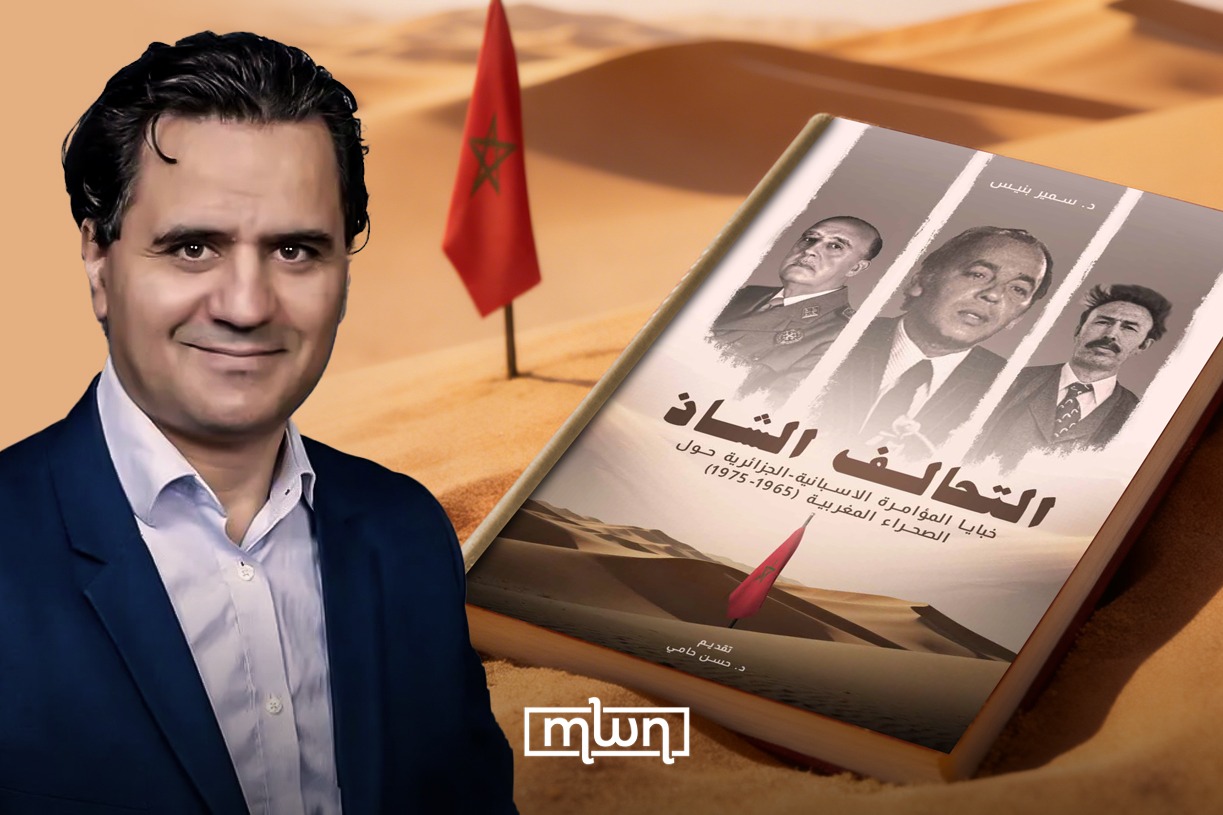
Marrakech – There are books that inform, and then there are books that alter the very cartography of a debate. Samir Bennis’s latest work, “The Unholy Alliance: The Hidden Conspiracy Behind the Spanish-Algerian Plot Over Morocco’s Sahara (1965-1979),” belongs emphatically with the latter category.
Published in Arabic to coincide with the fiftieth anniversary of the Green March, the book reads like an intellectual battering ram aimed squarely at the edifice of distortion, omission, and ideological posturing that has, for half a century, disfigured the international discourse on the Western Sahara dispute.
Spanning fifteen meticulously researched chapters and 512 pages, the book is, as Bennis told Morocco World News (MWN), an attempt “to unveil the many dimensions that have been deliberately obscured in the academic, media, and diplomatic debate surrounding the Sahara issue, and to delve into details that numerous Spanish academics, writers, and pro-separatist commentators have purposely chosen to ignore.”
He described the late King Hassan II’s decision to organize the Green March as “a watershed moment in modern Moroccan history that enabled Morocco to recover part of the territories seized by Spanish and French colonialism,” and insisted that the book “places this event in its proper political context, bringing the reader closer to the formidable obstacles and challenges that King Hassan II confronted during his diplomatic battle with both Spain and Algeria.”
The volume represents the second major scholarly salvo by Bennis in as many years, following the publication in July 2024 of his English-language treatise, “The Self-Determination Delusion: How Activist Scholars and Journalists Have Hijacked the Western Sahara Case.” That earlier intervention has earned considerable acclaim for its unflinching dissection of what Bennis identified as the systematic intellectual capture of the Sahara discourse by activist scholars and sympathetic journalists whose moralizing fervor had long since eclipsed any commitment to evidentiary discipline or analytical balance.
Where that earlier book trained its sights on the epistemological corruption of the international debate, this new Arabic-language companion turns inward, furnishing Moroccan readers themselves with the documentary ammunition and historical depth that Bennis believes have been conspicuously absent from the national conversation. For Bennis, this deficiency is all the more inexcusable given the abundance of archival evidence that vindicates Morocco’s position.
What distinguishes this work from the modest corpus of existing literature on the subject is not simply its partisan sympathy for the Moroccan position – though that sympathy is undisguised and unapologetic – but the forensic rigor with which it reconstructs the clandestine machinery of collusion between Madrid and Algiers.
Bennis has drawn upon an arsenal of primary sources that would make any archival historian envious: United Nations records, dispatches from the leading international newspapers of the 1960s and 1970s, classified reports from the Central Intelligence Agency, and the troves of the United States Department of State.
A decade-long diplomatic chessboard
The result is a work of formidable documentary density, one that traces, with almost novelistic suspense, the tortuous diplomatic chess match that unfolded between Rabat, Madrid, Algiers, Nouakchott, and Washington across more than a decade of high-stakes maneuvering.
The architecture of the book is itself a statement of historiographical intent. Rather than beginning with the Green March as a discrete event – a temptation to which commemorative literature invariably succumbs – Bennis insists on excavating the deep geological layers of the dispute.
The first two chapters are devoted to the period preceding Spain’s announcement, on August 20, 1974, of its intention to hold a self-determination referendum in the Sahara, and they establish what might be called the tectonic preconditions that would ultimately produce the seismic event of November 1975.
Here, Bennis chronicles the earliest phases of the dispute’s emergence on the bilateral stage between Morocco and Spain. He notably demonstrates how the Spanish presence in Morocco during the Protectorate era – itself a derivative arrangement flowing from the Franco-Spanish agreement that followed Morocco’s signing of the Protectorate treaty with France on March 30, 1912 – left a deep psychological wound among the Spanish political and military elite, one that would fester and metastasize into a colonial obstinacy of remarkable tenacity.
The Iberian country’s determination to retain the Sahara, Bennis argues, was never solely a matter of geostrategic calculation related to the security of the Canary Islands or the exploitation of the region’s marine wealth. It was, at a more visceral level, an act of compensatory imperialism – a refusal to accept the diminishment of Spanish prestige that Morocco’s independence had inflicted.
What emerges from these early chapters is a portrait of relentless Moroccan diplomatic initiative met, at every turn, by Spanish prevarication and bad faith. Bennis painstakingly documents how Morocco pursued a dual-track strategy, combining bilateral engagement with multilateral pressure through the United Nations, and how, as early as October 1957, it placed the dispute on the organization’s agenda, ultimately obliging Spain to acknowledge the Sahara as a Non-Self-Governing Territory under its administration.
Yet the portrait is not one of undiluted Moroccan sagacity. Bennis is notably candid – and this candor lends the work a credibility that polemical tracts typically lack. He traces, for example, what he regards as a critical Moroccan miscalculation: the meeting between King Hassan II and General Franco at Madrid’s Barajas Airport on July 6, 1963.
The cordial tone adopted by the Spanish dictator, Bennis contends, was interpreted by the Moroccan political class and media as a signal of potential Spanish willingness to relinquish the Sahara, leading Morocco to relax the pressure it had been exerting in the General Assembly, the Fourth Committee, and the Special Committee.
In Bennis’s telling, this was a masterclass in the art of diplomatic seduction – and Morocco fell for it. The mirage had dissipated within two years, and Spain’s refusal to comply with General Assembly Resolution 2072 of December 1965, which called upon it to negotiate with Morocco and Mauritania on sovereignty-related matters concerning both the Sahara and Ifni, revealed the true contours of Madrid’s intentions.
The book’s third chapter traces what Bennis identifies as Spain’s deliberate strategy of manufacturing a Sahrawi national consciousness. The project reached its institutional apotheosis with the creation of the Yemaa, the local Saharan assembly, in May 1967.
Yet this was not, Bennis argues, an exercise in democratic devolution. Instead, it was a coldly engineered attempt to construct a political subjectivity that would serve as the legitimating fiction for a client state under permanent Spanish tutelage. In the meantime, Spain worked assiduously to undermine Morocco’s confidence-building efforts with Mauritania, exploiting the fissures between Rabat and its neighbors to perpetuate its colonial grip.
An Atlantic obsession driving hostility
It is the book’s treatment of Algeria, however, that constitutes perhaps its most incendiary and consequential contribution to the historiography of the Sahara dispute. Bennis sketches with brutal clarity a portrait of the Algerian regime not as the disinterested champion of self-determination that it has long claimed to be, but as a calculating regional hegemon driven by a combustible mixture of territorial ambition, ideological grandiosity, and what he characterizes as a deep-seated sense of entitlement to regional supremacy.
As Bennis posits, the possession of vast territory and abundant subterranean wealth cultivated among the Algerian political and military elite a species of geopolitical narcissism, the conviction that they, and they alone, were destined to lead the Maghreb. The realization of this ambition, however, was contingent upon securing access to the Atlantic Ocean, a strategic objective that Algeria began pursuing in earnest from 1967 onward.
Since Morocco was the sole obstacle to this aspiration, Algeria embarked upon a systematic policy of hostility designed to isolate the kingdom from its African depth and to weaken it to the point where it could no longer raise the issue of the Eastern Sahara – its own territorial grievance against Algiers.
In this framework, Bennis recasts the Ifrane Agreement of January 1969 and the border demarcation treaty of June 1972 not as genuine acts of reconciliation but as Algerian stratagems designed to buy time and lull Morocco into a false sense of security.
President Boumediene’s signature on the border treaty, he asserts, was a tactical feint. It was a means of providing Morocco with hollow guarantees of support in its diplomatic contest with Spain while Algeria quietly laid the groundwork for the construction of a satellite state in the Sahara.
In Bennis’s analysis, the Polisario Front was not the authentic expression of Sahrawi aspirations but an instrument forged to serve Algeria’s geostrategic agenda, staffed in large measure by individuals entirely detached from the territory’s historical and social fabric. The book “reveals the true face of the Polisario Front as an entity created by a group of individuals, the majority of whom had no historical or social ties to the Sahara, whose sole objective was to serve Algeria’s geopolitical agenda in the region,” Bennis told MWN.
Indeed, the book’s middle chapters unspool the pivotal period between the summer of 1974 and the autumn of 1975 with a granularity and dramatic intensity that borders on the cinematic. Bennis traces King Hassan II’s diplomatic counter-offensive following Spain’s August 1974 announcement, showing how the Moroccan sovereign – operating in a context where Algeria enjoyed considerable influence within the Non-Aligned Movement and its foreign minister was poised to preside over the UN General Assembly – managed to assemble the diplomatic support necessary to refer the dispute to the International Court of Justice (ICJ).
In the process, Bennis convincingly presents the last-minute agreement between Moroccan Foreign Minister Ahmed Laraki and his Mauritanian counterpart, Hamdi Ould Mouknass, to partition the Sahara between their two countries as the epoch-making diplomatic breakthrough that tipped the balance in Morocco’s favor and opened the path to the eventual burial of the Spanish separatist project.
The Green March: A thunderclap by design
The eighth chapter examines, with particular acuity, King Hassan II’s strategic deployment of military rhetoric beginning in late September 1975 – a gambit that Bennis frames as a methodically devised exercise in coercive diplomacy rather than genuine bellicosity. The Moroccan monarch, Bennis, demonstrates through American intelligence assessments, was acutely aware that Morocco lacked the military capacity to prevail in a confrontation with either Spain or Algeria.
His increasingly martial language was designed not to prepare for war but to accomplish three interrelated objectives: to compel the Spanish government to soften its position, to galvanize American diplomatic intervention, and to sow confusion within the already fractured Spanish government.
It was, in essence, a carefully staged smokescreen, and it proved paralyzingly effective, consuming the Spanish government’s attention and analytical bandwidth in sterile conjecture and fruitless speculation about Morocco’s military intentions while the real blow was being prepared elsewhere entirely.
The announcement of the Green March on October 16, 1975, arrives in Bennis’s narrative with the force of a thunderclap. The book’s eleventh and twelfth chapters reconstruct the event and its immediate aftermath, revealing the deep divisions within the Spanish government that the March both exposed and exploited.
On one side stood the Foreign Ministry under Pedro Cortina and Ambassador Jaime de Pinies, doggedly pursuing the creation of an independent client state; on the other, Prime Minister Arias Navarro, the military high command, and figures like General Gutiérrez Mellado and Colonel Eduardo Blanco, who had come to recognize that Spain’s interests lay in accommodation with Morocco rather than in the construction of an artificial polity doomed to serve as a proxy for Algerian ambition.
The political vacuum created by General Franco’s terminal illness rendered inert the Spanish government’s capacity to formulate a coherent negotiating position, and the entry of Prince Juan Carlos into the equation – armed with the temporary executive authority that his assumption of power conferred – sealed the diplomatic geometry of the moment, tilting the balance beyond recovery in Morocco’s favor.
Bennis’s dissection of the American role in the crisis is among the book’s most revelatory contributions. Drawing on a September 1974 CIA report that he describes as a comprehensive analytical assessment of the dispute, Bennis establishes that the American intelligence community had concluded that the creation of an independent state in the Sahara was neither viable nor consistent with long-term American strategic interests in the region.
The report, which contained a detailed historical background of the conflict and unmasked Spain’s strategy of fomenting antagonism between Morocco, Algeria, and Mauritania to serve its colonial agenda, explicitly identified the partition of the Sahara between Morocco and Mauritania as the only sustainable solution.
Armed with this intelligence judgment, Secretary of State Henry Kissinger conducted a thirteen-month diplomatic effort aimed at midwifing a bilateral settlement between Rabat and Madrid. Kissinger worked behind the scenes to ensure the success of King Hassan II’s designs while maintaining, in public, a bearing of studied neutrality.
Crucially, the United States ensured that the three Security Council resolutions adopted between October 22 and November 6, 1975, contained no language condemning Morocco or attributing responsibility for the escalation of the crisis to the kingdom.
A decision Algiers couldn’t stop
At this critical juncture in the book’s tracing of a turning point in the Western Sahara story, Bennis insightfully and even affectively reconstructs the fury of Algeria’s President Boumediene upon realizing that the Green March would proceed, and that the balance of power was shifting inexorably toward Morocco. In these thrilling pages of psycho-historical analysis, Bennis provides his readers a small window into the depths of Boumediene’s mounting desperation in the course of multiple unfruitful meetings with the American ambassador to Algiers.
The dispatch of a high-level Algerian delegation to Madrid in early November, with the aim of pressuring the Spanish government into abandoning any bilateral accommodation with Morocco, achieved only temporary and superficial success.
The thirteenth chapter traces the ultimately futile efforts of the Algerian regime and UN Secretary-General Kurt Waldheim to prevent the conclusion of what would become the Madrid Accords. As Bennis documents, Algeria’s unrelenting efforts to derail or subvert these accords were definitively overtaken by the intervention of Prince Juan Carlos and the irreversible momentum that the Green March had generated.
The book’s penultimate chapter offers a searching analysis of the legal metamorphosis of the dispute between 1965 and 1975. Here, Bennis compellingly argues that the Security Council’s refusal to condemn Morocco or obstruct the Green March reflected a tacit recognition among its members that Morocco’s claim to a bilateral resolution with Spain was legitimate and grounded in historical realities confirmed by General Assembly debates between 1957 and 1965, and enshrined in Resolution 2072.
In this reading, the Madrid Accords were not an aberration but a restoration – a belated recognition of what the international community had itself acknowledged before the dispute’s legal character was transformed by Resolution 2229 in December 1966.
Yet Bennis does not end on a note of triumphalism. The book’s final chapter confronts what he regards as an enduring and largely unaddressed wound in Moroccan-Spanish relations: the question of historical memory. In these concluding pages, Bennis turns his analytical gaze upon the Spanish political, academic, and media establishment’s construction of a victimhood narrative in which Spain is cast as the injured party, supposedly betrayed by Moroccan treachery at a moment of political vulnerability.
He charges that this narrative has its roots not in the events of 1975 alone but in a centuries-old pattern of selective historical remembrance that erases Spain’s own record of colonial aggression against Morocco – from the Battle of Tétouan in 1859-1860 through the depredations of the Protectorate era – while magnifying every perceived Moroccan slight into an act of civilizational ingratitude.
The persistence of this narrative, Bennis contends, explains why, despite the extraordinary flourishing of bilateral relations since 1982 and Spain’s emergence as Morocco’s leading trade partner since 2013, broad segments of Spanish public opinion continue to harbor hostility toward Morocco. It is also why the Spanish academic and media discourse remains captive to the same stereotypical image of their southern neighbor that Spaniards have inherited over centuries, he writes.
History marshaled for advocacy
Bennis told MWN that the book is a deliberate attempt to equip Moroccans with “the damning facts and irrefutable arguments that can help them advocate more effectively, particularly with regard to the Green March.”
He situated the work as a complement to his 2024 English-language book, and lamented what he characterized as an absence of sustained Moroccan investment in the narrative battle surrounding the Sahara. “Despite the historic diplomatic gains that have enabled Morocco to assert its superiority over its adversaries and rendered Algeria’s dream of establishing a satellite state in the southern provinces impossible,” he noted, “serious and in-depth academic publishing remains rare.”
What Bennis has produced in this volume is not, it must be said, a work of dispassionate neutrality – nor does it pretend to be. It is, rather, a work of engaged scholarship, openly committed to the Moroccan position but disciplined in its unassailable source-based foundations and intricately wrought in its analytical architecture. It is a book that will infuriate those who have grown comfortable with the received narrative of the Sahara dispute, and it is precisely this capacity to disturb settled assumptions that constitutes its principal intellectual virtue.
For those who wish to understand why the Western Sahara question has resisted resolution for five decades, and why the narrative terrain remains as fiercely contested as the physical territory itself, “The Unholy Alliance” is indispensable reading.
In an era when the Sahara debate has been dominated by what Bennis memorably called in his earlier work “passionate and moralizing narrative” at the expense of historical fact and objective analysis, this book arrives as a remorseless, annihilating corrective. It demands engagement, provokes reflection, and refuses, above all, to be ignored.
Bennis concluded his announcement of the book with a dedication of quietly piercing and searing intimacy that, in its very simplicity, illuminated the deeply personal wellspring from which this monumental scholarly undertaking draws its animating force. “May God make this book an enduring charity for my late father, may he rest in peace, who instilled in us the love of our homeland and devotion to it, and for my mother, may God grant her healing, and for every member of my family,” he said.
It is a vindication to the man behind the argument – a recognition that behind the archival excavation, the diplomatic reconstruction, and the rhetorical combat with decades of distortion, there stands a son honoring a father’s most elemental bequest: the conviction that to love one’s country is not sentiment but duty. And that to defend the homeland’s truths against the tides of falsification is among the noblest forms that duty can assume.