Join on WhatsApp
 Join on Telegram
Marrakech – Francis Bacon wrote in 1597 that “knowledge itself is power.” Four centuries on, Moroccan political analyst and author Samir Bennis is making an unvarnished case that his country has been wielding every instrument of statecraft in defense of its Sahara – diplomatic leverage, military deterrence, economic heft – except the one weapon its adversaries have most ruthlessly exploited: the academy.
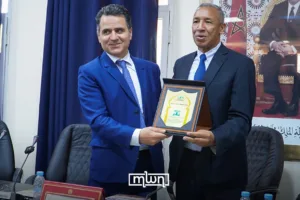
Speaking before a packed hall at Moulay Ismail University in Meknes on Tuesday during an intellectual forum convened to discuss his latest works, Bennis delivered what amounted to a blistering indictment of Morocco’s institutional neglect of its own foremost national cause within the corridors of higher education.
His core contention was lacerating in its lucidity and diamantine in its precision: a country cannot proclaim the Sahara as its paramount territorial imperative and simultaneously tolerate the absence of a single dedicated academic chair across its entire university system to study, interrogate, and disseminate the historical, legal, and diplomatic underpinnings of that very cause.
“It is unreasonable and unacceptable,” Bennis told the audience, “that a state which has endured seven decades of diplomatic and political anguish over this file has seen successive ministers of higher education fail to establish scientific chairs dedicated to the Moroccan Sahara, to Moroccan-Spanish relations, to the history of Morocco’s engagement with France.”
The rebuke was neither oblique nor couched in the decorous hedging that typically attends such institutional critiques. It was, rather, a full-throated indictment – aimed squarely at the Ministry of Higher Education and, by extension, at the structural complacency that has left Morocco’s narrative arsenal woefully under-armed in what remains, at its core, a battle of competing historiographies.
Diplomacy won the ground; academia must hold it
This month, Bennis embarked on a national university tour to present his books – most centrally “The Unholy Alliance: Inside the Spanish-Algerian Conspiracy Over Morocco’s Sahara (1965-1979)” – beginning at Cadi Ayyad University in Marrakech, continuing at Sidi Mohamed Ben Abdellah University in Fez, and culminating at the Meknes session that produced his most trenchant public remarks to date on the academic dimension of Morocco’s Sahara dossier.
Edward Said once observed that “the power to narrate, or to block other narratives from forming and emerging, is very important to culture and imperialism.” That observation could scarcely find a more instructive contemporary illustration than the Western Sahara dispute.
For decades, Algeria and its Polisario proxies, buttressed by a coterie of self-appointed leftist intellectuals across European and Anglophone academia, have constructed and propagated a counter-narrative so totalizing in its reach that it has functionally colonized the mainstream scholarly and journalistic discourse on the conflict.
The result is an epistemic landscape in which a fabricated separatist entity – conjured into existence by Spanish colonial machination and sustained by Algerian petrostate patronage – is afforded legitimacy it has never earned. Meanwhile, Morocco’s historically and legally grounded sovereignty rights are either distorted or relegated to footnote status.
Bennis articulated this imbalance with a gravitas and ferocity that no armchair theorists or pontificators – ensconced in tenured comfort and credentialed in little beyond contrarianism – could ever muster. Nassim Taleb popularized the phrase “skin in the game” to describe the chasm between those who theorize about risk and those who bear it.
Theodore Roosevelt once reminded us that “it is not the critic who counts,” but rather the one “who is actually in the arena, whose face is marred by dust and sweat and blood.” For Bennis, that arena has been a quarter century of relentless, solitary, self-funded, and uncompensated immersion in the subject.
“I have worked on this issue for over 25 years,” he recounted, “writing in Spanish, French, English, and Arabic, publishing prolifically – and at times directing criticism at certain matters that were not handled well. I did all of this with absolute freedom, and not once did any representative of the state contact me to silence or reprimand me.”
He punctuated this point with a personal anecdote about a 2014 chance encounter with Ambassador Omar Hilale, Morocco’s permanent representative to the United Nations and a figure revered across the Moroccan diplomatic establishment. “He told me: if we had ten people like you in Morocco, this issue would have been resolved long ago,” Bennis recalled. “That was, for me, the greatest personal honor – a validation that propelled me to redouble my efforts on this file, even though I receive no compensation from any quarter.”
University as the last unfinished front
The anecdote is illustrative of a paradox that lies at the heart of Morocco’s Sahara advocacy. The kingdom has, over the past two decades, executed what Bennis himself has termed a “historic remontada” – dismantling Algeria’s once-formidable diplomatic infrastructure on the issue, shrinking the roster of states recognizing the fictitious Tindouf-based republic from 84 to a dwindling handful, and securing landmark international endorsements of its autonomy plan.
Yet this diplomatic juggernaut has operated in a near-total vacuum of institutional academic production. The country that has outmaneuvered its adversaries on every conceivable geopolitical chessboard has somehow neglected to erect the intellectual fortifications necessary to consolidate those gains in the arena where narratives are forged, codified, and transmitted across generations.
Bennis’s call is not merely aspirational; it is strategically existential. For him, the university “is the scientific center upon which any diplomat or politician can draw.” It goes without saying that media, too, serves as a vehicle for national advocacy – but media can be dismissed as propaganda, discredited as state-sponsored messaging, or drowned out in the cacophony of competing headlines. Academia, by contrast, carries an institutional imprimatur that is far harder to impeach.
Without robust academic infrastructure – research centers, specialized curricula, peer-reviewed journals, international scholarly exchanges – Morocco’s diplomatic victories, however spectacular, remain vulnerable to the corrosive drip of a hostile narrative ecosystem that operates on its own logic, indifferent to the courtesies exchanged between foreign ministries.
He also directed his appeal toward the Ministry of National Education, urging that Morocco’s territorial integrity and the historical lineage of the Sahara cause be rendered “central and pivotal in history textbooks.” George Orwell’s dictum that “who controls the past controls the future” resonates with haunting pertinence here: if Moroccan youth are not inoculated with a rigorous, evidence-based understanding of their own national history, the narrative vacuum will be filled by the distortions peddled by Algiers and its ideological auxiliaries.
What renders Bennis’s intervention particularly authoritative is the evidentiary arsenal underpinning his own scholarship. His 512-page, 15-chapter opus on the Spanish-Algerian conspiracy draws on UN archives, CIA assessments, US State Department cables, and General Franco’s personal papers to reconstruct the period between 1965 and 1979 – a period he considers the most consequential and most deliberately obscured in the modern chronicle of the dispute.
His earlier English-language work, “The Self-Determination Delusion: How Activist Scholars and Journalists Have Hijacked the Western Sahara Case,” constitutes a forensic dismantling of the ideological scaffolding that has sustained the separatist narrative in Western academic and media circles.
Together, these works represent precisely the kind of rigorous, primary-source-driven scholarship that Bennis is calling on Morocco’s universities to institutionalize. A nation ascending to regional powerhouse status – economically, diplomatically, athletically – cannot afford to leave its most consequential national question at the mercy of adversarial narratives manufactured in Algerian think tanks and amplified by ideologically captured Western academics.
Mustafa Kemal Ataturk once cautioned that “nations which don’t find their national identities will be preyed upon by other nations.” Morocco has found its identity on the Sahara question – unequivocally, irreversibly, and with a diplomatic record that now speaks for itself on the international stage.
What it has not yet done is embed that identity within the institutional DNA of its own educational apparatus. Bennis’s call for dedicated academic chairs is not a peripheral recommendation; it is a foundational prerequisite for ensuring that Morocco’s diplomatic triumphs are not merely celebrated in the corridors of power but intellectually fortified in the lecture halls where the next generation of advocates, analysts, and diplomats will be forged.
The Sahara is Morocco’s. The scholarship must be, too.