
 Join on WhatsApp
 Join on Telegram
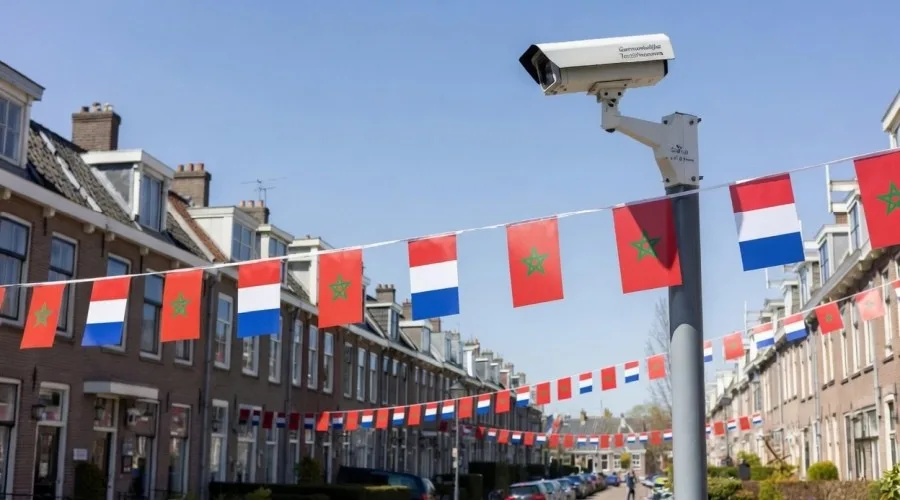
Marrakech – Major Dutch cities are deploying extra police, temporary surveillance cameras, and street stewards ahead of the 2026 FIFA World Cup Round of 32 clash between the Netherlands and Morocco. The match kicks off at 3:00 a.m. local time, Tuesday – 2:00 a.m. in Morocco – from Monterrey, Mexico.
Amsterdam, Rotterdam, Utrecht, The Hague, and Amersfoort have all confirmed preparations for the high-stakes encounter. The two nations sit nearly level on the FIFA world rankings, with Morocco sixth and the Netherlands seventh.
The battle carries particular weight because of the deep ties between the two countries. Moroccans form the second largest foreign ethnic group in the Netherlands after Turks. As of 2025, data from the Dutch Central Bureau of Statistics showed that 433,337 people of Moroccan origin – roughly 2.4% of the population – were living in the Netherlands.
The community is concentrated heavily in major cities, with Amsterdam, Rotterdam, and The Hague foremost among them. Their presence traces back to the guest worker agreements of the 1960s, which brought tens of thousands of Moroccan laborers, primarily from the Rif region, to fill postwar shortages in Dutch industry.
That demographic reality makes the match far more than a sporting event. Both nations have massive, passionate fanbases in the same streets.
The connection runs even deeper on the pitch. Three members of Morocco’s World Cup squad – Sofyan Amrabat, Noussair Mazraoui, and Anass Salah-Eddine – were born in the Netherlands. All three grew up in Dutch football before choosing to wear the flag of their fathers and represent Morocco, adding a deeply personal edge to an already charged encounter.
The Hague has been the most transparent about its measures. The city outlined to Dutch broadcaster Omroep West that temporary security cameras have been installed at busy locations across the city.
Extra deployment will focus on parts of the Centrum and Laak districts, areas that saw heightened activity during previous tournament matches. The municipality is working with police, emergency services, neighborhood volunteers, youth workers, and shop-street stewards to maintain order.
A police spokesperson announced the match is a top priority. “This match naturally has our attention, and we are certainly busy with preparations,” the spokesperson told reporters. The police declined to specify how many officers would be on duty.
The Hague is also granting bars and cafés special late-night exemptions – known locally as “verlaatjes” – to stay open past their normal closing hours. Applications are normally required seven working days in advance, but the city said it would accept requests through Monday.
Amsterdam said it conducts a risk-and-scenario assessment before every match. “A great match and victory can, of course, lead to spontaneous celebrations in public spaces, and there is room for that,” a city spokesperson told RTL Nieuws. “But celebrations sometimes also come with or turn into disruptions of public order, and we prepare well for that.” The city declined to share details of its security plan, citing operational concerns.
Utrecht struck a similar tone. “It is a major match with two countries that have a large following in the city,” a spokesperson indicated. “We monitor everything and adjust as needed.” The spokesperson noted most cafés in the city hold 24-hour licenses, so fans can watch in bars even at that hour. No public viewing screens have been set up.
Rotterdam unveiled that it is not taking measures beyond its usual posture but remains alert. The city said it would approve extended-hours requests from bars. “We give the hospitality sector the room to celebrate the World Cup,” a spokesperson said.
In Amersfoort, authorities placed extra camera surveillance at the De Stier roundabout, a location that saw unrest during earlier matches.
The precautions follow a pattern. Several Morocco matches during the 2022 World Cup triggered disturbances in Dutch cities, including during the group-stage win over Belgium and after the semifinal loss to France. Incidents also occurred during the Africa Cup of Nations (AFCON) matches in December and January.
As a knockout-round fixture, the match could go to extra time and penalties if scores are level – potentially stretching the night well past 5:00 a.m.
Read also: 2026 World Cup: Why Mexican Fans Are Backing Morocco Against the Netherlands