


 Join on WhatsApp
 Join on Telegram
Marrakech – There is a passage in Frantz Fanon’s “Black Skin, White Masks” so lacerating it reads like prophecy: “The colonized is elevated above his jungle status in proportion to his adoption of the mother country’s cultural standards.”
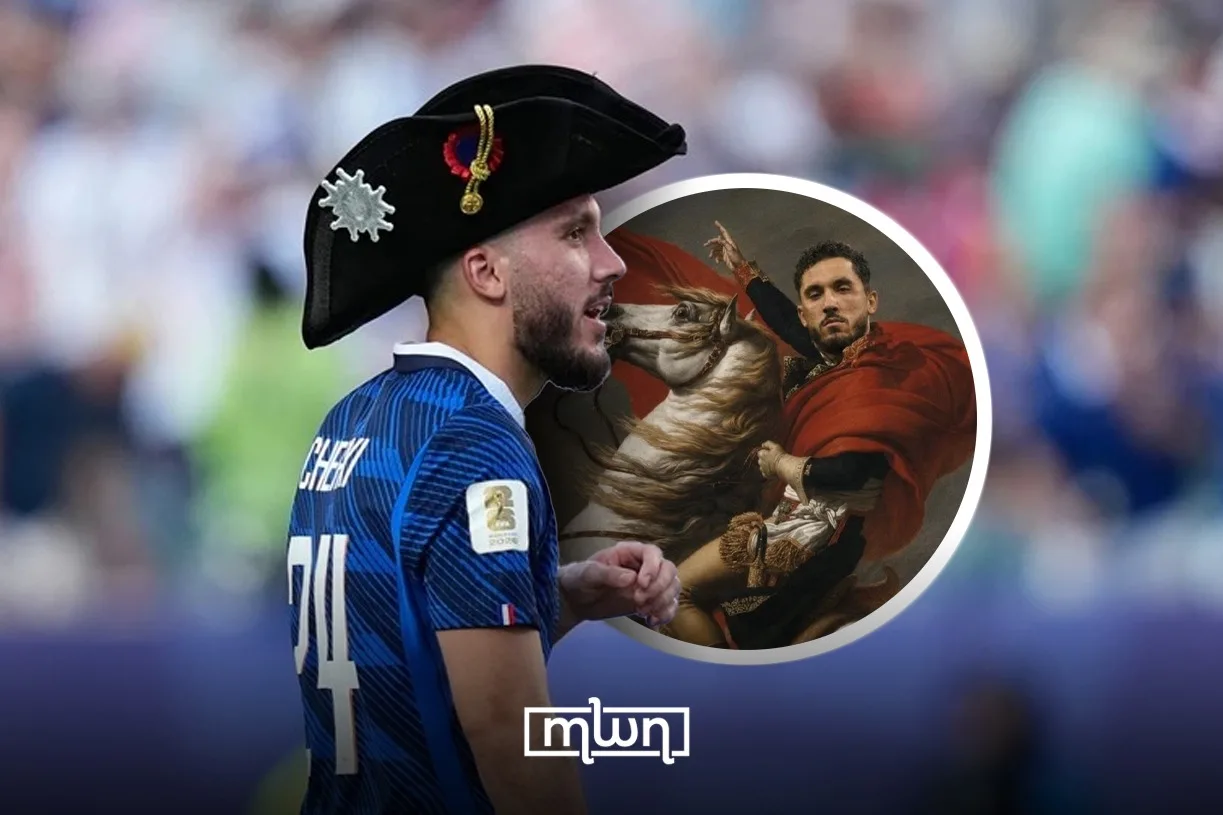
Seventy-two years after Fanon scribbled those words from the psychiatric ward of Blida-Joinville hospital – in Algeria, no less – a 22-year-old footballer from Lyon, whose mother Abla hails from the sun-scorched oasis city of Biskra, deep in Algeria’s Ziban region, paraded across the turf of Philadelphia’s Lincoln Financial Field wearing the bicorne of Napoleon Bonaparte. And he grinned while doing it.
Rayan Cherki did not merely don a hat on July 4. He performed, perhaps unwittingly, the most condensed act of colonial self-negation this World Cup has produced – the substitute player of Les Coqs, a man of Algerian blood, of Chaoui lineage, voluntarily crowning himself with the iconography of the very imperial machinery that devoured his forebears’ land, incinerated their libraries, and shipped their skulls to Parisian museums for the morbid amusement of ethnographers.
“Napoleon? That’s my nickname in the squad,” Cherki told reporters in the mixed zone, casual as a man discussing his breakfast order.
Earlier that evening, Cherki had posted photographs, including the one with the bicorne, alongside France head coach Didier Deschamps on the Lincoln Financial Field turf – the two locked in an embrace, all grins and post-qualification euphoria. The optics were warm, rehearsed, harmless.
Then the Napoleon image dropped, and the internet’s temperature inverted overnight. Cherki published an edited portrait – his own face grafted onto one of the most iconic imperial paintings of Bonaparte – flanked by laughing emojis, as though history were a filter and colonialism a punchline.
The reaction across Algerian social media was instantaneous and merciless. Commentators reached for the most lacerating word in the Algerian political lexicon: Harki – the term reserved for those Algerians who bore arms for France during the War of Independence, who chose the colonizer’s uniform over their own people’s liberation, and whose name, six decades later, still functions less as a historical category than as a verdict.
One wonders what nickname the squad of 1830 gave the Algerian dead.
View this post on Instagram
When the conqueror becomes the costume
Context is not decoration; it is the architecture of meaning. The bicorne is not a novelty prop. It is the sartorial signature of a man whose Egyptian campaign inaugurated France’s imperial appetite for the Muslim world, whose Napoleonic romanticism – by the admission of French historians themselves – directly fueled Charles X’s 1830 invasion of Algeria.
That invasion exterminated roughly one-third of the Algerian population. It lasted 132 years. It turned sovereign land into departmental territory. It rendered indigenous inhabitants subjects in their own country and confiscated not just their soil but their civilizational self-image.
And yet, the most electric detail of this episode is not the hat. It is the accompanying declaration. “Today, we show those who want to go to war against us… that we are ready to go to war too,” Cherki proclaimed after the match. The martial rhetoric, draped over the Napoleonic costume, produced an optics so grotesque it requires no editorializing.
A descendant of the colonized, cosplaying as the colonizer, borrowing the colonizer’s war cry – and directing it at Paraguay, a South American nation that itself lost 90% of its male population in the deadliest proportional conflict in modern history. Irony does not begin to describe it. Obscenity inches closer.
The calendar, as if conspiring with history, had arranged one final cruelty. The match fell on July 4 – mere hours before July 5, the date Algeria consecrates as its Independence Day. That date was not chosen arbitrarily by Algerian founders; July 5, 1830 was the very day French troops seized Algiers and inaugurated 132 years of colonial subjugation.
In 1962, Algerian revolutionaries reclaimed that same date as the day of liberation – transforming the anniversary of occupation into the anniversary of its defeat. So on the eve of the most sacred date in Algerian collective memory, a son of Biskra placed the colonizer’s crown upon his own head and declared himself ready for war. “One and a half million” Algerian martyrs did not die for this particular brand of irony.
Vikings, Pharaohs, and the architecture of (un)belonging
What renders the spectacle so dissonant and jarring – almost clinically so – is the civilizational canvas upon which this World Cup has been painted. Throughout this tournament, Erling Haaland has turned Norse mythology into a living liturgy: donning a Viking helmet after dispatching Ivory Coast, beating the longship drum before 20,000 roaring Norwegians at MetLife Stadium after slaying five-time champions Brazil, leading the now-viral “Viking Row” like a 21st-century Ragnar Lothbrok who happens to wear Manchester City blue.
The gesture was civilizational autobiography: Haaland summoning the seafaring marauders of Scandinavia’s golden age, anchoring his footballing triumph in the bedrock of Norse heritage. Nobody flinched. Nobody should have. It was magnificent – because it was rooted.
Mohamed Salah, for a decade, has worn the moniker “The Pharaoh” like a second skin – a title that tethers one of football’s transcendent talents to 5,000 years of Nilotic civilization. Liverpool’s Kop serenades him as “The Egyptian King.” Salah does not merely accept the designation; he embodies it, a walking, sprinting, goal-scoring rebuttal to every Orientalist caricature that ever reduced the Arab world to a footnote.
And Morocco? Morocco has turned identity itself into an act of sovereign narration. The Atlas Lions step onto the pitch wearing PUMA kits stitched with zellige geometric motifs and Amazigh ancestral patterns – a jersey that is itself a manuscript of twelve centuries of continuous statehood. Their players hoist Palestinian flags after victories, a civilizational solidarity that transcends borders. Goalkeeper Munir Mohamedi wraps the Amazigh tricolour around his waist.
Achraf Hakimi, Madrid-born captain, does not celebrate with champagne or confetti; he runs into the stands to embrace his mother, a former domestic worker, in a gesture that collapses the distance between diaspora and homeland in a single frame. And after every match, the Atlas Lions bow together in prayer, thanking God before the roar of the crowd. They do not borrow someone else’s mythology. They author their own.
The hierarchy is self-evident: Haaland reaches backward into Viking folklore and finds power. Salah reaches backward into Pharaonic grandeur and finds glory. Morocco reaches backward into Amazigh, Arab, Andalusian, and sub-Saharan tributaries and finds civilizational wholeness. Cherki reaches backward into Algerian memory and finds… what, exactly? a bicorne. The hat of the man whose geopolitical appetite set the table for the longest, bloodiest colonial occupation in North African history.
The difference is not aesthetic, but existential. Haaland, Salah, and the Atlas Lions perform identity. Cherki performs its palimpsestic erasure. And therein lies the cruelest lesson of this tournament: history does not, contrary to comforting illusions, write itself. It is neither neutral nor self-generating, but rather constructed, curated, and ultimately imposed. If a nation fails to narrate its own past with sovereign epistemology – fails to assert its interpretive authority and insist upon its own centrality within the narrative frame – it risks relegation to the margins of another’s chronicle, reduced to a fleeting presence in someone else’s epic.
History is never neutral. It ceaselessly reflects the voice of those who prevail, while other perspectives recede into a deafening silence or distortion. What is remembered as a fact often carries the imprint of selection and omission, where dominance determines visibility. To abstain from self-narration is therefore not passive, but a relinquishing of agency.
The Amazigh were, at one point, discursively recast as “Barbarians” by foreign chroniclers, their identity refracted through an exogenous and often derogatory lexicon. Invaders, in their turn, were rechristened “liberators,” while resistance figures found themselves relegated to the pejorative category of “kharijites.” These designations were not mere semantic accidents, nor innocuous mistranslations, but constituted deliberate acts of epistemic reconfiguration. In other words, they were acts of conquest by vocabulary – and they persist wherever a people cedes authorship of its own memory.
The Republic’s double ledger
This is the same French Republic whose commentators, pundits, and federation officials have spent the better part of four years questioning the authenticity of Morocco’s national team – a squad in which 19 of 26 players were born outside Morocco. “Not really Moroccan,” the insinuation goes. Mercenaries of convenience. Passport shoppers.
Yet France itself fields a squad in which 21 of 26 players trace their lineage to African soil – Cameroon, Togo, Mali, Senegal, Algeria, the Democratic Republic of Congo, Guinea, Nigeria, Mauritania, Benin. The arithmetic is not subtle: 80%of Les Bleus carry the genetic inheritance of the continent France spent three centuries plundering.
When Kylian Mbappé, son of a Cameroonian father and an Algerian Kabyle mother, scores a brace, he is irreducibly French. When Ousmane Dembélé, child of Malian and Mauritanian-Senegalese parentage, orchestrates a masterclass, no one whispers about the authenticity of his tricolore credentials.
And what makes the spectacle more corrosive still is the psychological machinery operating beneath it. When players of Algerian, Malian, or Cameroonian descent fail – when they sky a penalty, squander a decisive chance, or deliver a subpar performance – they are reminded, viciously and with racialized precision, by tabloid columnists, by the sewage currents of social media, by the far-right commentariat that never sleeps, of where they truly come from.
Mbappé is France’s golden son until he misfires in a final; then he is Cameroonian. Tchouaméni is a midfield colossus until he misses from the spot; then he is whatever shade of other the Republic needs him to be that evening. The response to this conditional belonging is never stillness. It is overcorrection. A frantic, almost Pavlovian cycle of allegiance-performance: louder anthems, more emphatic fist-pumps, and, apparently, the colonizer’s hat.
The red passport sits in the pocket. The voting card bears the tricolore. The accent is indistinguishable from that of any native Lyonnais or Parisian. Yet something ungovernable lingers in the Republic’s gaze – a suspicion, never articulated in polite company but understood by every child of the banlieue, that the assimilation is provisional, the belonging conditional, the Frenchness on permanent probation.
France adores proclaiming itself a nation sculpted by immigration, a civilization indebted to the labor, the intellect, and the sacrifices of those who crossed the Mediterranean. It will applaud their goals, frame their jerseys, print their faces on postage stamps. But accept them – wholly, irrevocably, without the invisible asterisk? Never. And so the sons of the colonized keep performing, keep proving, keep wearing hats that do not belong to them, hoping that one more gesture of devotion will finally close the distance between tolerance and belonging. It never does.
But when Achraf Hakimi, born in Madrid to Moroccan parents who chose Morocco before any other federation came calling, captains the Atlas Lions, suddenly the discourse pivots to birth certificates and the legitimacy of diasporic allegiance.
The double ledger is breathtaking. France does not recruit its African-descended players; it inherits them – through the very migration pipelines that colonialism engineered. Morocco does not steal anyone; it beckons its children home. The difference is that Morocco asks its diaspora sons to remember where they come from. France asks its diaspora sons to forget.
French President Emmanuel Macron crystallized this amnesia doctrine in October 2021 when he mused aloud to a group of young Franco-Algerians at the Élysée Palace: “Was there an Algerian nation before French colonization? That is the question.” It was not a question.
It was an erasure dressed as an inquiry – a rhetorical guillotine aimed at “5.63 million martyrs,” another number now being marketed with ritual certainty, even as the figure itself swells with every turn of Algeria’s propaganda apparatus and remains deeply contested – yet is endlessly deployed to sanctify a nationhood the French president casually placed in doubt.
The Moroccan counter-model
Morocco’s Atlas Lions offer the photographic negative of France’s assimilationist machinery. Mohamed Ouahbi, born in Schaerbeek, Brussels, to a Moroccan Riffian family from Nador, does not ask his players to sever the umbilical cord binding them to their origins. He understands that the diaspora is not a footnote to Morocco’s story, but one of the living arteries through which it continues to beat.
He does not ask Brahim Diaz to stop being Spanish, or Ayyoub Bouaddi to renounce his years in French youth football. He asks them to carry Morocco inside them the way one carries a heartbeat – involuntarily, permanently, non-negotiably. Moroccan identity, forged across twelve centuries of continuous statehood, across Amazigh, Arab, Andalusian, and sub-Saharan currents flowing into a single civilizational estuary, does not demand amputation. It demands acknowledgment.
That is why the Moroccan model works where the French model fractures. It does not weaponize belonging. It does not condition inclusion on cultural lobotomy. And it does not produce the spectacle of a young man from Biskra – a city whose very name derives from the Latin Vescera, a city that predates French civilization by millennia – genuflecting before the iconography of his own dispossession.
Morocco’s 3-0 victory over Canada, which carried the Atlas Lions into the quarter-finals, told the other half of the story. With goals from Azzedine Ounahi and Soufiane Rahimi, it showed that Moroccan football is no longer sustained by diaspora brilliance alone. It is now powered by a national infrastructure capable of producing, refining, and exporting its own talent – a system where homeland and diaspora no longer compete for legitimacy, but reinforce each other.
What remains
When the tournament ends, the bicorne will be forgotten by most. But the photograph will endure in the archives of colonial dissonance – a young Algerian, playing under a French flag, wearing the hat of a French emperor, in a stadium named after an American founding father, on the anniversary of American independence from British rule, and on the eve of Algeria’s own “Independence Day” from France. The layers of irony are so dense they border on the geological.
Aimé Césaire, another prophet of the colonial condition, once wrote in his essay “Discourse on Colonialism”: “A civilization that proves incapable of solving the problems it creates is a decadent civilization.” France has created a civilization that harvests African talent, wraps it in tricolore silk, and then lectures the nations from which that talent springs about the meaning of authenticity.
Cherki is not the villain of this story. He is its most poignant casualty – a subject caught in a quiet psychodrama of dislocation, somewhere between Lyon and Manchester, between Biskra and Philadelphia, where the thread of origin thins to near invisibility.
This is the deeper sleight of hand. Memory does not simply vanish, as some might argue. Memory is reorganized, subordinated to more dominant narratives that dictate which pasts remain legible and which dissolve into abstraction. The result is not amnesia, but a curated sense of estrangement.
The Vikings remember. The Pharaohs remember. The Atlas Lions remember.
The son of Biskra? He wore the conqueror’s hat and called it a nickname.
The year 1815 marked the decisive end of Napoleon. After returning from exile on the island of Elba, he briefly reclaimed the French throne during the period known as the Hundred Days, before suffering a crushing defeat at the Battle of Waterloo on June 18. That defeat sealed his permanent exile to Saint Helena – and perhaps next Thursday’s clash against Morocco will offer a modern-day reenactment of that imperial collapse.
Read also: The Colonizer’s Lineup: France Plays Africa and Has the Nerve to Lecture Morocco
Firdaous Naim contributed to this piece.


