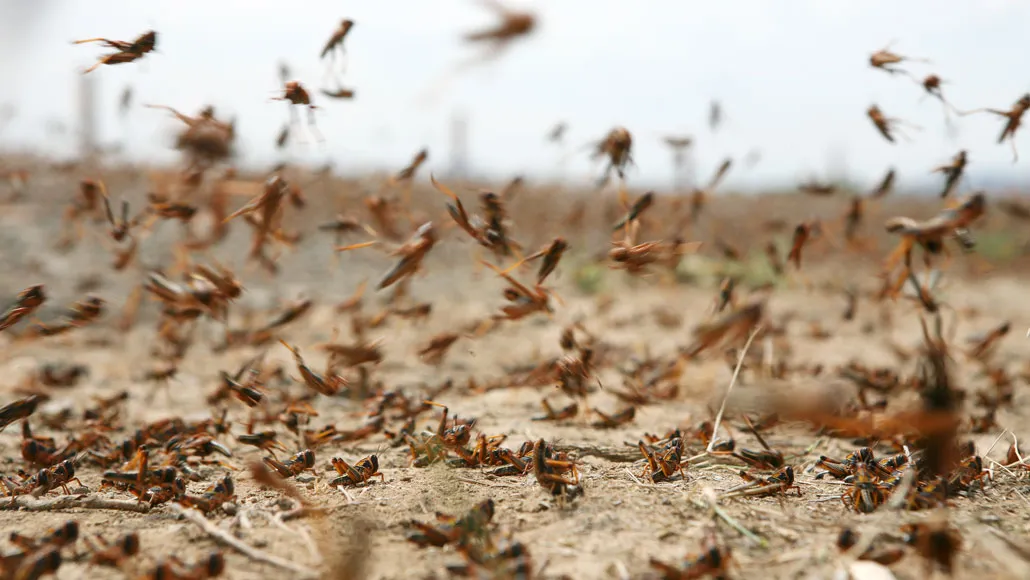
Marrakech – The United Nations Food and Agriculture Organization (FAO) has raised its alert level for Morocco, warning that desert locust swarms could form across the country as winged adult populations spread over vast areas.
In its latest Desert Locust Bulletin, No. 573, published on Tuesday, the FAO classified the Western Region – which includes Morocco – under a “caution” alert. The designation signals a moderate threat to crops and calls for heightened vigilance and potential control operations.
The bulletin reported that numerous groups of immature winged adults formed across wide stretches of Moroccan territory in June. Most hopper groups and bands had completed their fledging – the transition from larval to adult stage – by the end of the month. Scattered larvae and adults were also widely distributed.
Morocco bore the brunt of control efforts. The country treated 87,363 hectares in June alone, including 33,500 hectares by aerial spraying. The FAO noted that total control operations across the region more than doubled compared to May, rising from 41,946 hectares to 88,501 hectares. Algeria treated 1,070 hectares and Mauritania 68 hectares.
The bulletin identified the main affected areas in Morocco as stretching from Guelmim along the coast between Tiznit and Agadir, between Foum El Hassan and Foum Zguid, and to a lesser extent between Merzouga and Errachidia. Some adults had begun maturing, particularly along the coast and near Errachidia, where mating was observed.
Looking ahead, the FAO warned that immature adult groups “could form small swarms” in Morocco as maturation progresses. Some mature groups may migrate toward eastern Morocco and western Algeria to breed in July.
Read also: FAO: Agriculture Rebounds in Morocco but Import Needs Remain High
However, the bulletin stated that most groups would likely move south into Mauritania or other Sahel countries, where summer breeding is expected to begin.
“Surveys and control operations should continue at a sustained pace in affected areas,” the FAO urged, calling for additional surveys in Sahel nations.
Beyond Morocco, the situation has remained largely contained. In Algeria, a few immature adult groups were observed near Tindouf and Béni-Abbès. In Mauritania, local populations reported locust groups in early June across areas from Adrar to Gorgol, though only isolated adults were detected during official surveys later in the month.
The Central and Eastern regions were both classified as “calm.” No locusts were reported in Egypt, Oman, or India. Isolated adults were observed in southeastern Iran. The FAO said small-scale summer breeding could occur in Sudan, western Eritrea, interior Yemen, and along the Indo-Pakistani border, but added that no significant developments were expected in those areas.
The bulletin covers the general situation in June and provides forecasts through mid-August.